New-coin research report · By CoinNudge Research · · Guide updated 2026-10-03 · 15 min read
What is Orochi Network (ON) coin, and is it worth holding?
Orochi Network (ON) is a verifiable-data infrastructure token. ON has a plausible infrastructure use case but a thin public history and an unproven token-value capture path. Its last complete 7-day provider return was −10.9% versus BTC +4.0%. Only 30 matched daily marks are available here; this is not a proven long-term holding advantage or a personal buy call.
Inspect the original price observations · Check the new-coin watchlist
What should a ON investor know first?
- ON changed −10.9% over the last complete 7-day provider window versus BTC +4.0%.
- 30 comparable daily observations; 30-day returns and long-run hit rates are not inferred when unavailable.
- ON has a plausible infrastructure use case but a thin public history and an unproven token-value capture path. A conditional hold needs independently measured service activity, clear supply release terms and enough bid depth to exit; a whitepaper utility list alone is insufficient.
What is Orochi Network's ON coin, rather than another token called ON?
ON is the token described by Orochi Network as part of its verifiable-data infrastructure. KuCoin opened ON/USDT trading in September 2026. The project documentation proposes uses for validator incentives, storage, ZK sequencers and fees; these designed functions still need live-usage evidence.
Identity comes first: Ethereum ERC-20 ON contract linked from the official KuCoin listing. The relevant market event is KuCoin spot, 2026-09-17 10:00 UTC. Match the asset and the trading route before combining prices, documents or wallet instructions; a same-name token is outside this report.
| New-coin identity | Verified or dated evidence | What it does not prove |
|---|---|---|
| Asset category | Verifiable-data infrastructure token | A category is not a holder return |
| Listing | KuCoin spot, 2026-09-17 10:00 UTC | Listing date is not necessarily token creation date |
| Chain and contract | Ethereum ERC-20 ON contract linked from the official KuCoin listing | Check identity before using any price series |
| Market-price history | 30 matched daily observations from 2026-08-28 to 2026-09-26 | Too short for a long-cycle probability claim |
Verify: Orochi official ON-token documentation · Orochi published allocation · KuCoin official ON listing · Orochi official documentation
Does Orochi's verifiable-data product require economic demand for ON?
A documented infrastructure use case does not establish realized economic demand for ON. Orochi's documented design gives ON roles in validator participation, storage, sequencer compensation and network fees. That is a token-demand hypothesis, not proof of realized paying usage or cash distributed to passive holders. A useful infrastructure product can grow while token rewards, operating costs or supply releases absorb much of its economic benefit.
The falsifiable question is whether a token-specific benefit or measurable demand exists. Product adoption, community size, exchange listing and tokenholder economic rights are four different claims; this report does not merge them. Revisit this section if dated primary documents or usage records change.
Verify: Orochi official ON-token documentation · Orochi published allocation · KuCoin official ON listing · Orochi official documentation
What do ON's falling price and limited history tell a holder?
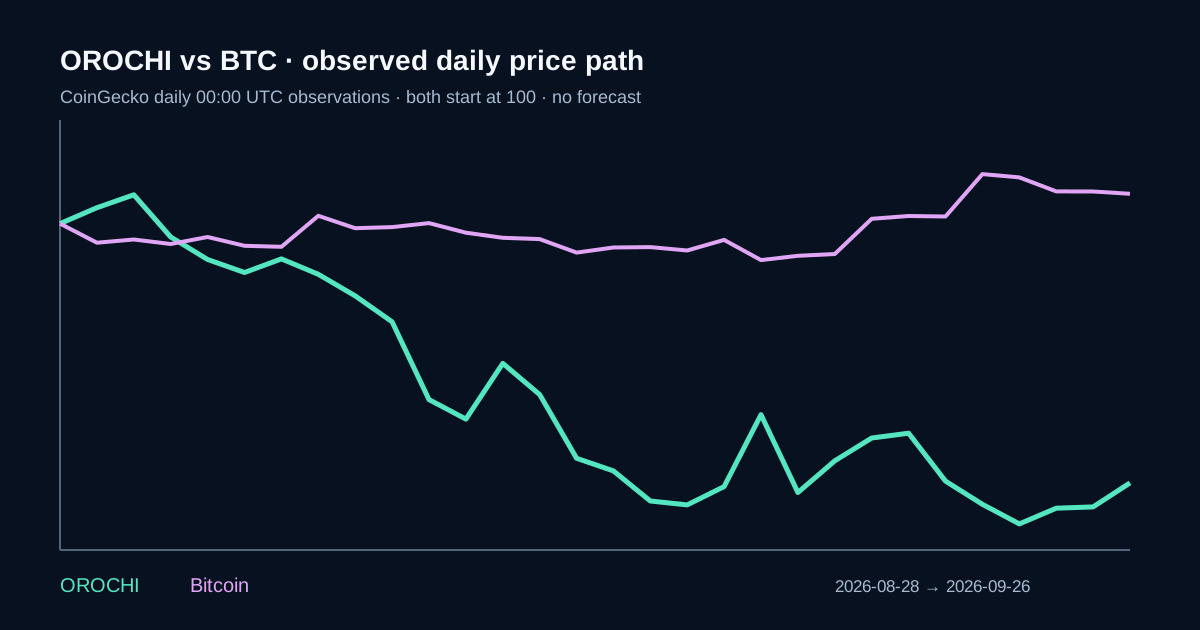
ON's falling paired path weakens a simple recent-momentum holding story, but it does not prove the infrastructure project must fail. Using the same CoinGecko 00:00 UTC USD marks for ON and BTC, ON moved −10.9% over the most recent complete 7-day window, versus BTC +4.0%. Across the full 30-observation provider path, it moved −41.4%, versus BTC +4.7% on the same dates. These are descriptive USD reference-price changes, not achievable net returns.
Provider observations can predate the specific exchange listing named above and may aggregate other venues. This full observed path is not a claim about returns after buying on that exchange's listing day. The worst observed one-day close-to-close change was −17.8% on 2026-09-17; the maximum daily-mark peak-to-trough drawdown was −50.2%. A reader could have faced worse intraday conditions, fees and slippage. A 30-day return is deliberately left blank when the provider has fewer than 31 complete daily marks.
| Matched price window | ON USD change | BTC USD change | UTC start / reason missing |
|---|---|---|---|
| 7 days | −10.9% | +4.0% | 2026-09-19 |
| 14 days | −3.2% | +8.9% | 2026-09-12 |
| 30 days | Insufficient complete days | — | No matched start |
| Full observed span | −41.4% | +4.7% | 2026-08-28 → 2026-09-26 |
Verify: Complete daily data · Original CoinGecko price response
Does an ON holder receive fees, equity or validator rewards automatically?
No automatic entitlement to protocol fees, company equity or a fixed validator yield is established for a passive ON holder. The documented design uses ON for validation, storage and interactions; validator and sequencer rewards depend on participation and operating risk, not merely holding a balance.
Do not infer a company share, revenue distribution or guaranteed airdrop from ticker ownership. Where a benefit depends on staking, eligibility, an application or a later company event, those conditions must be evaluated separately.
| Question | Current finding | Verification boundary |
|---|---|---|
| Transferable token? | Ethereum ERC-20 ON contract linked from the official KuCoin listing | Verify chain and exact contract or native asset |
| Product or holder rights | The documented network design uses ON for validation, storage and interactions. A passive ON holder is not thereby entitled to protocol revenue, company equity or a fixed staking yield. Prospective validator and sequencer rewards require participation and operating risk. | Read primary terms; conditions can change |
| Company equity? | No direct equity right verified | Do not equate token with ordinary shares |
Verify: Orochi official ON-token documentation · Orochi published allocation · KuCoin official ON listing · Orochi official documentation
Which evidence connects Orochi adoption to value captured by ON?
Trace three links separately: a verifiable service is used; the use requires ON payment or participation; the resulting demand is not merely recycled subsidy or outweighed by new tradable rewards. Orochi's token documentation establishes the proposed roles, but this edition does not measure all three links in production.
For one claimed integration, identify the service, period and activity records; distinguish a trial, incentivized usage and recurring paid usage. Next document how payment reaches a provider, validator or sequencer and what passive holders actually receive. Finally compare token-denominated paid activity with reward issuance and scheduled wallet releases using compatible time units. A product announcement cannot substitute for those cash-flow and token-flow records.
If fees, subsidies or releases cannot be reconciled, retain ON as an unverified value-capture thesis rather than capitalize a hypothetical revenue stream. There is no new fee study or projected staking yield in this profile.
Verify: Orochi's documented ON utility roles · Frozen ON supply and price evidence
Can ON allocation percentages tell you the next unlock or selling pressure?
No. An allocation bucket identifies intended ownership, while an unlock calendar specifies when restrictions change and a transfer records what actually moved. Provider circulating supply is a fourth concept. Airdrop conditions for a recipient class must not be reused as a team, investor or reserve release schedule.
To evaluate one proposed date, require the relevant bucket, beneficiary, vesting rule, source publication, amount and wallet or contract evidence. Compare with actual transferable balances and venue depth; unlocking does not imply immediate selling. Until those records align, leave the next-unlock amount unknown rather than extrapolating the 14.4% provider circulating/max snapshot into a monthly dilution rate.
Verify: Published ON allocation and intended utilities · Recipient-specific ON airdrop vesting
How should ON's low circulating share be read alongside token allocations?
Read ON's low provider circulating share as a supply question, not a timetable or selling forecast. Allocation percentages identify intended buckets; vesting terms identify restrictions, and actual transfers identify movement. The snapshot reports about 144 million circulating, 700 million total and one billion maximum, but none of those fields alone dates the next unlock or proves its recipient will sell.
At 2026-09-26T09:38:20.000Z, CoinGecko reports 144,275,000 circulating, 700,000,000 total and 1,000,000,000 maximum ON. Their differences are useful questions, not a dated sell-volume forecast. Provider-defined circulation may differ from actual immediately executable float.
| ON supply field | Provider snapshot | Investor interpretation |
|---|---|---|
| Circulating | 144,275,000 | Provider-estimated current float |
| Total | 700,000,000 | May include locked or restricted tokens |
| Maximum | 1,000,000,000 | Not a vesting schedule |
| Circulating / maximum | 14.4% | Does not identify a next unlock date |
Verify: Frozen CoinGecko supply source · Orochi official ON-token documentation · Orochi published allocation · KuCoin official ON listing · Orochi official documentation
Do ON tokenomics turn Orochi service use into demand without excessive dilution?
ON has a documented allocation and proposed validator, prover, storage and network-fee uses; those roles do not prove realised fee demand or a dividend for passive holders. Recipient-specific airdrop vesting does not disclose every team, investor or reserve release date.
Compare actual token-paid service activity with incentives, treasury transfers and circulating balances over a common period. Verify each recipient class and executed wallet movement before estimating dilution. A fixed maximum and provider float are useful denominators, not a forecast of next-month selling or a claim of corporate equity.
| Token-economics dimension | Documented mechanism or attributed claim | What remains unproven / investor implication |
|---|---|---|
| Supply and allocation | Orochi publishes a one-billion-token maximum: 30% network incentives, 21.55% ecosystem reserve, 15% foundation, 11.65% marketing/liquidity, 10% team, 8% investors and 3.8% airdrop. | Allocation percentages describe intended ownership buckets, not current tradable balances. |
| Release mechanism | The official airdrop terms distinguish a 12-month monthly vest for the top 6,000 wallets from a one-month cliff for other eligible recipients. | Do not infer dates for all team, investor and reserve tokens from airdrop terms; reconcile current wallet movements. |
| Use and rights | The project describes ON for validator/prover participation, storage, network fees and incentives. | Planned utility does not prove realised fee demand, dividends or equity for a passive holder. |
| Investor check | Compare dated network payments with issuance and treasury transfers, plus executable order-book depth. | A one-billion maximum and 144-million provider float do not by themselves predict a next-month sale. |
Verify: Orochi official ON allocation and utility · Orochi official airdrop vesting
Can ON's reported turnover support the order you want to exit?
No. Reported turnover cannot guarantee an exit at your intended size. CoinGecko reports $1,639,445 24-hour aggregated turnover at 2026-09-26T09:38:20.000Z. That is turnover across reported markets, not cash resting within 1% of the best bid and not guaranteed fill size. KuCoin spot, 2026-09-17 10:00 UTC confirms one venue and pair, not all venues or your jurisdiction.
This release does not have a same-time, validated order-book-depth series for this token. Therefore spread, executable $10,000 depth and expected slippage are explicitly unknown. Before any decision, check the exact pair, bid/ask ladder, deposit/withdrawal status and the size you actually intend to trade.
| Liquidity check | Dated observation | Limit |
|---|---|---|
| Aggregated reported 24h turnover | $1,639,445 | Not venue-specific executable depth |
| Known exchange event | KuCoin spot, 2026-09-17 10:00 UTC | Availability depends on region and account |
| Live spread and ±1% depth | Not measured in this release | Must check a current venue book |
| Order-size slippage | Not measured in this release | Cannot be inferred from 24h turnover |
Verify: Frozen market response · Orochi official ON-token documentation · Orochi published allocation · KuCoin official ON listing · Orochi official documentation
Which Orochi community activity would demonstrate real service adoption?
Useful community evidence includes developers integrating the data infrastructure, verifiable customer examples and technical support resolutions. Listing-day X attention, airdrop discussion or reward farming is not the same as recurring service demand.
No bot-filtered, contract-matched social time series is available for this release. We therefore do not print a fabricated “community score” or treat post counts as unique buyers. Future updates should freeze source, query, period, duplicate filtering and examples of substantive discussion.
Verify: Orochi official ON-token documentation · Orochi published allocation · KuCoin official ON listing · Orochi official documentation
Do ON holdings give binding control over Orochi's fees and issuance?
The official ON utility document describes validators and network incentives, but the reviewed text does not establish a universal binding token-weighted vote for every ON holder. Identify who can change fee schedules and rewards and verify actual proposals before describing decentralised control.
Separate formal binding controls from a social vote, an exchange listing process and project marketing. A governance claim should name the proposer, voting eligibility, executable contract or organization, timelock and appeal/correction path.
Verify: Orochi official ON-token documentation · Orochi published allocation · KuCoin official ON listing · Orochi official documentation
What must improve before ON has a defensible holding thesis?
ON has a plausible infrastructure use case but a thin public history and an unproven token-value capture path. A conditional hold needs independently measured service activity, clear supply release terms and enough bid depth to exit; a whitepaper utility list alone is insufficient.
What would strengthen the thesis: Verified data-service usage and paid ON flows grow while supply releases and validator concentration stay measurable. What would weaken or invalidate it: Usage claims cannot be reproduced, reward issuance dominates real demand, or the thin spot venue cannot absorb the intended order.
The historical price evidence contains only 30 matched daily observations from 2026-08-28 to 2026-09-26; it cannot estimate a stable win probability, long-run expected return or suitable position size. Set an investment horizon, maximum loss and next evidence review before calling ON a long-term hold.
| Hold-decision test | Condition to check | Failure mode |
|---|---|---|
| Asset identity | Ethereum ERC-20 ON contract linked from the official KuCoin listing | Wrong same-name token or chain |
| Token-specific value | The documented network design uses ON for validation, storage and interactions. A passive ON holder is not thereby entitled to protocol revenue, company equity or a fixed staking yield. Prospective validator and sequencer rewards require participation and operating risk. | Project popularity does not accrue to holders |
| Supply and control | CoinGecko reports about 144 million circulating, 700 million total and one billion maximum at this snapshot. Orochi publishes the allocation across seven buckets, but provider float and issuer allocations are not a verified future unlock calendar. Wallet-to-exchange transfers and the relevant vesting terms are needed before projecting dilution dates. | Unexpected tradable float or concentrated control |
| Exit feasibility | Current book depth for intended order | Reference price cannot be executed |
| Thesis invalidation | Usage claims cannot be reproduced, reward issuance dominates real demand, or the thin spot venue cannot absorb the intended order. | Indefinite hold without a test |
Verify: Frozen ON calculation and complete observations · Orochi official ON-token documentation · Orochi published allocation
Can you inspect all dated ON and BTC comparison prices?
Yes. The 30 matched 00:00 UTC observations below include each reported provider price, 24-hour provider volume and same-date BTC reference. The first row has no previous-day change; it is not a zero-return day.
This is one short, overlapping historical path. Do not count each daily row as an independent investment experiment or interpret a missing 30-day comparison as 0%.
| UTC day | ON daily change | ON USD price | Provider 24h turnover | BTC USD price |
|---|---|---|---|---|
| 2026-08-28 | First observation | $0.248503 | $2,628,598 | $80,268 |
| 2026-08-29 | +2.5% | $0.254780 | $2,284,477 | $77,821 |
| 2026-08-30 | +2.0% | $0.259898 | $2,009,383 | $78,225 |
| 2026-08-31 | −6.4% | $0.243164 | $1,267,455 | $77,658 |
| 2026-09-01 | −3.7% | $0.234262 | $1,551,611 | $78,553 |
| 2026-09-02 | −2.2% | $0.229120 | $1,251,788 | $77,416 |
| 2026-09-03 | +2.3% | $0.234494 | $1,226,875 | $77,297 |
| 2026-09-04 | −2.6% | $0.228410 | $1,202,426 | $81,265 |
| 2026-09-05 | −3.8% | $0.219829 | $2,703,760 | $79,671 |
| 2026-09-06 | −4.7% | $0.209591 | $1,105,444 | $79,822 |
| 2026-09-07 | −14.7% | $0.178751 | $1,929,197 | $80,329 |
| 2026-09-08 | −4.3% | $0.171003 | $1,985,010 | $79,093 |
| 2026-09-09 | +12.9% | $0.193084 | $4,230,572 | $78,451 |
| 2026-09-10 | −6.4% | $0.180733 | $1,944,459 | $78,283 |
| 2026-09-11 | −14.0% | $0.155501 | $1,341,575 | $76,555 |
| 2026-09-12 | −3.2% | $0.150506 | $1,663,828 | $77,204 |
| 2026-09-13 | −7.9% | $0.138567 | $1,216,431 | $77,262 |
| 2026-09-14 | −1.1% | $0.137007 | $1,462,992 | $76,819 |
| 2026-09-15 | +5.3% | $0.144265 | $2,438,425 | $78,173 |
| 2026-09-16 | +19.8% | $0.172765 | $3,880,032 | $75,590 |
| 2026-09-17 | −17.8% | $0.141944 | $5,784,473 | $76,147 |
| 2026-09-18 | +8.8% | $0.154498 | $3,907,008 | $76,371 |
| 2026-09-19 | +5.9% | $0.163549 | $1,731,483 | $80,874 |
| 2026-09-20 | +1.1% | $0.165422 | $2,440,740 | $81,236 |
| 2026-09-21 | −11.5% | $0.146462 | $1,271,085 | $81,169 |
| 2026-09-22 | −6.3% | $0.137242 | $1,553,019 | $86,597 |
| 2026-09-23 | −5.6% | $0.129510 | $5,061,771 | $86,183 |
| 2026-09-24 | +4.8% | $0.135715 | $2,850,578 | $84,382 |
| 2026-09-25 | +0.4% | $0.136222 | $1,295,049 | $84,378 |
| 2026-09-26 | +7.0% | $0.145727 | $1,718,184 | $84,076 |
Verify: All observations CSV
How were ON's price path and issuer statements separated?
ON's dated provider prices were recalculated separately from issuer statements about utility, allocation and rewards; a price-series check does not independently verify realized service demand. Research calculation version new-coin-provider-path-1.0; generated 2026-09-26T09:40:07.872740+00:00. Price and BTC comparison use CoinGecko market-chart 00:00 UTC USD observations, aligned by exact UTC day; the final intraday quote was excluded. Returns equal end/start − 1; path drawdown uses the maximum earlier observed daily mark. The full 30-observation span is clearly labelled and is not mislabeled as 30 days.
The original provider response is frozen and hashed SHA-256 df95e66464a044491f9e00acbed50f9007697d14a8ff2033330bd3fd084839ac. The JSON and CSV allow independent recalculation. Supply/turnover are separate dated CoinGecko snapshot fields at 2026-09-26T09:38:20.000Z, not information known at the first chart date. Official project/exchange documents support identity and intended rights; issuer assertions are marked as such. No causal link between social activity and later returns is claimed.
| Reproducible evidence | Download | Boundary |
|---|---|---|
| Calculation JSON | /research-data/new-coin-profiles/2026-09-26-v1/orochi.json | Version, summaries, full observations and hash |
| Daily rows | /research-data/new-coin-profiles/2026-09-26-v1/orochi-daily.csv | Matched provider prices and turnover |
| Original price response | /research-data/new-coin-profiles/2026-09-26-v1/orochi-coingecko-source.json | CoinGecko input, not PIT live archive |
| Original market response | /research-data/new-coin-profiles/2026-09-26-v1/coingecko-market-source.json | Dated supply and volume snapshot |
Verify: Orochi official ON-token documentation · Orochi published allocation · KuCoin official ON listing · Orochi official documentation · Dated CoinGecko market chart response · Dated CoinGecko supply and market response · Full research JSON · Matched daily observation CSV
Take the next step with this evidence.
Choose ongoing Telegram monitoring or inspect structured data in your own research workflow.
Receive qualifying events in Telegram.
Use the ready-made alert checklist, message explanations and daily briefing. Check the supported categories and coins before subscribing; every Research page is not a separate alert category.
Check the alert list · View alert plans
Inspect the data before choosing a pack.
Prepared research packs supply scoped features, separate outcomes where available and quality flags. Buy a fixed edition once and download directly; API use is optional.
Check data pack samples · Explore the full data catalog · Compare data plans
Each purchased pack includes its specified fields and published date range. This page's full dataset is not automatically included. Other data families require coverage, date, field and source-use confirmation before purchase. Telegram Pro is a separate 30-day service; historical packs are one-time purchases.
Frequently asked questions
What is Orochi Network (ON) coin?
ON is the token described by Orochi Network as part of its verifiable-data infrastructure. KuCoin opened ON/USDT trading in September 2026. The project documentation proposes uses for validator incentives, storage, ZK sequencers and fees; these designed functions still need live-usage evidence.
Is ON worth holding?
ON has a plausible infrastructure use case but a thin public history and an unproven token-value capture path. A conditional hold needs independently measured service activity, clear supply release terms and enough bid depth to exit; a whitepaper utility list alone is insufficient.
Is ON a good coin to buy now?
No unconditional buy answer follows from 30 daily observations. Check exact asset identity, documented rights, supply control, current depth and your own maximum loss.
How much did ON grow over 7, 14 and 30 days?
The 7-day matched provider return was −10.9%. The 14-day return was −3.2%. A full 30-day return is unavailable in this frozen release; the page shows the complete shorter path instead.
Does ON have governance rights?
The official ON utility document describes validators and network incentives, but the reviewed text does not establish a universal binding token-weighted vote for every ON holder. Identify who can change fee schedules and rewards and verify actual proposals before describing decentralised control.
Can I reproduce the ON chart?
Yes. Download the frozen CoinGecko input, 30 matched UTC daily rows and versioned calculation JSON linked in the method section.
What are ON tokenomics?
ON has a published one-billion allocation across seven buckets, including 30% incentives and 21.55% ecosystem reserve. Airdrop vesting differs by recipient class. Token utility is documented, but passive holders have no established dividend or equity claim.
Sources and verification
Track ON only after checking live liquidity and your own risk limit.
Use the token report for the evidence boundary, then verify current market conditions or alert coverage separately.
Explore Telegram alert coverage