New-coin due-diligence case · By CoinNudge Research · · Guide updated 2026-10-03 · 17 min read
How to research a new crypto coin before buying
How do you research a new crypto coin before buying? Check identity, issuer claims, supply and executable liquidity separately. In our September 17 MEXC screen, 13 of 20 selected watchlist coins had positive seven-day returns, but 11 had less than $1,000 of observed bid depth within 0.5% and nine had spreads above 20 basis points. The watchlist is rank-selected, not a representative listing cohort. The DGAI case then shows why even a +21.14% price week does not resolve conflicting issuer vesting documents.
Inspect the worked case · See current listings
How do you research a new crypto coin beyond its first price jump?
- Confirm the exact chain, contract, spot pair and opening time in the venue announcement; a ticker alone is not an identity check.
- Read the project's own product, token-rights and supply documents against one another. A conflict is a reason to ask for clarification, not a number to fill in by guesswork.
- Observe turnover and order-book depth at the time you could trade. All 20 selected market rows are visible below; past volume is not a fill guarantee and a strong first week does not certify fundamentals.
What did a real new-coin review find that the price chart missed?
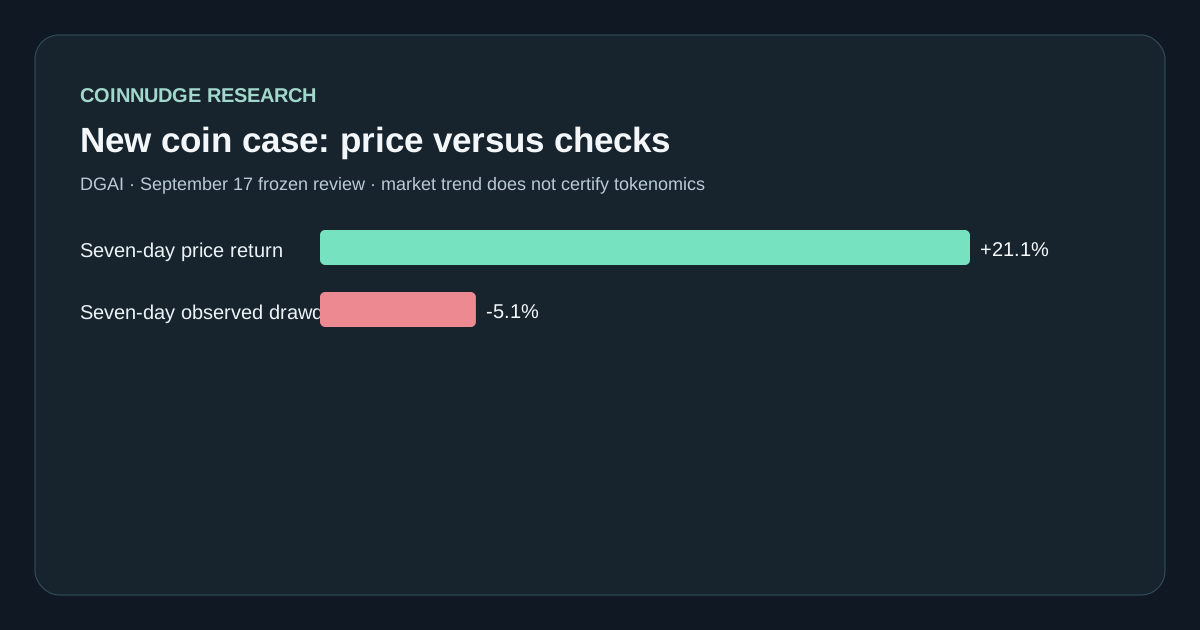
DGAI’s +21.14% seven-day price rise did not resolve a conflict over its team-vesting timing. In CoinNudge’s frozen September 17, 2026 MEXC example, median daily USDT quote turnover was $18.28 million and recorded path drawdown was 5.07%. The 9.66/10 watchlist score ranked market-research conditions; it was not an issuer-quality score or a probability of future profit.
The DGrid litepaper describes the team’s 10% allocation as two-year linear vesting. A separate issuer MiCAR-format document describes a one-year cliff followed by two years of linear vesting; both state a one-billion-token planned supply. Without the controlling current schedule and deployed mechanism, that conflict prevents a precise next-unlock conclusion. An issuer’s MiCAR-format disclosure is not a regulator endorsement.
For a buyer’s research file, retain both dated documents and label team vesting unresolved. Ask which schedule governs, who can amend it and whether enforcement is on-chain. Watching the market remains possible; certifying the supply thesis does not. This is an issuer-specific case, not a claim that all new listings have the same discrepancy.
| DGAI check at review time | Observed evidence | Status | Next action |
|---|---|---|---|
| Official MEXC spot announcement | Named DGAI/USDT market and listing notice | Venue claim checked | Verify current pair, chain and contract |
| Seven-day price and turnover | +21.14%; $18.28m median daily quote turnover | Historical market observation | Recheck spread and depth now |
| Team vesting | Two-year linear vs one-year cliff plus two-year linear | Issuer documents conflict | Obtain current controlling schedule and contract |
| Paying users and paid inference | Issuer describes a network and incentive design | Not independently verified | Find actual paid workload and token settlement |
| Contract/security review | Whitepaper is not a deployed-contract audit | Not established here | Check admin privileges and independent audits |
Verify: MEXC DGAI announcement · DGrid litepaper · Issuer MiCAR-format disclosure
What did the 20-coin MEXC watchlist reveal beyond the DGAI case?
The frozen September 17, 2026 MEXC watchlist showed price gains alongside execution and path risks: 13 of its 20 selected rows rose over seven days, while the selected-row median return was +9.41% and median measured drawdown 13.85%. Those are ranked-watchlist observations, not all new listings or a buyer’s success probability. DGAI’s separate issuer-document check supplies a different evidence layer.
Execution evidence changed the picture. Eleven of 20 rows showed less than $1,000 of observed bid depth within 50 basis points of the book midpoint, and nine showed quoted spreads above 20 basis points at the snapshot. CATE was up 41.90% but had only about $4 of measured near-mid bid depth; HOODRAT was up 32.99% with an 82.90-basis-point spread. MARSCOIN had about $20.68m median daily traded quote value yet lost 14.18% in seven days. Volume, return, current depth and document quality each answer a different question.
Nine of these 20 rows were MEXC Meme+ markets. That is the venue's market type, not evidence that every token belongs to CoinNudge's separate Meme investment category. The ranked list also contains unequal listing ages and was chosen by a screening score, so it cannot be used to estimate how a random new listing performs. DGAI's issuer-document conflict is not imputed to any other coin without reviewing that issuer's documents.
| Selected watchlist example | Seven-day move | Observed execution or document issue | What the investor should check |
|---|---|---|---|
| DGAI | +21.14% | ~$18.28m median turnover; issuer vesting descriptions conflict | Governing schedule, contract and today's depth |
| CATE | +41.90% | ~$4 near-mid bid depth in one snapshot | Whether a real sell order can execute |
| HOODRAT | +32.99% | 82.90-bp quoted spread at observation | Order size, spread and slippage |
| MARSCOIN | −14.18% | ~$20.68m median turnover despite a falling price | Why traded volume did not support price |
| STONK | +8.66% | 45.12% measured price-path drawdown | Risk before reading the terminal return |
Verify: Full 20-row watchlist data · Ranked watchlist CSV · Order-book evidence
How do you verify a new token's identity before trusting its ticker?
A venue announcement proves only that the venue announced a specified market. Record the project name, ticker, chain, exact contract or native-asset identifier, market type and opening time. Confirm the same identity from the project and chain explorer, then separately confirm deposits and trading are actually open. Spot listing, perpetual listing, Convert support and a new trading pair are not interchangeable events.
If any identity field disagrees, stop. A matched ticker on an unrelated chain or a copied website is not a harmless typo when it directs you to a different asset. CoinNudge's live listing feed is a discovery aid; it cannot certify every contract or issuer.
| Identity field | Source to compare | Fail or wait condition |
|---|---|---|
| Ticker and legal/project name | Venue announcement + project site | Different issuer under same ticker |
| Chain and contract | Venue notice + project link + explorer | No exact contract or mismatch |
| Market and open time | Spot-pair notice + actual venue status | Only futures/Convert announced or trading not open |
Verify: CoinNudge verified listing feed
Does the new coin’s product generate demand or rights for token holders?
A useful project is not automatically a valuable token: identify who pays, whether payment needs the token, and what economic or governance rights a holder actually receives. Compare claimed customer demand with token demand; downloads, airdrop participation and product revenue are not interchangeable with cash flow to token holders.
DGAI’s issuer describes inference payments, node collateral and governance, but this case did not independently verify recurring paid inference revenue or an audited payment-to-token-demand link. That is an unknown, not proof of zero usage. To resolve it, request dated paid-workload evidence, the settlement mechanism and the relevant deployed contract; distinguish token fees from subsidies and emissions funding participants.
Verify: DGrid litepaper and token role
Which allocation, vesting and supply checks belong in new-coin research?
Record circulating, total and maximum supply with their definitions and dates; then map team, investor, ecosystem and liquidity allocations to beneficiaries and transfer restrictions. A percentage allocation without its governing schedule cannot identify the next transferable amount.
For each tranche, ask whether release is coded, administered or only projected, who can revise the rule and whether unlocked units were already included in the provider’s circulation estimate. Release eligibility is not a sale or a net addition to tradable float. DGAI’s contradictory team timing is a reason to preserve an unresolved field rather than choose the more attractive document or fabricate an exact FDV.
Verify: FDV versus circulating supply analysis · Issuer disclosure
Who can change the token contract, and who controls its supply?
Verify deployed privileges and holder concentration separately from the whitepaper. Record whether administrators can mint, pause, upgrade, blacklist or change transfer rules; identify the control address, multisig/timelock conditions and whether an independent audit covers the same deployed version.
For ownership, separate exchange custody, liquidity-pool, treasury, vesting and burn addresses before treating an explorer’s top-holder percentage as beneficial-owner concentration. A large custodian address may represent many users; several wallets may share one controller. If address labels or privileges cannot be verified, record the uncertainty and the controlling contract/source needed to resolve it. This DGAI case does not supply an independent contract audit or a complete beneficial-owner census.
Verify: DGAI verification ledger: contract/security not established
How do you judge a new coin’s community and governance without mistaking hype for adoption?
Look for observable participation and decision rights, not follower totals alone. A useful community check records whether participants ask product questions, developers ship dated releases, proposals lead to documented decisions and token holders can actually exercise the claimed governance rights.
Separate issuer posts, paid promotion, incentives and independent user reports; save dated examples and compare them with actual activity. A large chat or an airdrop can reflect marketing rather than paying demand, and a governance token can leave important controls with administrators. These are due-diligence questions, not social-growth results measured in the frozen DGAI market dataset. Where evidence is absent, mark community quality or governance effectiveness unverified rather than infer legitimacy from popularity.
Can high new-coin trading volume hide a difficult exit?
Yes. Completed trade turnover describes past transactions; an order book describes current quoted liquidity at specific prices. The frozen DGAI median USDT quote turnover is not the amount you could sell immediately, and a first-week price rise cannot guarantee a later fill.
Inspect both sides of the current book, spread, depth near your intended price and venue order constraints. Compare your order with the bids available for an exit, not just the displayed top price or historical volume. Quotes can disappear and one book snapshot is not a fill simulation. The 20 selected September 17 watchlist rows below expose this distinction; they are not an unbiased cohort of all newly listed assets.
Verify: Official MEXC market-data API definitions · CoinNudge listing outcome coverage
Which new-coin gains concealed thin exit liquidity in the 20-row screen?
A positive first-week return did not establish an easy exit in this frozen September 17, 2026 screen: 13 of 20 selected MEXC rows rose, yet 11 had observed bid depth below $1,000 within 50 basis points and nine had quoted spreads above 20 basis points. The full table keeps the original ranked selection and all 20 rows. Seven-day return and path drawdown describe the completed path; quote turnover describes completed trades; spread and bid depth describe one book snapshot. These clocks are not a single safe-to-buy score.
“Bid below $1k” and “spread above 20 bp” are execution-review flags, not universal pass/fail cutoffs. Neither flag does not establish contract safety, sustainable demand or lasting liquidity. DGAI separately receives the issuer-document checks in this article, including unresolved vesting; the other rows are market-only observations, not 19 additional issuer reviews. A flagged token may support a smaller order, but one book snapshot cannot estimate your eventual fill. This rank-selected watchlist is not an unbiased cohort of all new listings.
| Selected coin | 7d price change | 7d path drawdown | Median quote turnover | Bid depth · 50 bp | Quoted spread | Market-only review flag |
|---|---|---|---|---|---|---|
| 1. DGAI | +21.14% | −5.07% | $18.28m | $19,959 | 5.36 bp | Neither book flag; issuer checks separately reviewed |
| 2. CNPY | +84.65% | −6.48% | $1.46m | $756 | 33.41 bp | Bid below $1k · Spread above 20 bp |
| 3. KII | +4.13% | −5.43% | $8.20m | $706 | 3.64 bp | Bid below $1k |
| 4. CASHCAT | +10.15% | −7.65% | $1.77m | $3,650 | 26.81 bp | Spread above 20 bp |
| 5. AERO | −0.83% | −7.76% | $2.65m | $38,296 | 3.36 bp | Neither book flag; issuer unreviewed |
| 6. CATE | +41.90% | −22.06% | $453,857 | $4.32 | 38.10 bp | Bid below $1k · Spread above 20 bp |
| 7. 牛来 | +27.41% | −25.82% | $1.07m | $7,748 | 12.06 bp | Neither book flag; issuer unreviewed |
| 8. NES | +41.67% | −5.31% | $65,489 | $89.61 | 27.55 bp | Bid below $1k · Spread above 20 bp |
| 9. CAP | +26.78% | −11.09% | $58,420 | $1,964 | 9.15 bp | Neither book flag; issuer unreviewed |
| 10. GRVT | +4.55% | −4.17% | $391,098 | $7,554 | 11.53 bp | Neither book flag; issuer unreviewed |
| 11. DOS | −3.92% | −8.87% | $493,757 | $2,795 | 24.66 bp | Spread above 20 bp |
| 12. DELTA | +29.29% | −31.53% | $130,859 | $210 | 11.89 bp | Bid below $1k |
| 13. AIINU | +28.89% | −19.22% | $170,516 | $168 | 61.63 bp | Bid below $1k · Spread above 20 bp |
| 14. STONK | +8.66% | −45.12% | $1.28m | $327 | 31.32 bp | Bid below $1k · Spread above 20 bp |
| 15. MARSCOIN | −14.18% | −27.43% | $20.68m | $38,199 | 8.78 bp | Neither book flag; issuer unreviewed |
| 16. PONS | −15.67% | −19.82% | $2.60m | $10,540 | 15.01 bp | Neither book flag; issuer unreviewed |
| 17. HOODRAT | +32.99% | −33.70% | $71,815 | $126 | 82.90 bp | Bid below $1k · Spread above 20 bp |
| 18. PIPEDOG | −2.70% | −10.58% | $62,878 | $357 | 15.86 bp | Bid below $1k |
| 19. ALIGN | −4.81% | −16.61% | $90,352 | $122 | 15.87 bp | Bid below $1k |
| 20. FONE | −6.21% | −39.70% | $290,936 | $3.22 | 25.59 bp | Bid below $1k · Spread above 20 bp |
Verify: All 20 frozen market observations and selection order · Issuer-specific DGAI check statuses
How was this real new-coin due-diligence case reproduced?
Reproduce the market path from the frozen September 17, 2026 listing release, and verify issuer-review statuses from the separately recorded document checks. Market bars and a research score do not establish the truth of an issuer statement. The public case JSON retains the daily rows and labels each check verified, issuer claim, conflicting or unknown; the October 3 editorial update does not turn the case into a current buy signal.
Download the complete case JSON, the check ledger and the daily market CSV. The deterministic contract and SHA-256 files are in the release directory. This check tests whether an example can be audited; it does not statistically validate the checklist as a profitable trading strategy. Reopen all external project sources before applying it today.
| Public evidence | What can be recalculated | What cannot be inferred |
|---|---|---|
| Case JSON + daily market CSV | Observed seven-day path and named source vintages | Today's tradable fill or future return |
| Check ledger CSV | Five disclosed verification statuses | That unverified equals fraudulent |
| SHA-256 manifest | Whether published files changed | That the original issuer claims are true |
Verify: Full case JSON · Check ledger CSV · Daily market CSV · Release manifest
When should a new-coin research result mean watch, wait or stop?
Watch when identity is verified but the research remains incomplete; wait when a material fact such as vesting or executable liquidity lacks evidence; stop the proposed interaction when the chain/contract or market identity conflicts. These are analytical handling categories, not certified buy/sell grades.
Write the unresolved field, why it affects your decision and what evidence could resolve it. For DGAI team vesting, that means the dated controlling schedule plus deployed enforcement; for a thin book, it means current size-specific depth, not last week’s turnover. Reopen the record after official clarification or verifiable activity, preserving the earlier version instead of silently turning “unknown” into “verified.”
Take the next step with this evidence.
Choose ongoing Telegram monitoring or inspect structured data in your own research workflow.
Receive qualifying events in Telegram.
Use the ready-made alert checklist, message explanations and daily briefing. Check the supported categories and coins before subscribing; every Research page is not a separate alert category.
Check the alert list · View alert plans
Inspect the data before choosing a pack.
Prepared research packs supply scoped features, separate outcomes where available and quality flags. Buy a fixed edition once and download directly; API use is optional.
Check data pack samples · Explore the full data catalog · Compare data plans
Each purchased pack includes its specified fields and published date range. This page's full dataset is not automatically included. Other data families require coverage, date, field and source-use confirmation before purchase. Telegram Pro is a separate 30-day service; historical packs are one-time purchases.
Frequently asked questions
How do I research a new crypto coin before buying?
Verify the exact venue market and token identity; compare official product, token-rights and supply documents; inspect current liquidity and contract privileges; record unknowns. A listing or price jump alone does not complete due diligence.
Is a new Binance or MEXC listing proof a coin is safe?
No. An exchange notice establishes an announced market, not audited contract safety, sustainable customer demand or a favorable investment return.
Does DGAI's September price increase prove its tokenomics are good?
No. The frozen September 17 case observed a +21.14% seven-day move, while issuer documents described different team-vesting timing. The market move does not reconcile those documents.
What if two project documents disagree on unlocks?
Mark the field unresolved, identify which dated document and deployed contract control, and wait for a verifiable clarification before relying on a precise unlock estimate.
Can I use this as a live new-coin buy list?
No. It is a dated worked example and reusable verification workflow. The current listing feed and market depth must be checked separately, and neither is a buy instruction.
Is reported volume the amount I can sell immediately?
No. Historical trade turnover is not current order-book depth; executable size depends on spread, liquidity at your order price and venue conditions.
Did most of the 20 newly listed coins rise, and can I copy the watchlist?
Thirteen of 20 selected September 17 MEXC watchlist rows had positive seven-day returns, but the list was rank-selected and is not a representative listing cohort. Eleven had under $1,000 of near-mid bid depth in the observed snapshot. This is not a repeatable buy probability.
Do the 20-row market flags certify any new coin as safe?
No. Seven selected rows had neither a sub-$1,000 bid-depth flag nor a greater-than-20-basis-point spread flag at one order-book snapshot. That does not establish contract safety, issuer quality, lasting liquidity or an expected return; only DGAI received a separate issuer-document review here.
How do I check whether a new crypto coin is a scam?
Verify exact identity, deployed contract privileges, source claims, holder labels and realistic exit liquidity. A listing, audit badge or large community alone does not establish safety. This case is a verification workflow, not a fraud-detection guarantee.
Does a large token community prove real adoption?
No. Distinguish promotion and incentive participation from dated product usage, paying customers and enforceable governance. The DGAI market observations do not independently measure those community outcomes.
Sources and verification
- MEXC DGAI listing noticeOfficial venue event; not token quality approval.
- DGrid litepaperIssuer's product and two-year-linear team vesting description.
- DGrid MiCAR-format disclosureIssuer's one-year-cliff plus two-year-linear description; not regulator endorsement.
- CoinNudge frozen market caseDated market values, five check statuses and limits.
- Case observation ledgerCheck-by-check status and what to verify next.
- Twenty-row MEXC watchlist evidenceRank-selected price, spread, depth and listing-type context; not the full listing universe.
See what the alert actually tells you.
Preview the Telegram listing message and the complete alert scope before choosing a plan.
Preview listing alerts