Single-asset evidence report · By CoinNudge Research · · Guide updated 2026-10-03 · 20 min read
What is ZEC coin, and is it worth holding?
ZEC is the native currency of Zcash, a network supporting both transparent and shielded transfers; a price rally alone does not measure privacy adoption. For a holding decision, a defensible ZEC holding case needs dated evidence of privacy use, continuing wallet and exchange access, and execution liquidity; the current rally alone cannot establish those conditions. In the frozen Binance spot daily-open window ending September 25, 2026, ZEC returned +268.9% versus BTC +40.5%; across 57 earlier monthly starts, its median was −1.6% and 23/57 beat BTC. Overlapping history is not a future win rate or personal buy call.
Inspect all historical starts · Check current market context
What should investors know about ZEC?
- ZEC gained +268.9% in the last frozen 90-day window; this differs from its historical monthly-start median −1.6%.
- 23/57 complete historical 90-day starts beat BTC, while 57/57 had a deeper daily-open drawdown.
- A defensible ZEC holding case needs dated evidence of privacy use, continuing wallet and exchange access, and execution liquidity; the current rally alone cannot establish those conditions.
What is ZEC coin, and are all Zcash transfers private?
ZEC is the native currency of Zcash, a network supporting both transparent and shielded transfers; a price rally alone does not measure privacy adoption.
ZEC is the network currency; a wallet's chosen transaction path determines which privacy properties the user receives. Holding coins on an exchange is not the same as completing a shielded transfer.
The investment question requires two separate checks: whether the intended privacy workflow remains usable, and whether a volatile quoted-price position fits the holder's horizon. The 57 paired 90-day paths answer the second historically; they do not establish how many new people used Zcash.
| ZEC at a glance | Dated evidence | How to read it |
|---|---|---|
| Documented token role | Can hold and transfer the native currency including supported shielded use | Not an automatic claim on every project activity |
| Last frozen 90-day spot return | +268.9% | BTC on the same UTC dates: +40.5% |
| Historical 90-day monthly median | −1.6% | 57 overlapping complete starts, not a forecast |
| Current circulating supply | 16,952,175 | CoinGecko response updated 2026-09-26T08:35:30.000Z |
Verify: Zcash address and value-pool documentation · Zcash Foundation
Does owning ZEC provide privacy access, company shares or income?
ZEC gives access to the native currency and supported transfer functions, not shares in a development company or an automatic claim on a development fund. Shielded functionality depends on the wallet and transaction path.
A holder evaluating privacy should distinguish transparent, shielding, shielded and deshielding flows under the technical documentation. A public transaction count or value-pool total cannot identify all individual users or prove that every transfer was private.
Community discussion and grants can influence development priorities, but a forum poll is not an equity vote or a contractual payout. Verify the active network rule and the exact beneficiary before inferring a financial right.
| Who owns what | Documented role or participation | What cannot be inferred |
|---|---|---|
| ZEC holder | Can hold and transfer the native currency including supported shielded use | No company-equity or revenue share established |
| Privacy user | Can choose supported shielded addresses and wallets | Not every wallet or exchange supports every privacy flow |
| Governance participant | Community and grant discussions exist | Do not equate forum polls with a universal automatic equity-like vote |
Verify: Zcash address and value-pool documentation · Zcash Foundation
Can you actually use shielded ZEC and still exit through your venue?
Only if the wallet and venue support the specific transaction path you intend. A ZEC balance or exchange listing does not certify shielded deposits, shielded withdrawals or availability in every jurisdiction.
Before transferring, compare the wallet's supported address/transaction types with the exchange's current deposit and withdrawal instructions. Where permitted, verify a small transfer and receipt before scaling. A failed compatibility check means stop and resolve the route—not retry a larger payment or assume the privacy feature will work automatically.
This operational test is separate from the frozen return experiment. The public price study excludes custody failures, transfer delays and any costs of moving through an alternative venue; those gaps matter when judging whether a holding thesis can be implemented.
Verify: Zcash transparent and shielded address documentation
Is ZEC’s rally evidence of privacy adoption?
No: the ZEC rally is not evidence, by itself, that privacy adoption grew. Zcash provides a documented shielded-payment capability, but price and social attention do not count the people using that capability.
Zcash distinguishes transparent and shielded transactions. Its technical documentation explains that shielded addresses conceal transaction details, while value-pool totals can be examined without seeing individual balances. That supports a genuine privacy feature, but comparing a price chart with one shielded-supply snapshot does not identify new users or prove adoption caused the rally.
A stronger fundamental test needs a dated series of shielded-pool balance, shielded transaction activity, wallet support and actual venue accessibility. We have not independently frozen that longitudinal adoption series for this release, so this report does not call the recent move usage-backed. Exchange access and jurisdiction may also differ for privacy coins.
An adoption check should compare the same privacy metric over matching dates and define what it measures: pool value, transaction type or wallet availability. These are complementary proxies, not interchangeable counts of independent people. The missing longitudinal series in this release means the rally is not certified as adoption-driven; it does not prove that no adoption occurred.
ZEC's dated price experiment below measures spot returns and drawdown paths, not the causal contribution of project adoption. The release has no independently frozen continuous operating-economics series that completes this value-capture test.
Verify: Zcash address and value-pool documentation · Zcash Foundation
Does ZEC’s 21-million cap eliminate new miner supply?
No. ZEC's eventual 21-million cap does not eliminate ongoing miner issuance before that limit is reached. The remaining theoretical stock is not one imminent unlock, and active subsidy rules must be checked separately.
CoinGecko’s separate 2026-09-26T08:35:30.000Z response reports 16,952,175 circulating ZEC out of 16,953,145 total and 21,000,000 maximum. These are provider classifications, not an audit of custodian balances or a schedule of future exchange selling.
The provider snapshot reports circulating and maximum ZEC, but remaining theoretical issuance is not one scheduled unlock. Network issuance and shielded-pool movement need to be distinguished. Privacy itself also limits what external observers can infer about individual behavior.
ZEC's remaining eventual supply is mined under versioned consensus rules, not released in one venture-style unlock. Check the active block-subsidy rule and recipients, then separate new mined units from existing inventory moved out of a shielded pool or custodian. No new mint is needed for an existing holder to sell. Old funding percentages must not be treated as today's allocation.
| ZEC supply field | Frozen provider value | Reading rule |
|---|---|---|
| Circulating supply | 16,952,175 | CoinGecko provider definition at 2026-09-26T08:35:30.000Z |
| Total supply | 16,953,145 | May differ from circulating and maximum supply |
| Maximum supply | 21,000,000 | Missing is not zero and not equal to total supply |
| Reported circulating / maximum | 80.7% | Not a dated release schedule or tradable-float audit |
Verify: Frozen original supply response · Zcash address and value-pool documentation · Zcash Foundation
What do ZEC tokenomics mean for mining issuance, privacy use and holder rights?
ZEC has a 21-million eventual cap but still enters circulation through protocol block subsidies and halvings. A cap does not mean all coins already circulate, and current subsidy recipients are a versioned consensus question rather than a generic venture-token unlock calendar.
Read active subsidy rules alongside mined supply, verified shielded use and your venue’s custody and exit conditions. Shielded-activity measures do not identify unique users or promise price appreciation. Holding ZEC grants neither company equity nor a guaranteed development-fund payment.
| Token-economics dimension | Documented mechanism or attributed claim | What remains unproven / investor implication |
|---|---|---|
| Supply model | ZEC has a 21 million maximum supply and proof-of-work block issuance that declines through halvings. | The cap does not mean that all 21 million coins already circulate. |
| Distribution | New coins arise through the consensus subsidy; recipient and development-funding rules are versioned protocol matters. | Do not reuse an older funding percentage as the current allocation without checking the active consensus rules. |
| Use and rights | ZEC pays for transfers and supports optional shielded transactions. | A ZEC holder receives neither company equity nor a guaranteed development-fund payment. |
| Investor check | Compare current mined supply, next subsidy schedule and verified shielded use with liquidity. | Privacy usage statistics do not identify every user or imply future price appreciation. |
Verify: Zcash protocol basics and supply
How does ZEC’s recent surge compare with longer BTC-matched paths?
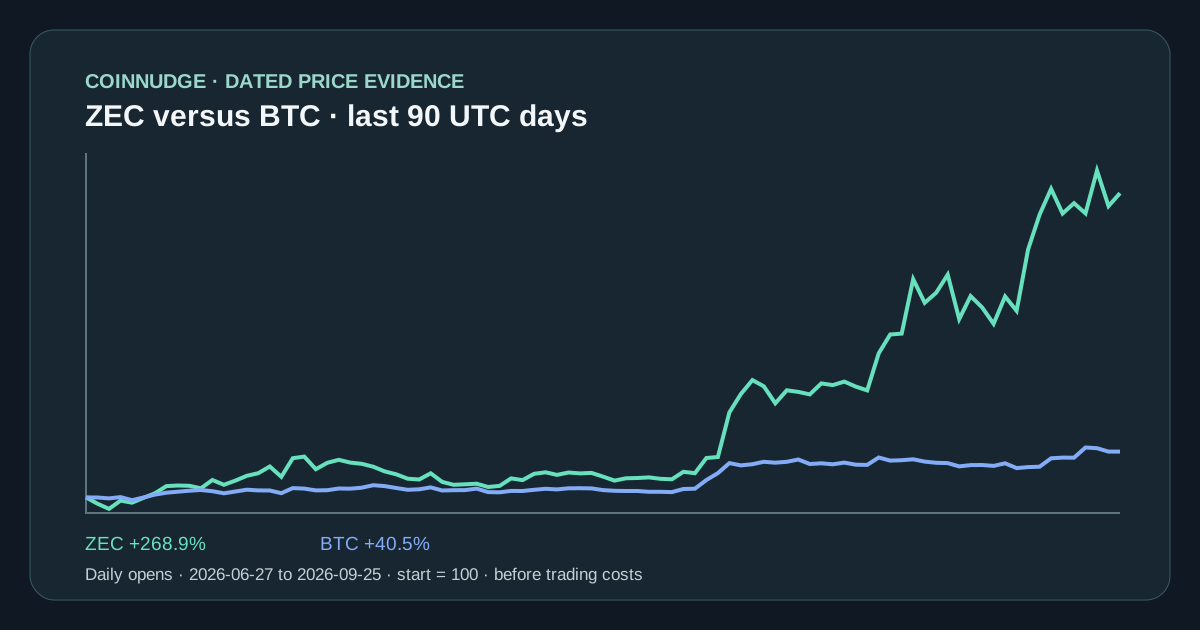
At the September 25 UTC daily-open endpoint, ZEC returned +268.9% over 90 days versus BTC +40.5% on exactly the same days. The 365-day ZEC path was +2533.7% versus BTC −25.5%. These different windows are one dated path each—not five independent tests or a prediction.
The 90-day chart plots all 91 matched UTC daily opens from 2026-06-27 to 2026-09-25, normalized to 100 on the first day. A later CoinGecko price or 24-hour change may differ because the venue, market window and timestamp differ. The table reports the actual shared-start comparison rather than mixing unrelated provider percentages.
| Matched holding window | ZEC spot return | BTC spot return | ZEC minus BTC / status |
|---|---|---|---|
| 7 days | +5.4% | +10.5% | -5.0 pp |
| 30 days | +101.4% | +7.5% | 93.9 pp |
| 90 days | +268.9% | +40.5% | 228.4 pp |
| 180 days | +624.0% | +27.2% | 596.9 pp |
| 365 days | +2533.7% | −25.5% | 2559.2 pp |
Verify: Full dated path and methods
What do 57 earlier ZEC holding windows show beyond the latest rally?
Across the frozen matched 90-day monthly starts, ZEC's median return was −1.6% versus BTC +1.9%, and 23/57 starts beat BTC. That is descriptive historical evidence, not a future success probability; the full overlapping sample, dependence check and opposing cases appear below.
We prespecified every first day of a month after the Binance listing had a full prior month, through June 2026. Of 57 candidate 90-day starts, 57 had a complete 91-daily-open ZEC/BTC pair and 0 were excluded for missing daily opens. The ZEC median endpoint was −1.6%, BTC's was +1.9%; ZEC beat BTC in 23/57. Those windows overlap and must not be treated as 57 independent win-probability trials.
ZEC had a deeper daily-open peak-to-trough drawdown in 57/57 matched windows. The lower 10th-percentile ZEC endpoint was −38.9% and the upper 90th percentile +66.1%. Every-third-month sensitivity has only 19 observations and 8 BTC-beating starts; it is a dependence check, not a statistically powered forecast.
The worst BTC-relative start was 2023-12-01: −4.2% for ZEC against +65.5% BTC, with −42.8% asset drawdown. A counterexample is 2025-09-01: +1039.1% for ZEC versus −16.1% BTC. Showing both prevents the current rally or a past collapse from becoming the whole story.
| 90-day monthly cohort measure | ZEC | BTC / paired comparison | Interpretation |
|---|---|---|---|
| Complete starts | 57 | 57 | Same UTC dates and 91 daily opens |
| Median endpoint | −1.6% | +1.9% | Not an expected future return |
| 10th / 90th percentile | −38.9% / +66.1% | −24.9% / +47.8% | Descriptive tail range |
| Outperformed BTC | 23/57 | — | Overlapping monthly windows |
| Deeper path drawdown | 57/57 | — | Measured at daily opens only |
| Every-third-month check | 8/19 | — | Small non-overlap sensitivity |
Verify: All matched starts and excluded candidates · Frozen calculation contract
Which ZEC windows beat BTC—and what losses appeared along the way?
Both winning and losing ZEC windows are shown: all 57 eligible same-date ZEC/BTC 90-day observations are visible chronologically below. The worst BTC-relative start was 2023-12-01: −4.2% for ZEC against +65.5% BTC, with −42.8% asset drawdown. A counterexample is 2025-09-01: +1039.1% for ZEC versus −16.1% BTC. These are contrasting examples from the complete table, not independent future scenarios. A first-of-month start is the frozen sample design, not a suggested buying schedule.
Compare terminal return with interim drawdown in each row. Daily-open paths can understate intraday harm; fees, spreads, slippage, tax, staking and leverage are excluded. The complete input CSV and exclusion ledger are available for independent recalculation.
| UTC start | ZEC 90d | BTC 90d | ZEC − BTC | ZEC path drawdown |
|---|---|---|---|---|
| 2021-10-01 | +36.9% | +6.0% | +30.8 pp | −50.2% |
| 2021-11-01 | −42.5% | −37.7% | -4.7 pp | −69.8% |
| 2021-12-01 | −46.1% | −24.2% | -21.9 pp | −61.4% |
| 2022-01-01 | +21.6% | −1.5% | +23.2 pp | −42.0% |
| 2022-02-01 | +31.3% | +0.0% | +31.3 pp | −45.8% |
| 2022-03-01 | −22.2% | −31.7% | +9.5 pp | −60.4% |
| 2022-04-01 | −67.7% | −55.8% | -11.9 pp | −69.1% |
| 2022-05-01 | −44.2% | −36.8% | -7.3 pp | −61.2% |
| 2022-06-01 | −31.6% | −36.2% | +4.6 pp | −44.5% |
| 2022-07-01 | +1.5% | −2.7% | +4.1 pp | −33.2% |
| 2022-08-01 | −15.7% | −10.7% | -5.0 pp | −37.3% |
| 2022-09-01 | −33.1% | −18.0% | -15.1 pp | −46.7% |
| 2022-10-01 | −31.8% | −14.4% | -17.4 pp | −38.0% |
| 2022-11-01 | −10.3% | +15.9% | -26.2 pp | −34.5% |
| 2022-12-01 | −0.7% | +34.8% | -35.5 pp | −19.6% |
| 2023-01-01 | +4.0% | +72.1% | -68.1 pp | −37.5% |
| 2023-02-01 | −19.3% | +21.4% | -40.7 pp | −37.5% |
| 2023-03-01 | −22.0% | +19.9% | -41.9 pp | −30.0% |
| 2023-04-01 | −23.7% | +7.0% | -30.6 pp | −43.9% |
| 2023-05-01 | −19.2% | +0.4% | -19.6 pp | −36.2% |
| 2023-06-01 | −18.0% | +1.9% | -19.9 pp | −28.5% |
| 2023-07-01 | −21.8% | −11.3% | -10.5 pp | −28.9% |
| 2023-08-01 | −6.8% | +18.1% | -24.9 pp | −20.7% |
| 2023-09-01 | +17.4% | +45.9% | -28.5 pp | −14.2% |
| 2023-10-01 | +6.4% | +56.0% | -49.6 pp | −17.2% |
| 2023-11-01 | −18.8% | +25.0% | -43.8 pp | −41.5% |
| 2023-12-01 | −4.2% | +65.5% | -69.7 pp | −42.8% |
| 2024-01-01 | +11.7% | +64.6% | -52.9 pp | −30.8% |
| 2024-02-01 | −1.6% | +42.5% | -44.1 pp | −41.3% |
| 2024-03-01 | −3.9% | +10.7% | -14.6 pp | −41.3% |
| 2024-04-01 | −33.6% | −14.4% | -19.2 pp | −35.7% |
| 2024-05-01 | +54.3% | +10.1% | +44.2 pp | −34.1% |
| 2024-06-01 | +23.2% | −12.1% | +35.3 pp | −33.8% |
| 2024-07-01 | +40.8% | +4.9% | +35.9 pp | −38.2% |
| 2024-08-01 | +14.5% | +12.5% | +2.0 pp | −41.2% |
| 2024-09-01 | +69.2% | +65.3% | +4.0 pp | −20.3% |
| 2024-10-01 | +118.3% | +48.0% | +70.3 pp | −35.2% |
| 2024-11-01 | +15.3% | +47.6% | -32.3 pp | −44.1% |
| 2024-12-01 | −36.6% | −12.5% | -24.1 pp | −60.0% |
| 2025-01-01 | −30.1% | −11.8% | -18.3 pp | −52.1% |
| 2025-02-01 | −13.3% | −5.8% | -7.5 pp | −32.4% |
| 2025-03-01 | +41.5% | +25.2% | +16.3 pp | −29.3% |
| 2025-04-01 | +1.9% | +31.3% | -29.4 pp | −30.1% |
| 2025-05-01 | +12.4% | +25.3% | -12.8 pp | −32.4% |
| 2025-06-01 | −19.9% | +3.6% | -23.6 pp | −36.3% |
| 2025-07-01 | +59.8% | +4.7% | +55.1 pp | −23.7% |
| 2025-08-01 | +851.9% | −5.0% | +856.9 pp | −29.5% |
| 2025-09-01 | +1039.1% | −16.1% | +1055.2 pp | −35.3% |
| 2025-10-01 | +627.5% | −23.5% | +651.0 pp | −55.3% |
| 2025-11-01 | −12.6% | −22.8% | +10.2 pp | −55.3% |
| 2025-12-01 | −48.5% | −25.9% | -22.6 pp | −62.1% |
| 2026-01-01 | −51.5% | −22.1% | -29.4 pp | −62.5% |
| 2026-02-01 | +27.0% | −0.6% | +27.7 pp | −39.0% |
| 2026-03-01 | +140.5% | +9.7% | +130.8 pp | −22.9% |
| 2026-04-01 | +64.0% | −11.8% | +75.7 pp | −46.2% |
| 2026-05-01 | +33.3% | −16.2% | +49.5 pp | −46.2% |
| 2026-06-01 | +47.9% | +6.2% | +41.7 pp | −41.6% |
Does the sampled ZEC book prove your venue can execute an exit?
A quoted ZEC price does not guarantee your order can buy or exit there. This report has one dated Binance order-book sample, separate from historical daily turnover; execution requires a fresh route-specific book and cost check.
The historical ZEC/USDT Binance spot candles show $295,813,800 median daily quote turnover across 30 complete UTC days. This is a transaction-flow measure, not cash available at a specific bid or ask. It also excludes other exchanges and market-maker obligations.
A separate CoinNudge Binance book sample observed at 2026-09-26T08:35:34.499Z shows 0.07 bps quoted spread and $2,715,724 returned depth within ±1% of mid. The modelled $10,000 buy slippage is 0.69 bps before fees and latency. Recheck the live book and your actual venue; this is one snapshot, not guaranteed execution.
Before an actual ZEC order, match the pair, venue and observation time, then estimate the buy from asks and the planned exit from bids at the intended size. Add fees and any transfer costs; one basis point is 0.01%. If the returned levels cannot fill the size, or access/data is delayed, reduce the planned exposure or wait for adequate evidence—not extrapolate the historical turnover into depth.
| Liquidity or execution measure | Dated observed value | Limit |
|---|---|---|
| 30-day Binance spot median daily quote turnover | $295,813,800 | 30 complete archived UTC days; turnover ≠ executable depth |
| Sampled bid/ask spread | 0.07 bps | One Binance book observation; can change by the second |
| Visible depth within ±1% of mid | $2,715,724 | Returned 500 levels per side only |
| Simulated $10k buy / sell slippage | 0.69 / 1.10 bps | Excludes fees, latency and later book changes |
Verify: Frozen top-30 order-book source · Current market-depth research
Can ZEC social attention reveal genuine privacy users?
ZEC social enthusiasm does not show that privacy use grew. For a holding thesis, identify whether an argument contains a defined privacy metric, a reproducible date range and evidence of usable wallets and trading routes.
A third-party directory showed about 64,899 X mentions over 7 days and 213 Reddit mentions over 30 days for ZEC at the September 26 review. Those are different time windows and may include promotions, bots or ticker collisions. They are not unique people, buyers, monthly search volume or a measure of tokenholder rights.
The underlying social response was not frozen in this release. These report-time directory figures cannot now be independently replayed and are not used as a quantitative test of fundamental demand or current community size.
Social excitement around a rapidly rising coin is useful evidence of attention, not proof of user growth. Compare pro-privacy arguments with FOMO, exchange-access complaints and objections about observable adoption before attributing the rally to fundamentals.
To use ZEC discussion constructively, choose one factual claim, follow its direct source, note the date and beneficiary, and compare it with the rights and supply checks in this report. An unsupported promotion remains attention evidence; it is not converted into a holder-benefit claim or buying score.
Verify: Cross-platform social directory · CoinGecko short-window search attention · Zcash address and value-pool documentation · Zcash Foundation
Which privacy-use and access checks support a ZEC holding thesis?
There is no unconditional yes from this evidence. A defensible ZEC holding case needs dated evidence of privacy use, continuing wallet and exchange access, and execution liquidity; the current rally alone cannot establish those conditions. The last frozen 90-day return was +268.9%, while the median of 57 earlier monthly-start windows was −1.6%; 23/57 beat BTC. These overlapping historical paths describe risk, not the chance of a profitable hold from today.
Evidence that would strengthen a holding thesis: A sustained, independently checkable rise in relevant privacy usage with broad wallet/venue support and healthy spot depth. Evidence that would weaken or end it: Price and X mentions climb while comparable privacy-use metrics are absent or flat, or exchange/region access narrows.
A holder should state a time horizon, position size, acceptable drawdown and specific facts that would trigger a reassessment. Revision trigger for this report: A dated shielded-usage series that meets a defined observation protocol could materially change this provisional interpretation. The checklist is not a personal recommendation, target price or promise that the next 90 days resemble a prior cohort.
Before holding ZEC for a privacy thesis, verify both a supported self-custody workflow and an exit venue available to you. A historical Binance book does not certify your jurisdiction, deposit address type or withdrawal support. If the route fails a small permitted test or access cannot be confirmed, do not treat a quoted price as an executable exit; choose a different route or stay unexposed.
| Holding decision check | Evidence to verify | Why it matters |
|---|---|---|
| Tokenholder benefit | Can hold and transfer the native currency including supported shielded use | No company-equity or revenue share established |
| Future tradable supply | Official allocation dates and actual transfers | Provider float alone is not a sell forecast |
| Ability to exit | Fresh bid/ask depth plus fees and latency | Historical turnover is not a fill guarantee |
| Opportunity cost versus BTC | 57 complete historical paired starts plus current common window | Absolute gains can still lag BTC |
| Thesis invalidation | A dated shielded-usage series that meets a defined observation protocol could materially change this provisional interpretation. | A stated reason to reassess is more useful than an indefinite hold slogan |
Verify: Frozen ZEC/BTC price study · Complete ZEC monthly observation ledger · Zcash address and value-pool documentation · Zcash Foundation
How can you replay the ZEC study without inferring private user identities?
Reproduce ZEC's spot results from the matched asset/BTC daily inputs, complete observation CSV, exclusions and frozen JSON below. Keep the original calculation version and cutoff: the October 3, 2026 edit clarifies decisions and subquestions, not a recalculation or a fresh market release.
Calculation coin-profile-spot-paths-1.0; historical cutoff 2026-09-25 UTC. The archived candle ledger preserves event_time, observed_at and ingested_at. Historical fills may have been collected retrospectively; this study does not claim every bar was available to CoinNudge on its original event date.
Recent returns use the same UTC daily-open start and endpoint for ZEC and BTC with every intermediate day present. The monthly study buys at the first-day open and exits at the day-90 open, with 91 complete daily opens per pair; maximum drawdown is min(path / prior running peak − 1). It assumes no costs or dividends. The asset and BTC daily input CSVs enable independent numerical replay. Candidate and exclusion counts, input SHA-256 87138f292bafdb394798f682978b9d6f296b96b5c9fdb92f7878e82ce1b8569c of the complete normalized archive objects, and output SHA-256 ed7c51563e233ef1f64ebc443fc9af188219f34e5f192589a55bc3cf7c8f9142 of the research result identify the frozen release; the manifest separately hashes each downloadable file.
Supply comes from a separate CoinGecko 2026-09-26T08:35:30.000Z observation; the separate book package was generated at 2026-09-26T08:37:46.983Z, while the ZEC row was observed at 2026-09-26T08:35:34.499Z. Neither is silently inserted as information known to historical cohort investors. No causal claim links community activity or project usage to later return.
| Reproducible file | Contents | Time/interpretation boundary |
|---|---|---|
| Research JSON | /research-data/coin-profiles/2026-09-26-v1/zec.json | Calculation version, summary and full paired cohort |
| Observation CSV | /research-data/coin-profiles/2026-09-26-v1/zec-monthly-observations.csv | 57 matched monthly starts |
| Asset daily inputs | /research-data/coin-profiles/2026-09-26-v1/zec-daily-inputs.csv | Event, observation and ingestion dates |
| BTC daily inputs | /research-data/coin-profiles/2026-09-26-v1/btc-daily-inputs.csv | Matched BTC daily opens and provenance |
| Excluded starts | /research-data/coin-profiles/2026-09-26-v1/zec-exclusions.csv | 0 missing pairs; header retained if zero |
| Supply source | /research-data/coin-profiles/2026-09-26-v1/coingecko-supply-source.json | Dated provider fields, not a historical feature |
| Order-book source | /research-data/coin-profiles/2026-09-26-v1/orderbook-source.json | Sampled current market, may omit this asset |
Verify: CoinNudge frozen spot-path research · Complete monthly observation ledger · Daily historical input ledger · Matched BTC daily input ledger · Frozen CoinGecko supply response · Dated order-book source · Social directory and limitations · Zcash address and value-pool documentation · Zcash Foundation
Take the next step with this evidence.
Choose ongoing Telegram monitoring or inspect structured data in your own research workflow.
Receive qualifying events in Telegram.
Use the ready-made alert checklist, message explanations and daily briefing. Check the supported categories and coins before subscribing; every Research page is not a separate alert category.
Check the alert list · View alert plans
Inspect the data before choosing a pack.
Prepared research packs supply scoped features, separate outcomes where available and quality flags. Buy a fixed edition once and download directly; API use is optional.
Check data pack samples · Explore the full data catalog · Compare data plans
Each purchased pack includes its specified fields and published date range. This page's full dataset is not automatically included. Other data families require coverage, date, field and source-use confirmation before purchase. Telegram Pro is a separate 30-day service; historical packs are one-time purchases.
Frequently asked questions
What is Zcash (ZEC) used for?
ZEC is the native currency of Zcash, a network supporting both transparent and shielded transfers; a price rally alone does not measure privacy adoption. This answers the token's documented role, not whether its price is attractive.
Is ZEC worth holding?
There is no unconditional yes in this dated research. A defensible ZEC holding case needs dated evidence of privacy use, continuing wallet and exchange access, and execution liquidity; the current rally alone cannot establish those conditions. The historical 57 monthly 90-day starts overlap, and 23/57 beat BTC; this is not a future success rate. Check your own horizon, loss limit and live evidence before deciding.
Is ZEC a good coin to buy now?
This report is not a personalized buy call. The latest dated 90-day ZEC path was +268.9% versus BTC +40.5%, but only 23/57 earlier 90-day monthly starts beat BTC and rights, supply and execution still matter.
How has ZEC performed over 7, 30, 90 and 365 days?
The matched Binance spot daily-open returns are 7 days +5.4%; 30 days +101.4%; 90 days +268.9%; 365 days +2533.7% through September 25, 2026. These are dated historical windows, not live quotes.
Does the ZEC rally prove privacy adoption?
No. This release has verified price paths but no independently frozen longitudinal shielded-usage series.
Are all ZEC transactions private?
No. Zcash documentation distinguishes transparent and shielded addresses and several transaction types.
Does a shielded balance reveal who is using ZEC?
No. Publicly observable value-pool totals do not reveal individual shielded addresses or user counts.
Can I reproduce this ZEC study?
Yes. The page exposes every 57 matched 90-day start, the daily input CSV, exclusions, version and hashes. The windows overlap, so observed counts are not independent future probabilities.
Does ZEC trading volume guarantee easy execution?
No. The 30-day Binance spot turnover is separate from one sampled order book. At the cited snapshot the returned ±1% book depth was $2,715,724; later depth and actual fills can differ.
Does an exchange ZEC listing guarantee shielded withdrawals?
No. Check the particular venue's address-type support, current withdrawal instructions and regional availability. A price quote is not proof that a chosen privacy workflow can be used.
What are ZEC tokenomics?
ZEC is capped at 21 million and enters circulation through declining mining rewards. It has no typical venture-token cliff calendar; current subsidy recipients must be read from active consensus rules. Owning ZEC is not an equity or revenue claim.
Sources and verification
- CoinNudge frozen spot-path researchMatched daily-open returns, full cohort and audit hashes.
- Complete monthly observation ledgerEvery eligible 90-day matched start.
- Daily historical input ledgerActual daily inputs with observation and ingestion time.
- Matched BTC daily input ledgerThe same-date BTC opens used in every paired return and drawdown.
- Frozen CoinGecko supply responseProvider-defined current float, total and maximum supply at its own timestamp.
- Dated order-book sourceSampled Binance books for covered markets; not the entire exchange.
- Social directory and limitationsDirectional 7-day X and 30-day Reddit mention counts; bot and promotion filtering unverified.
- Zcash address and value-pool documentationPrimary distinction between transparent and shielded use and what can be measured.
- Zcash FoundationGovernance and ecosystem primary-source entry.
- Zcash protocol basics and supply
Monitor ZEC market changes without treating a dated report as a current order.
Use this report for the thesis and risk checks, then verify current liquidity and any alert separately.
Preview Telegram alert coverage