Single-coin evidence report · By CoinNudge Research · · Guide updated 2026-10-03 · 20 min read
What is Midnight (NIGHT) coin, and is it worth holding?
Midnight NIGHT coin generates DUST for private network computation; it is not a cash dividend. Holding NIGHT needs evidence of recurring DUST demand and supply absorption, not just launch attention. In the frozen 90-day path ending September 26, 2026, NIGHT returned −18.6% versus BTC +40.1%; 0/6 completed historical 90-day month-start paths beat BTC. These overlapping, retrospective paths are exploratory, not current buying odds.
See the research evidence · Check market context
Quick answer: NIGHT coin in three checks
- Midnight NIGHT coin generates DUST for private network computation; it is not a cash dividend. Holding NIGHT needs evidence of recurring DUST demand and supply absorption, not just launch attention. In the frozen 90-day path ending September 26, 2026, NIGHT returned −18.6% versus BTC +40.1%; 0/6 completed historical 90-day month-start paths beat BTC. These overlapping, retrospective paths are exploratory, not current buying odds.
- Coverage is 292 daily asset opens, with 6 complete historical 90-day month-starts. The cohort is exploratory.
- The unresolved value-capture question is: Can actual DUST demand cause durable NIGHT holding rather than just launch-period attention?
What is Midnight NIGHT coin, and why does DUST matter to holders?
Midnight’s NIGHT is a visible network/governance token that generates DUST, a non-transferable resource for private computation. This differs from a privacy coin that directly hides transfers, and it is not a dividend on application fees. The question for a prospective holder is: Can actual DUST demand cause durable NIGHT holding rather than just launch-period attention? This report separates issuer rules, third-party supply estimates and 292 observed spot daily opens rather than treating a price chart as proof of product adoption.
The issuer documentation supports the project description, but tokenholders, users, operators and treasury beneficiaries can be different parties. The table distinguishes what can be checked at this release from what would still need operating evidence. Use the rights and supply sections to define the holding thesis, then the BTC-matched paths to assess opportunity cost; neither layer substitutes for the other.
| NIGHT research question | Current evidence | Boundary |
|---|---|---|
| What is the asset? | Midnight’s NIGHT is a visible network/governance token that generates DUST, a non-transferable resource for private computation. This differs from a privacy coin that directly hides transfers, and it is not a dividend on application fees. | Issuer description, not holder income |
| Price evidence | 292 daily opens; 2025-12-09–2026-09-26 | Retrospective spot data |
| 90-day comparison | −18.6% versus BTC +40.1% | One ending-date path |
| Verified project-to-token cash flow | Not independently established | No dividend inferred |
Verify: Midnight NIGHT and distribution · Midnight tokenomics whitepaper
Does using Midnight DUST require buying and keeping NIGHT?
Not every Midnight user needs to buy NIGHT: holders generate DUST and developers can delegate that capacity to application users. The issuer separates the public NIGHT token from shielded, decaying, non-transferable DUST. This is a possible usage link, not proof that each private transaction creates a fresh NIGHT purchase.
A useful value-capture test therefore needs dated DUST demand, NIGHT held or delegated to satisfy it, regeneration rates and net token turnover. None of those are established by an exchange listing or a count of wallets eligible for a distribution. NIGHT ownership is also not ownership of the Midnight foundation or a contractual fee dividend.
The participant categories below distinguish potential users and operators from a passive NIGHT holder; they do not establish that any reward program is live.
| Participant | Relevant right or activity | Do not infer |
|---|---|---|
| Product user | NIGHT generates DUST, a shielded and non-transferable transaction resource; NIGHT is a governance/native token. | Every user must hold the token |
| Passive token holder | NIGHT is not an equity claim or a direct distribution of network revenue. DUST is operational capacity, not a second liquid cash dividend. | Equity or automatic fee income |
| Operator, miner or DAO participant | Depends on this project’s participation rules | Same economics as simply buying the spot token |
Verify: Midnight NIGHT and distribution · Midnight tokenomics whitepaper
What does the 450-day NIGHT thaw mean for tradable supply?
Midnight states a 24 billion NIGHT total and a 450-day distribution thaw, described as quarterly installments. A thaw is eligibility to transfer units, not proof of a same-day sale. The CoinGecko circulating figure is a later third-party estimate; it should not be subtracted from maximum supply and labelled “the next unlock”.
Supply risk is concentrated in what portion of newly liquid units reaches exchanges and whether application capacity demand offsets it. The official page reports large claim and scavenger distributions, but address counts do not measure distinct retained users or demand for production DUST.
CoinGecko’s 2026-09-27T03:57:30.000Z snapshot estimates 16,607,399,401 circulating NIGHT, 24,000,000,000 total and 24,000,000,000 maximum units. These are provider estimates, not a verified holder ledger. In particular, the gap between total and circulating units is not a dated unlock schedule.
| NIGHT supply field | Frozen estimate or official rule | Correct reading |
|---|---|---|
| Official distribution | 24 billion total NIGHT; the official page describes a 450-day staged thaw for distribution allocations. Thaw eligibility is not proof that units were sold. | Issuer mechanism; check actual transfers |
| Circulating | 16,607,399,401 | Provider estimate, not spendable-float audit |
| Total / maximum | 24,000,000,000 / 24,000,000,000 | Neither is a forecast of tomorrow’s sell pressure |
| Market cap / FDV | $426,588,287 / $616,479,355 | Valuation measures, not realized project revenue |
Verify: Frozen provider supply response · Midnight NIGHT and distribution · Midnight tokenomics whitepaper
Which Midnight usage numbers would show real token demand?
Recurring DUST consumption and the NIGHT balances supporting it were not independently established in this frozen release, so the report cannot show that application usage sustained NIGHT demand. The explicit null operating_observation and token_capture_observation mean not verified, never zero activity.
For a follow-up release, request 1) Weekly unique fee-paying applications and DUST consumed; 2) NIGHT held/delegated for independently verified production use; 3) Net NIGHT inflow/outflow and thaw-to-sale conversion. Align their observation dates to supply and prices before testing whether use and token demand move together.
A privacy-network story can attract users, developers and speculators for different reasons. Ask whether an announcement is a deployed app, recurring DUST usage, or only a partnership. Social posts and claimant-address counts are not verified paying-user or price-support data.
| Evidence test | What this release has | What it can and cannot show |
|---|---|---|
| DUST consumed by live apps | Not independently frozen here | Would measure actual network-resource use, not yet NIGHT holder income |
| NIGHT held/delegated for application capacity | Not independently frozen here | Would test whether usage creates persistent NIGHT demand |
| Distribution thaw versus net exchange deposits | Official schedule exists; realized sales unverified | Unlock eligibility and selling must remain separate |
Verify: Source-status record · Midnight NIGHT and distribution · Midnight tokenomics whitepaper
Did NIGHT outperform BTC after its first months of trading?
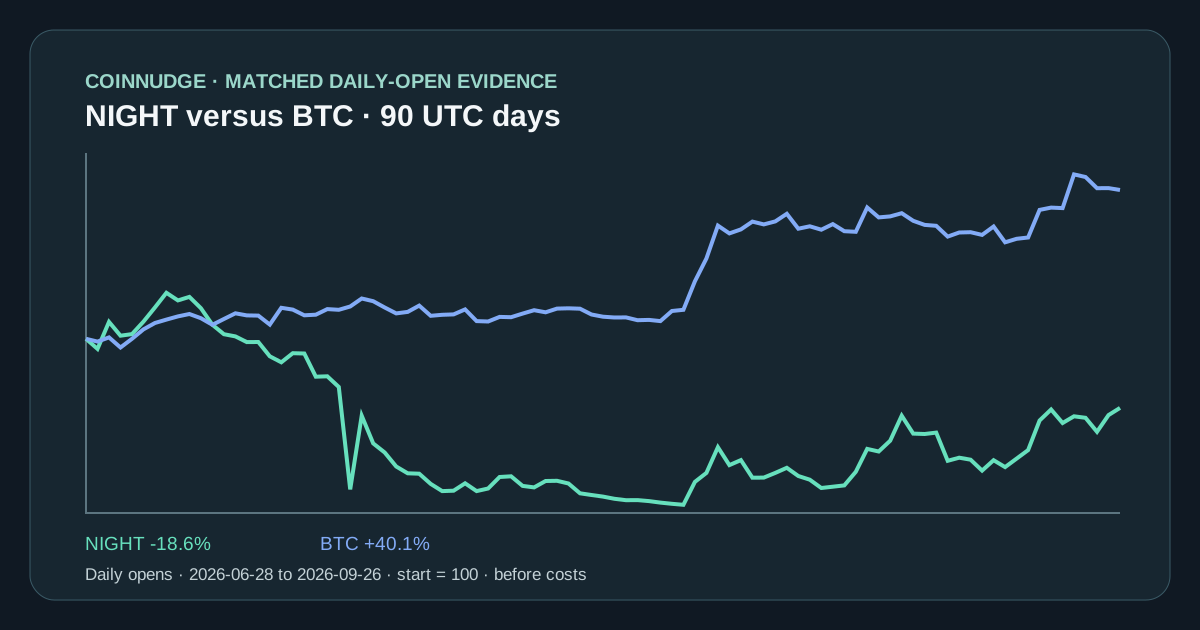
NIGHT did not beat Bitcoin in the frozen 90-day path ending September 26, 2026: −18.6% versus +40.1%. That dated loss is consistent with, but separate from, the six historical month-start outcomes below; it does not measure the next 90 days. The matched windows below show how much the answer changes with entry horizon, while the chart compares normalized values from the same UTC start. NIGHT/USDT comes from a retrospective MEXC public API retrieval while BTC/USDT comes from CoinNudge’s local Binance archive; cross-venue basis and stablecoin pair differences are not adjusted.
A spot return excludes fees, spread, slippage, taxes and any financing cost. Drawdown uses daily opens and therefore can miss worse intraday prices. A price increase cannot independently establish that token economics improved.
| Matched UTC holding window | NIGHT return | BTC return | NIGHT − BTC | Path drawdown |
|---|---|---|---|---|
| 7 days · 2026-09-19–2026-09-26 | +4.4% | +4.0% | +0.4 pp | −7.4% |
| 14 days · 2026-09-12–2026-09-26 | +19.7% | +8.9% | +10.8 pp | −7.4% |
| 30 days · 2026-08-27–2026-09-26 | +27.4% | +6.4% | +21.0 pp | −18.6% |
| 60 days · 2026-07-28–2026-09-26 | +33.7% | +31.9% | +1.7 pp | −18.6% |
| 90 days · 2026-06-28–2026-09-26 | −18.6% | +40.1% | −58.7 pp | −50.8% |
| 180 days · 2026-03-30–2026-09-26 | −48.6% | +27.4% | −76.0 pp | −65.1% |
| 365 days · 2025-09-26–2026-09-26 | Unavailable | Unavailable | — | 74 missing daily bars |
Verify: All asset daily inputs
Did six historical NIGHT holding paths support a long-term holding case?
The main hypothesis was that NIGHT would beat BTC over prespecified 90-day month-start holding periods. The observed main result was 0/6 BTC-beating paths, median NIGHT return −42.1% versus median BTC −6.2%, and 6/6 with a deeper asset drawdown. A BTC-beating count is not a buy probability, because starts overlap and the studied coin was selected as a currently interesting asset.
The sample is one symbol, not all available coins: 292 NIGHT daily opens from 2025-12-09 to 2026-09-26. We predeclared first-of-month 30/90-day and Monday 14-day entry dates, require complete same-UTC asset and BTC paths, and keep excluded candidates in a separate ledger. NIGHT/USDT comes from a retrospective MEXC public API retrieval while BTC/USDT comes from CoinNudge’s local Binance archive; cross-venue basis and stablecoin pair differences are not adjusted.
Only 6 complete 90-day starts meet the protocol; no confidence interval or general future win probability is claimed. The non-overlapping sensitivity contains 2 starts.
| Prespecified holding sample | Complete / candidate | NIGHT median | Beat BTC | Deeper drawdown | Status |
|---|---|---|---|---|---|
| Monthly 90 days | 6/6 | −42.1% | 0/6 | 6/6 | Exploratory |
| Monthly 30 days | 8/8 | −20.3% | 3/8 | 7/8 | Exploratory |
| Monday 14 days | 39/39 | −6.6% | 16/39 | 37/39 | Descriptive; overlapping |
Verify: Full research JSON · All candidate outcomes
Was NIGHT stronger after a rising or falling Bitcoin month?
NIGHT lost value in both prior-BTC environments: median 90-day return was −44.4% for the three starts after BTC strength and −39.8% for the three after BTC weakness; neither group had a BTC-beating path. Three observations per group cannot establish a dependable market-timing rule. BTC state means its 30-day return before entry, not whether BTC fell during the later holding window; this is not a simultaneous sell-off hedge test.
Before each hypothetical entry, BTC’s preceding 30-day daily-open return classifies the market as up or down. The classification uses only information available before that entry, not the later BTC outcome. The table tests whether NIGHT’s relationship with BTC is stable across prior environments.
Even a large subgroup is only descriptive: there is one asset, one exchange pair and correlated market periods. If a subgroup is below 20 observations, treat its ratio as exploratory. We do not present a small split as evidence of a predictive trading signal.
| Pre-entry BTC state | 90-day starts | NIGHT median | Beat BTC |
|---|---|---|---|
| Prior BTC 30d up | 3 | −44.4% | 0/3 |
| Prior BTC 30d down | 3 | −39.8% | 0/3 |
| Prior BTC state unavailable | 0 | — | 0/0 |
Verify: Full observation ledger
Did any of the six NIGHT starts overturn the weak holding result?
NIGHT’s least weak 90-day start still underperformed BTC, so this sample offers no winning counterexample to the six-start headline. The weakest BTC-relative 90-day start was 2026-06-01: NIGHT −47.8% versus BTC +6.2%, with −56.5% daily-open path drawdown. The least weak BTC-relative case was 2026-04-01: NIGHT −33.4% versus BTC −11.8%. Even that case still lost more than BTC; it is not a counterexample to the cohort’s underperformance. These cases were selected after calculation to illustrate both tails, never to define a trading rule.
The table shows 6 most recent eligible 90-day starts out of 6; 0 older starts remain in the public CSV. Dates are UTC, endpoints use opening prices, and the drawdown column describes the loss a holder might have seen before the endpoint. A positive final return could still have been difficult to hold through.
The current 90-day result and the historical cohort answer different questions. A short rally may be real while the base rate of earlier starts is weak. The risk check is to ask what would invalidate the issuer’s token mechanism and whether the present price can be executed at the intended size.
| UTC start | UTC end | NIGHT return | BTC return | NIGHT − BTC | Path drawdown |
|---|---|---|---|---|---|
| 2026-01-01 | 2026-04-01 | −45.8% | −22.1% | −23.7 pp | −54.5% |
| 2026-02-01 | 2026-05-02 | −31.3% | −0.6% | −30.7 pp | −49.3% |
| 2026-03-01 | 2026-05-30 | −39.8% | +9.7% | −49.4 pp | −52.0% |
| 2026-04-01 | 2026-06-30 | −33.4% | −11.8% | −21.6 pp | −38.3% |
| 2026-05-01 | 2026-07-30 | −44.4% | −16.2% | −28.2 pp | −53.6% |
| 2026-06-01 | 2026-08-30 | −47.8% | +6.2% | −54.0 pp | −56.5% |
Verify: All case rows
Is NIGHT exchange turnover proof of an easy exit?
Across 30 valid recent daily candles, median quoted daily NIGHT turnover on MEXC Spot NIGHTUSDT was $72,306. This is traded amount accumulated over 24 hours, not bid-side depth at one instant. The higher the intended order relative to live depth, the less a historical daily-open return describes attainable performance.
No synchronized live spread or level-two depth is frozen for this release, so this report cannot quote a trustworthy $10,000 execution cost. Check a fresh order book, pair identity, fees and withdrawal route before interpreting the historical numbers as personally tradable.
For a proposed NIGHT order, compare its size with same-time asks for an entry and bids for an exit, calculate size-weighted prices plus your actual fees, and check the permitted withdrawal network. If depth is absent or the estimated exit loss exceeds your budget, reduce the size or wait; the historical turnover figure cannot pass that test for you.
| Execution input | Observed or missing | Action |
|---|---|---|
| 30-day median daily quote turnover | $72,306 | Context only; not executable depth |
| Spot venue | MEXC Spot NIGHTUSDT | Check your actual trading venue |
| Live spread and ±1% depth | Not captured in release | Obtain a current order-book snapshot |
| Leverage, funding and liquidation | Not modelled | Do not apply spot outcomes to perps |
Verify: Venue candle inputs
When would holding NIGHT have a stronger evidence case?
NIGHT remains a conditional research candidate, not a demonstrated income asset: verify recurring DUST use, NIGHT retention or delegation supporting that use, and actual transfers from thawed supply. If those observations remain unavailable, a price rally cannot resolve the holding thesis.
Write the DUST-demand evidence you need, a review date around the relevant thaw, and a loss budget. Failure is unverified or subsidized usage, or actual liquid supply arriving without sufficient depth; waiting for better records is a valid outcome. Use a fresh executable quote and your own horizon and loss limit; none of the historical start frequencies is a future win probability.
| Decision gate | Evidence to request | Failure mode |
|---|---|---|
| Project activity | Weekly unique fee-paying applications and DUST consumed | Project story remains unmeasured |
| Token capture | Net NIGHT inflow/outflow and thaw-to-sale conversion | Usage never reaches passive holder |
| Opportunity cost | 6 90-day starts versus BTC | One recent rally replaces full distribution |
| Supply | 24 billion total NIGHT; the official page describes a 450-day staged thaw for distribution allocations. Thaw eligibility is not proof that units were sold. | Actual transfers or emissions overwhelm demand |
| Execution | Fresh spread and order-book depth | Historical price cannot be filled |
Verify: NIGHT frozen token-economics evidence · NIGHT BTC-matched holding paths
How can the NIGHT analysis be reproduced?
Reproduce the NIGHT price results from the public daily-input and observation files: verify the release manifest hashes, join asset and BTC opens on UTC dates, require a complete path, then recalculate returns and running-peak drawdown. A hash mismatch or a missing date means stop and resolve the input mismatch, not fill it with zero.
Calculation version single-coin-paired-paths-20260927-2.0; price endpoint 2026-09-26 UTC; asset coverage 2025-12-09–2026-09-26; source type retrospective public MEXC API retrieval. Price returns are end daily open divided by start daily open minus one. BTC-relative results are percentage-point differences, and path drawdown is the worst normalized daily open versus the earlier running peak.
All dates, qualified observations, excluded candidate starts and exact inputs are available below. NIGHT/USDT comes from a retrospective MEXC public API retrieval while BTC/USDT comes from CoinNudge’s local Binance archive; cross-venue basis and stablecoin pair differences are not adjusted. Historical backfills are not labelled as data originally observed by CoinNudge at those old event dates. The provider supply snapshot was retrieved on 2026-09-27T03:59:28.770Z; it is not a 2023 or 2025 point-in-time supply estimate.
The release manifest hashes frozen inputs and outputs. Operating-source review is a separate version with nulls for unverified activity and token capture. No p-value or out-of-sample trading edge is asserted; sample selection, overlapping windows, venue differences and survival of the selected token limit inference.
Editorial review: October 3, 2026. Definitions, result explanations and holding conditions were clarified; no historical experiment was rerun. Price evidence still ends September 26, 2026, and the separate supply/source review remains dated September 27. Recheck current issuer terms, transfers and order-book liquidity before using this historical report for a present decision.
| Public evidence file | Purpose | Availability |
|---|---|---|
| Research JSON | /research-data/hot-coin-profiles/2026-09-27-v2/night.json | All summary and row-level results |
| Outcome CSV | /research-data/hot-coin-profiles/2026-09-27-v2/night-observations.csv | Every qualifying historical start |
| Exclusion CSV | /research-data/hot-coin-profiles/2026-09-27-v2/night-exclusions.csv | Missing or rejected candidates |
| Asset candle CSV | /research-data/hot-coin-profiles/2026-09-27-v2/night-daily-inputs.csv | Unrounded price/turnover inputs |
| BTC candle CSV | /research-data/hot-coin-profiles/2026-09-27-v2/btc-daily-inputs.csv | Same-date comparator |
| Field dictionary | /research-data/hot-coin-profiles/2026-09-27-v2/field-dictionary.json | Formula and null semantics |
| Fundamental review | /research-data/coin-fundamentals/2026-09-27-v3/night.json | Issuer rules and explicit evidence gaps |
| Manifest | /research-data/hot-coin-profiles/2026-09-27-v2/manifest.json | Frozen SHA-256 identities |
Verify: Frozen paired-price study · Full cohort observations · Asset daily spot inputs · Same-date BTC inputs · Excluded candidate ledger · Calculation dictionary · Frozen input manifest · Tokenomics and fundamental source review · Frozen CoinGecko supply snapshot · MEXC original kline response · MEXC official spot kline specification · Midnight NIGHT and distribution · Midnight tokenomics whitepaper
Take the next step with this evidence.
Choose ongoing Telegram monitoring or inspect structured data in your own research workflow.
Receive qualifying events in Telegram.
Use the ready-made alert checklist, message explanations and daily briefing. Check the supported categories and coins before subscribing; every Research page is not a separate alert category.
Check the alert list · View alert plans
Inspect the data before choosing a pack.
Prepared research packs supply scoped features, separate outcomes where available and quality flags. Buy a fixed edition once and download directly; API use is optional.
Check data pack samples · Explore the full data catalog · Compare data plans
Each purchased pack includes its specified fields and published date range. This page's full dataset is not automatically included. Other data families require coverage, date, field and source-use confirmation before purchase. Telegram Pro is a separate 30-day service; historical packs are one-time purchases.
Frequently asked questions
What is NIGHT coin and what is it used for?
Midnight’s NIGHT is a visible network/governance token that generates DUST, a non-transferable resource for private computation. This differs from a privacy coin that directly hides transfers, and it is not a dividend on application fees. That mechanism does not guarantee an investment return.
Is NIGHT coin worth buying or holding?
NIGHT remains a conditional research candidate, not a demonstrated income asset: verify recurring DUST use, NIGHT retention or delegation supporting that use, and actual transfers from thawed supply. If those observations remain unavailable, a price rally cannot resolve the holding thesis. The short historical cohort is exploratory; price evidence ends September 26, 2026, and current supply and executable liquidity must be checked separately.
How has NIGHT performed compared with Bitcoin?
In the 90-day same-UTC period ending September 26 2026, NIGHT returned −18.6% and BTC returned +40.1%. Across 6 eligible historical 90-day month-starts, 0 beat BTC.
How many historical NIGHT observations are in this study?
292 daily asset opens and 53 accepted holding-path rows across three horizons. Historical retrieval is retrospective, not original-date local observation.
Is NIGHT a privacy coin like a hidden-value transfer token?
No. The issuer describes NIGHT as public/unshielded; DUST is the shielded, non-transferable resource used for private computation.
Does holding NIGHT automatically pay cash fees?
No contractual cash dividend is documented. Holding NIGHT generates DUST capacity; economic benefit depends on what that capacity is worth and how it is used.
Is a 450-day thaw an immediate 24-billion-token sale?
No. A distribution schedule describes eligibility; actual circulation, transfers and sales must be observed separately.
Can I download and reproduce the NIGHT result?
Yes. The complete JSON, observation CSV, daily inputs, exclusion ledger, field dictionary and SHA-256 release manifest are linked in the method section.
Sources and verification
- Frozen paired-price studyAll calculations, observations, hashes and inclusion counts
- Full cohort observationsEvery eligible 14/30/90-day start
- Asset daily spot inputsAll daily opens and quoted turnover
- Same-date BTC inputsBTC/USDT benchmark
- Excluded candidate ledgerMissing paired paths, if any
- Calculation dictionaryReturn and drawdown formulas
- Frozen input manifestSHA-256 for release files
- Tokenomics and fundamental source reviewIssuer claims and explicitly missing operating evidence
- Frozen CoinGecko supply snapshotProvider estimate and retrieval time
- MEXC original kline responseRetrospective exchange response with request URLs
- MEXC official spot kline specificationAPI fields and timestamp rules
- Midnight NIGHT and distributionOfficial issuer or protocol disclosure
- Midnight tokenomics whitepaperOfficial issuer or protocol disclosure
Track NIGHT in the wider market context.
Use this report to frame the token-economics questions, then verify today’s liquidity and supply before acting.
Explore market alerts