Decision guide · By CoinNudge Research · · Guide updated 2026-09-12 · 10 min read
How to use crypto trading alerts safely: a five-step checklist
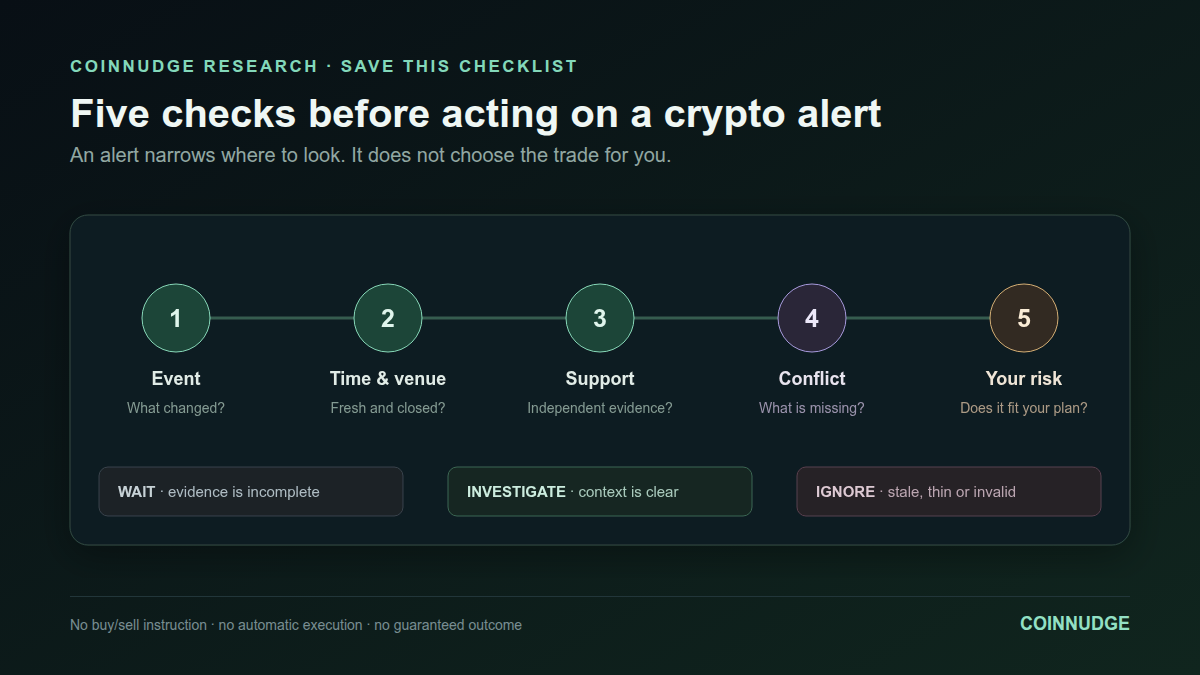
Use a crypto alert as a prompt to investigate, not an order to trade. A practical five-step process is: identify what changed; verify the venue, timeframe and event time; separate the trigger from supporting evidence; keep conflicts and missing data visible; then decide whether the setup fits your own risk plan. As of September 7, 2026, CoinNudge messages are designed around those layers and display time in the user's selected timezone. They can narrow where to look, but they cannot choose an entry, position size, stop or acceptable loss for the user, and they do not guarantee the next price move.
Preview alert list · Explore research data · See alert plans
Key points
- Confirm the coin, venue, event time, timeframe and closed-data status before interpreting direction
- Separate the trigger from confirmation: price or an indicator can trigger while volume, trend, flow or leverage evidence disagrees
- Treat missing data as missing, not neutral or supportive
- A useful alert narrows where to look; position size, entry, exit and risk remain the user's responsibility
How do you start using CoinNudge alerts?
Start in three steps: choose Free or Pro and confirm the monitored scope; connect your private chat with CoinNudge Alerts Bot; then select notification language, timezone and—on Pro—up to 10 personal spot coins. Telegram delivery works after the connection is confirmed, so the website does not need to remain open.
| Step | Action | Result |
|---|---|---|
| 1 | Review the complete alert list and choose Free or Pro | You know which categories and coins are monitored before paying |
| 2 | Open CoinNudge Alerts Bot from My alerts and complete the private-chat connection | The bot can associate eligible alerts with your account |
| 3 | Set notification language, timezone and optional personal coins | Messages use your local time and chosen delivery language |
What should you do when a crypto alert arrives?
A repeatable response is more useful than reacting to the color of a notification. CoinNudge messages are organized so that the same five questions can be asked every time.
| Step | Question | What to check | Reason |
|---|---|---|---|
| 1 | What changed? | Coin, venue, alert category, direction and exact trigger | Prevents a label such as bullish from replacing the underlying fact |
| 2 | When and where? | Local event time, data age, timeframe and source venue | A fresh 15-minute Binance event is not the same as a delayed whole-market claim |
| 3 | What confirms it? | Volume, ADX/DMI, ATR, VWAP, 1h/4h trend, spot flow, OI, funding or liquidation context | Shows whether participation and market structure support the trigger |
| 4 | What conflicts or is missing? | Opposing higher timeframe, weak trend, stale source or unavailable evidence | Stops uncertainty from being silently converted into confidence |
| 5 | Does it fit my plan? | Liquidity, spread, volatility, entry logic, invalidation, position size and maximum loss | The alert cannot know the user's finances or risk tolerance |
Verify: CoinNudge methodology · Complete Telegram alert list
How do you separate a trigger from confirmation?
The trigger answers only why the alert exists. A closed 15-minute MACD crossover, a five-minute price move or an extreme funding observation can each trigger a rule. Confirmation answers a different question: does other available evidence make the observation more meaningful?
Do not count closely related calculations as independent proof. MACD and EMA both derive from price and can turn together. Stronger context comes from different evidence families such as participation, trend strength, volatility regime, executed-order flow and leverage positioning.
- Trigger: the exact rule that changed state.
- Support: independent evidence aligned with the trigger.
- Conflict: available evidence pointing the other way.
- Missing: evidence that was unavailable, stale or not applicable.
- Risk note: the reason the event still does not predict the next move.
What should each field in a Telegram alert tell you?
The example below is illustrative, not a live or historical signal: ‘SOL · Binance Spot · bullish MACD cross · 15m candle closed 14:45 local time. Support: ADX 24, +DI aligned, volume 1.8×, price 0.6% above UTC-day VWAP, 1h/4h trends aligned. Conflict: none detected. Missing: Coinbase confirmation not applicable to SOL. Next: verify current spread and whether price still holds above VWAP. Risk: a confirmed trigger does not guarantee continuation.’
| Message field | What it answers | Example interpretation |
|---|---|---|
| Event | Why was the rule created? | A bullish MACD crossover closed on 15 minutes |
| Source and closed timeframe | Which venue and completed data produced it? | Binance Spot; no unfinished candle is treated as final |
| Support | Which independent evidence aligns? | Trend strength, DMI direction, participation, VWAP and higher timeframes |
| Conflict | Which available evidence points the other way? | None detected in the illustrative inputs; this is not certainty |
| Missing | Which expected evidence is unavailable or not applicable? | Coinbase confirmation only covers BTC and ETH, so it is not applicable to SOL |
| Next verification | What should be checked now? | Current spread, liquidity and whether the observed structure remains intact |
| Risk boundary | What can the alert not decide? | Continuation, entry, position size, stop and acceptable loss |
When should you wait, investigate or ignore an alert?
| Response | Use it when | What it does not mean |
|---|---|---|
| Wait | The trigger is valid but volume, trend alignment or data completeness is weak | Wait is not a delayed buy or sell instruction |
| Investigate | Event time, venue, liquidity and multiple independent evidence families are clear | Investigation is not automatic permission to enter |
| Ignore | The alert is stale, the market is too thin, spread is unacceptable or a critical source is missing | Ignoring one event does not predict the opposite direction |
How should you read a technical indicator alert?
Start with the closed timeframe. RSI entering an extreme zone shows unusual momentum; it does not prove reversal. A MACD or EMA crossover shows a change in price-derived momentum; low ADX can make repeated crosses less useful. A Bollinger close outside a band shows expansion beyond a recent envelope; ATR and volume help show whether volatility and participation expanded with it.
Then compare the 15-minute event with closed 1-hour and 4-hour context. Agreement is useful evidence. Disagreement is not an error: it may show that a short-term move is fighting a larger trend.
How should you read price and volume alerts?
A rapid price move tells you that repricing has already happened over the measured window. It does not tell you whether entering after the alert offers a favorable price. Check whether quote volume expanded, whether the pair is sufficiently liquid, whether the move is broad or isolated, and how far price has moved from VWAP.
A relative volume spike compares the latest completed window with that market's own recent baseline. It is not proof of deposits, withdrawals or new capital entering the entire crypto market.
For Binance Spot candle data, CoinNudge reads taker-buy quote volume directly. Derived active-sell quote volume equals total quote volume minus taker-buy quote volume; executed-order imbalance equals taker-buy quote volume minus derived active-sell quote volume. These venue-specific executed amounts are not wallet deposits, withdrawals or whole-market capital flow.
Verify: Binance Spot market-data documentation · CoinNudge methodology
How should you read funding, open-interest and liquidation alerts?
Funding shows the payment pressure between long and short positions on a perpetual venue. Open interest shows the amount of open contracts, but a change alone does not reveal which side is dominant. Liquidations show forced closures that have already occurred on the observed venue.
Read them together with price. Rising price and rising OI can reflect new leveraged participation; strongly positive funding can also show increasing long-side crowding. Falling OI during a sharp move can reflect positions closing or being forced out. These interpretations remain conditional and venue-specific.
| Observed combination | Reasonable interpretation | Do not conclude |
|---|---|---|
| Price up, OI up, positive funding stretched | New leveraged participation with possible long crowding | Price must reverse now |
| Price down, OI up, negative funding stretched | New short participation with possible short crowding | A short squeeze is guaranteed |
| Price moves sharply, OI falls, liquidations expand | Positions are being closed and leverage may be leaving | The move is finished |
| Spot active buying aligns while leverage is not extreme | The move has spot participation and less obvious crowding | The asset is safe to buy |
Verify: Hyperliquid Info endpoint · OKX liquidation-orders channel · CoinNudge methodology
How should you use a new-listing alert?
Verify the exchange, market type and official source. A spot listing, futures contract, new pair, pre-market event and launch program are not interchangeable. Check whether the announcement contains an explicit opening time and whether the status is announced, opening soon or already open.
A listing can be delayed or cancelled, and a new market can have wide spreads and thin depth. The event explains availability; it does not prove token legitimacy or future price appreciation.
Verify: Binance official announcements · MEXC official announcements · CoinNudge methodology
What does a good alert interpretation look like?
Illustrative example—not a live signal: suppose a 15-minute bullish MACD crossover closes while ADX is 16, volume is normal and the 4-hour trend remains down. The trigger is real, but the evidence is weak and conflicted. A useful message should say that instead of converting the crossover into a strong buy call.
Second illustrative example: suppose price rises quickly, quote volume is unusually high, price is above UTC-day VWAP, spot active buying aligns, OI rises and funding is already strongly positive. Participation supports the move, while leverage crowding raises reversal and liquidation risk. Both facts belong in the same message.
How do you avoid crypto alert fatigue?
More notifications do not automatically create more useful information. Repeated low-quality events can train a user to ignore everything. Prefer state changes, closed-data confirmation, meaningful thresholds, cooldowns and grouped evidence over a separate message for every metric update.
CoinNudge applies same-direction cooldowns, groups related same-coin events when appropriate and filters stale or incomplete observations from private Telegram delivery. Users can pause Telegram delivery, but they should also review whether the monitored coins and alert categories still match their actual decisions.
What can a crypto alert never decide for you?
An alert does not know the user's income, open positions, leverage, tax situation, legal restrictions or maximum acceptable loss. It cannot decide position size, whether the spread is acceptable at execution time, or whether a trade belongs in a personal plan.
CoinNudge reports market observations and explicitly avoids guaranteed returns, success-rate theatre and automatic execution. The CFTC warns users to be skeptical of AI and bot promotions that promise unusually large or guaranteed returns.
Verify: CFTC customer advisory · CoinNudge methodology
How do I turn my alert journal into a repeatable research question?
Record what you knew when the message arrived, what you decided and what later happened as separate fields. This lets you distinguish the alert's information from your execution and from hindsight.
A personal journal is not a representative market dataset. Public Market Events rows do not disclose private messages, account identities or your fills.
- Save the message time, venue, coin, condition and any stale or conflicting context.
- Define a fixed review window before looking at outcomes and include ignored alerts in the journal.
- Compare similar observations rather than selecting only messages followed by large price moves.
Verify: CoinNudge signal methodology · CoinNudge technical indicator alert guide
Take the next step with this evidence.
Reading about how to use crypto trading alerts safely: a five-step checklist? Choose ongoing notifications or a dataset you can inspect in your own research workflow.
Receive qualifying events in Telegram.
Use the ready-made alert checklist, message explanations and daily briefing. Check the supported categories and coins before subscribing; every Research page is not a separate alert category.
Check the alert list · View alert plans
Inspect the data before choosing a plan.
Market Events v1 connects recorded events and comparison rows with context, later outcomes and quality flags. Paid access provides customer API keys and daily JSON, CSV and Parquet files.
Check Market Events sample · Explore the full data catalog · Compare data plans
Researcher and Research Desk currently include Market Events v1 only, for its specified pairs and published history. This page's full dataset is not automatically included. Other data families require coverage, date, field and source-use confirmation before purchase. Telegram Pro and data access are separate subscriptions.
Frequently asked questions
Should I trade immediately when a crypto alert arrives?
No. First verify the event time, venue, liquidity, supporting evidence, conflicts and how the setup fits your own risk plan.
What does 'data missing' mean in an alert?
It means a source was unavailable, stale, insufficient or not applicable. Missing evidence is not bullish, bearish or neutral confirmation.
Why can two indicators disagree?
They measure different transformations and time windows. Disagreement can reveal a transition or a weak setup and should be retained rather than hidden.
Is active buying the same as money flowing into an exchange?
No. CoinNudge's active buying and selling describe executed orders on the named spot venue. They are not deposits, withdrawals or total market capital flow.
Can CoinNudge manage my stop loss or position size?
No. CoinNudge does not connect trading keys, execute orders or provide personalized risk instructions.
Sources and verification
- CoinNudge signal methodologyExact rule, source, timeframe and missing-data boundaries
- CoinNudge technical indicator alert guideDetailed interpretation of RSI, MACD, EMA, Bollinger, ADX, ATR and VWAP
- Hyperliquid Info endpoint documentationPrimary documentation for venue-specific perpetual context
- OKX liquidation-orders channelPrimary documentation for observed forced-liquidation events
- Binance official announcementsPrimary exchange source for Binance listing-event verification
- MEXC official announcementsPrimary exchange source for listing-event verification
- CFTC advisory on AI and trading-bot claimsConsumer-risk context for guaranteed returns and automated-money claims
Turn the five-step workflow into a daily habit.
Inspect the Telegram examples first, then activate 30 days of Pro for $8.99 if the structured messages fit your process.
See plans and pay