Evidence guide · By CoinNudge Research · · Guide updated 2026-09-12 · 11 min read
Crypto technical indicator alerts: what the signals mean
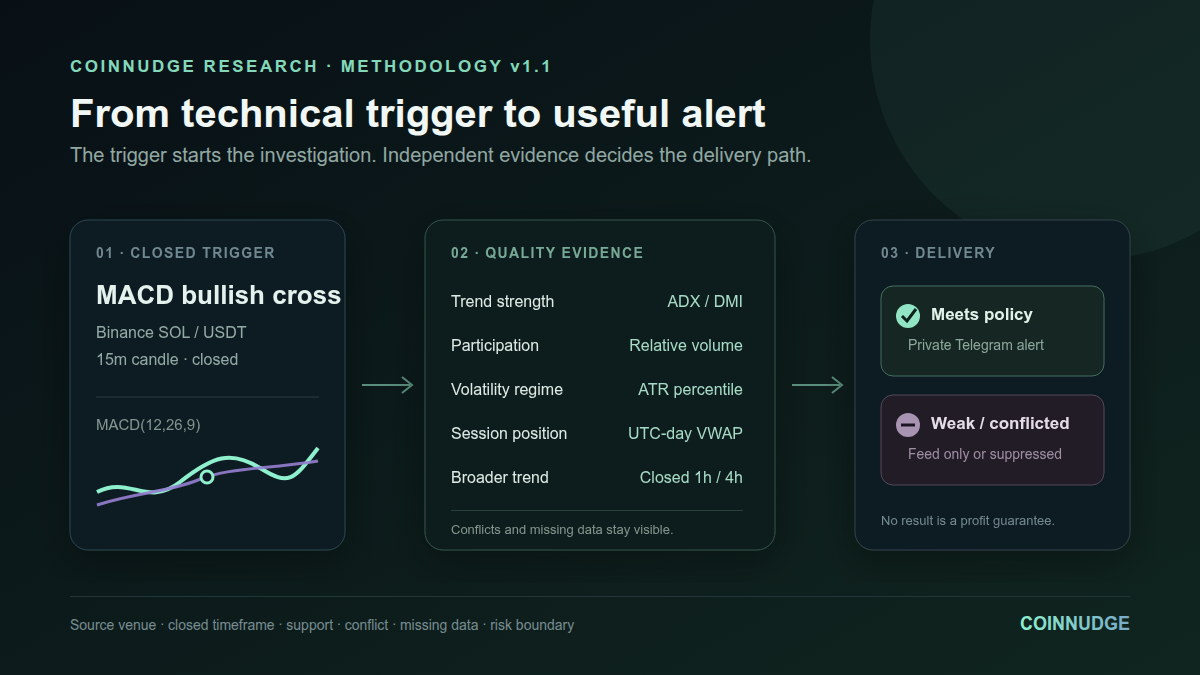
Crypto technical indicator alerts notify you when a defined market condition is confirmed; they do not predict the next candle. As of September 7, 2026, CoinNudge tracks four trigger families—RSI, MACD, EMA and Bollinger—on closed 15-minute candles, then adds closed 1-hour and 4-hour trend context. ADX/DMI, ATR, volume and UTC-day VWAP help judge signal quality. A useful alert names the coin, venue, timeframe, trigger, supporting evidence, conflicts and missing data. Even when several conditions align, the result remains a market observation rather than a guaranteed buy or sell instruction.
Preview alert list · Explore research data · See alert plans
Key points
- RSI, MACD, EMA and Bollinger events are observations, not guaranteed buy or sell instructions
- CoinNudge confirms technical triggers on a closed 15-minute candle and adds closed 1-hour and 4-hour context
- ADX/DMI, ATR percentile, volume and UTC-day VWAP help identify trend quality, volatility regime and weak breakouts
- Insufficient, stale or gapped data should suppress an alert instead of being presented as confirmation
What is a crypto technical indicator alert?
A technical indicator alert is a notification that a transparent rule has changed state. Examples include RSI entering an extreme zone, the MACD line crossing its signal line, EMA9 crossing EMA21, or a candle closing beyond a Bollinger band.
The alert is useful when it lets you investigate a change without keeping every chart open. It becomes misleading when a threshold is presented as proof that price must rise or fall. Indicators summarize past and current price or volume data; they cannot guarantee the next move.
Verify: CoinNudge methodology
Which four indicators trigger CoinNudge technical alerts?
CoinNudge uses four familiar trigger families so that every event can be explained in ordinary language. The platform manages the parameters; users do not need to build Pine scripts or configure separate rules for every monitored coin.
| Indicator | Bullish-side event | Bearish-side event | What it can support | What it cannot prove |
|---|---|---|---|---|
| RSI(14) | Enters 30 or below | Enters 70 or above | Momentum has reached an extreme relative to recent closes | An immediate reversal or a profitable entry |
| MACD(12,26,9) | MACD line closes above the signal line after being at or below it | MACD line closes below the signal line after being at or above it | Momentum direction has changed on the selected timeframe | That the new direction will persist |
| EMA9 / EMA21 | EMA9 closes above EMA21 | EMA9 closes below EMA21 | Shorter-term price weighting has crossed the longer-term weighting | A trend is strong or early |
| Bollinger(20, 2σ) | A candle closes above the upper band | A candle closes below the lower band | Price has moved outside its recent statistical envelope | A breakout will continue or immediately reverse |
Verify: TradingView technical-alert documentation · CoinNudge methodology
Why does closed-candle confirmation matter?
An unfinished candle can cross a threshold and move back before the interval ends. Treating that temporary move as final creates alerts that disappear when the candle closes. CoinNudge therefore evaluates the technical trigger using completed candles and requires two completed observations for crossover detection.
Technical alerts are timed from a closed 15-minute candle. Closed 1-hour and 4-hour candles provide broader trend context. This is slower than reacting to every tick, but it makes the event reproducible and reduces intrabar noise. CoinNudge is not designed for millisecond execution.
Verify: TradingView alert interval documentation · CoinNudge methodology
How do ADX, ATR and VWAP improve the alert context?
CoinNudge treats ADX/DMI, ATR and VWAP as quality context rather than three more standalone buy or sell signals. Their job is to explain whether the trigger occurred in a meaningful environment.
| Context measure | Question it answers | CoinNudge use | Important limitation |
|---|---|---|---|
| ADX(14) + DMI | Is a directional trend strong enough to take a crossover seriously? | ADX below 20 prevents a standalone MACD or EMA cross from being promoted to Telegram; +DI and -DI describe direction | High ADX measures trend strength, not whether price is rising |
| ATR(14) percentile | Is current candle movement unusually quiet or volatile? | ATR as a percentage of price is compared with the previous 96 closed candles and helps adapt movement thresholds | ATR measures movement size, not direction |
| UTC-day VWAP | Is price above or below the venue's volume-weighted session price? | The alert reports price position and distance from Binance UTC-day VWAP | It is not every trader's cost basis and it resets at 00:00 UTC |
| Relative quote volume | Did participation expand with the event? | The latest closed candle is compared with the previous 20 closed candles, excluding itself | Volume on one venue is not total-market capital inflow |
Verify: CoinNudge methodology · Binance Spot market-data documentation
Which prices and formulas make the calculations reproducible?
The technical trigger uses Binance USDT Spot closed prices for the named symbol. RSI(14) uses Wilder smoothing of closed-price gains and losses. EMA9 and EMA21 use standard exponentially weighted closed-price series; MACD is EMA12 minus EMA26, with an EMA9 signal line. Bollinger(20, 2σ) uses the 20 closed prices and population standard deviation.
ATR(14) follows true range, is divided by closed price, and is ranked against the previous 96 closed 15-minute candles, excluding the current observation. UTC-day VWAP is cumulative Binance quote volume divided by cumulative base volume from 00:00 UTC through the latest closed interval. Coinbase USD data is separate BTC/ETH confirmation and never replaces the Binance USDT trigger input.
Verify: Binance Spot kline fields · CoinNudge methodology v1.1
What does multi-timeframe context add?
A 15-minute bullish crossover can occur while the 4-hour market remains weak. Conversely, a short-term bearish event can be a small pullback inside a stronger higher-timeframe advance. A useful notification should preserve that disagreement rather than turning every trigger into a single green or red verdict.
CoinNudge shows the trigger timeframe separately from the closed 1-hour and 4-hour trend context. Alignment strengthens the observation; conflict lowers its quality and tells the user what still needs confirmation. Different timeframes are context, not independent votes that can be added into a guaranteed score.
When are technical indicator alerts most likely to mislead?
False or low-value alerts are common when price is range-bound, liquidity is thin, a candle is unfinished, the move lacks participation, or several indicators are mathematical variations of the same price series. MACD and EMA, for example, are related trend calculations and should not be counted as two independent confirmations.
- RSI can stay overbought or oversold during a strong trend.
- MACD and EMA can repeatedly cross during a low-ADX range.
- A Bollinger close outside the band can continue, reverse or reflect a temporary volatility shock.
- A volume spike on an illiquid pair can be large relative to its own weak baseline but still hard to trade.
- Missing or stale higher-timeframe data should be labeled or filtered, never silently treated as support.
Does every technical trigger become a Telegram alert?
No. CoinNudge can retain a valid rule event in the website feed while keeping a standalone or low-information observation out of private Telegram. The delivery policy asks whether the event is strong enough, independently confirmed or part of a more useful same-window group.
These are current delivery rules, not performance claims. They can be revised when monitored quality evidence justifies a change; the methodology and this guide must be updated together.
| Technical event | Standalone Telegram requirement | Other path to delivery |
|---|---|---|
| RSI extreme | RSI reaches 25 or below, or 75 or above | A same-window price, material-volume or spot-flow event provides independent confirmation |
| MACD or EMA crossover | Closed 1h/4h context aligns, ADX is at least 20, DMI is not countertrend, relative volume is at least 1.5× and the candle moves at least 0.25% | An independent same-window price, material-volume or spot-flow event confirms the technical family |
| Bollinger breakout | Materiality changes with ATR regime and countertrend risk; normal context requires at least 3× relative volume and a 1% candle move | Stricter requirements apply in countertrend or already-extreme volatility; a quiet regime can qualify with a smaller move |
| Related technical events | MACD and EMA are not counted as two independent votes | Related same-coin, same-window observations may be grouped into one message with conflicts retained |
Verify: CoinNudge methodology · Complete Telegram alert list
What should a technical alert message contain?
A user should not have to decode a mechanical line such as ‘RSI oversold.’ CoinNudge structures a deliverable message around the event and its evidence.
- What changed: coin, venue, trigger, direction and closed timeframe.
- When it happened: event time in the user's selected timezone.
- What confirms it: volume, trend strength, volatility regime, VWAP and higher-timeframe alignment when available.
- What conflicts: opposing trend or flow evidence that lowers conviction.
- Why it matters: a plain-language explanation of the market state.
- What to verify next: the evidence that has not yet appeared.
- Risk boundary: the condition is not a prediction or personalized trade instruction.
How do the current Telegram promotion rules behave in two examples?
Illustrative example A—not a historical or live trade: a bullish MACD crossover closes on 15 minutes, but ADX is 16, relative volume is 0.9× and the closed 4-hour trend points down. The crossover is a valid feed event, yet it does not meet the current standalone Telegram requirement. The message is suppressed unless independent same-window evidence changes the case.
Illustrative example B—not a performance claim: a bullish 15-minute MACD crossover closes with ADX at or above 20, +DI aligned, relative volume at or above 1.5×, candle change at or above +0.25%, and closed 1-hour and 4-hour trends aligned. That combination meets the current standalone Telegram promotion rule. It still reports an observed setup, not a guaranteed entry or return.
What does the first 48-hour operational quality snapshot show?
Snapshot captured September 7, 2026 at 15:26 UTC for the preceding 48 hours. The system recorded 1,346 signal rows: 714 public-feed rows and 632 private-scope rows. These are processing records, not unique trades, users or profitable outcomes. Evidence status was confirmed for 1,183 rows, mixed for 14, insufficient for 10 and not classified for 139.
For 1,331 applicable records, source-event-to-record latency was 31.1 seconds at the median and 64.8 seconds at the 95th percentile. The delivery queue recorded 340 sent, 2 expired, 0 failed and 293 cancelled records, with no current backlog at capture time. Cancelled records include delivery-policy suppression and must not be read as failed notifications. This early snapshot measures pipeline behavior, not signal accuracy or investment performance; a seven-day series is not yet available.
Who are preconfigured technical alerts for?
They are most useful for self-directed traders who understand that an alert starts an investigation and who prefer a maintained checklist over building separate rules for every symbol. They are not designed for someone who needs arbitrary custom code, a full charting workstation, backtesting, automated execution or personalized entries and exits.
CoinNudge Pro monitors its maintained default basket plus up to 10 personal coins and delivers eligible events to a private Telegram chat. The public Market radar can inspect a broader directory, but that should not be confused with continuous private alert coverage.
How can I evaluate an indicator alert without counting every trigger as a trade?
Keep an event log and a separate decision log. A recorded RSI, MACD, EMA or Bollinger event describes a rule condition; an execution requires its own entry time, fill, fees and exit rule.
Market Events v1 contains published event and comparison rows for its specified pairs; it does not provide a complete continuous indicator history or a verified strategy return.
- Group recorded events by indicator, direction and timeframe before comparing forward windows.
- Retain non-event comparison observations and missing outcomes. Count overlapping windows separately when reporting the effective sample size.
- Use the Market Events sample to inspect field definitions and availability times before designing a study.
Verify: CoinNudge signal methodology · Binance Spot API market-data documentation
Take the next step with this evidence.
Reading about crypto technical indicator alerts: what the signals mean? Choose ongoing notifications or a dataset you can inspect in your own research workflow.
Receive qualifying events in Telegram.
Use the ready-made alert checklist, message explanations and daily briefing. Check the supported categories and coins before subscribing; every Research page is not a separate alert category.
Check the alert list · View alert plans
Inspect the data before choosing a plan.
Market Events v1 connects recorded events and comparison rows with context, later outcomes and quality flags. Paid access provides customer API keys and daily JSON, CSV and Parquet files.
Check Market Events sample · Explore the full data catalog · Compare data plans
Researcher and Research Desk currently include Market Events v1 only, for its specified pairs and published history. This page's full dataset is not automatically included. Other data families require coverage, date, field and source-use confirmation before purchase. Telegram Pro and data access are separate subscriptions.
Frequently asked questions
Are crypto technical indicator alerts buy and sell signals?
They report bullish-side or bearish-side indicator events, but they are not instructions or guarantees. Price structure, liquidity, trend strength, volatility and the user's own risk plan still matter.
Why does CoinNudge use a 15-minute trigger?
It offers a practical balance between timeliness and noise for the current product. CoinNudge also adds closed 1-hour and 4-hour context instead of treating the 15-minute event in isolation.
Can I change the RSI or MACD parameters?
No. CoinNudge is a preconfigured alert service. Managed parameters make messages consistent and reduce setup work. Users who need arbitrary parameters or custom scripts may be better served by a charting platform.
Does ADX tell me whether price will go up?
No. ADX describes trend strength. DMI provides directional context, and neither guarantees continuation.
Do I need an exchange API key?
No. CoinNudge evaluates read-only public market data and does not request exchange trading credentials or execute orders.
Sources and verification
- CoinNudge signal methodologyProduct rules, data sources, closed-candle handling and limitations
- Binance Spot API market-data documentationPrimary venue documentation for spot candlesticks and market data
- TradingView technical alerts documentationIndependent product documentation showing indicator, strategy, drawing and pattern alert capabilities
- CFTC advisory on AI and trading-bot claimsConsumer-risk context for guaranteed returns and unverifiable win-rate claims
Put the technical alert framework to work.
Preview the service, compare Free and Pro, then activate 30 days of CoinNudge Pro for $8.99 with no automatic renewal.
See plans and pay