Single-coin evidence report · By CoinNudge Research · · Guide updated 2026-10-03 · 20 min read
What is SuperRare (RARE) coin, and is it worth holding?
SuperRare RARE coin supports marketplace curation and DAO governance; treasury fee receipts are not an automatic dividend to every holder. Holding RARE needs a documented link between recurring art-market use and the specific holder benefit being claimed. The frozen 90-day path ending September 26, 2026 gained +33.9%, below BTC +40.1%; 8/56 historical 90-day month-start paths beat BTC, and all had deeper daily-open drawdowns. These overlapping observations are descriptive, not future odds.
See the research evidence · Check market context
Quick answer: RARE coin in three checks
- SuperRare RARE coin supports marketplace curation and DAO governance; treasury fee receipts are not an automatic dividend to every holder. Holding RARE needs a documented link between recurring art-market use and the specific holder benefit being claimed. The frozen 90-day path ending September 26, 2026 gained +33.9%, below BTC +40.1%; 8/56 historical 90-day month-start paths beat BTC, and all had deeper daily-open drawdowns. These overlapping observations are descriptive, not future odds.
- Coverage is 1812 daily asset opens, with 56 complete historical 90-day month-starts. Overlapping starts are dependent.
- The unresolved value-capture question is: Does marketplace activity and DAO governance translate into measurable value for a passive RARE holder?
What is SuperRare RARE coin, and what can its holders govern?
RARE is a curation and DAO-governance token around the SuperRare art marketplace. Marketplace fees can reach a community treasury; that is not the same as an automatic cash distribution to each RARE holder. The question for a prospective holder is: Does marketplace activity and DAO governance translate into measurable value for a passive RARE holder? This report separates issuer rules, third-party supply estimates and 1812 observed spot daily opens rather than treating a price chart as proof of product adoption.
The issuer documentation supports the project description, but tokenholders, users, operators and treasury beneficiaries can be different parties. The table distinguishes what can be checked at this release from what would still need operating evidence. Use the rights and supply sections to define the holding thesis, then the BTC-matched paths to assess opportunity cost; neither layer substitutes for the other.
| RARE research question | Current evidence | Boundary |
|---|---|---|
| What is the asset? | RARE is a curation and DAO-governance token around the SuperRare art marketplace. Marketplace fees can reach a community treasury; that is not the same as an automatic cash distribution to each RARE holder. | Issuer description, not holder income |
| Price evidence | 1,812 daily opens; 2021-10-11–2026-09-26 | Retrospective spot data |
| 90-day comparison | +33.9% versus BTC +40.1% | One ending-date path |
| Verified project-to-token cash flow | Not independently established | No dividend inferred |
Verify: SuperRare official RARE FAQ · SuperRare official fee policy · SuperRare public API documentation
Where do SuperRare marketplace fees go—and who receives them?
SuperRare’s published policy sends the 3% buyer marketplace fee to the DAO treasury, not straight to every RARE wallet. Its official help center identifies governance and curation uses, with separate primary- and secondary-sale distribution rules. Treasury governance is not the same as an automatic proportional cash dividend.
The critical bridge would show completed NFT sales, exact fee receipts, treasury balances and spending, active voting power and any RARE lock or reward program over the same periods. A headline increase in NFT prices can occur without RARE participation, and a DAO treasury may deploy fees rather than distribute them.
The participant comparison below distinguishes actual DAO or curation activity from passive ownership; eligibility for a specific reward still requires that program’s current terms.
| Participant | Relevant right or activity | Do not infer |
|---|---|---|
| Product user | RARE supports curation and DAO governance. Marketplace fees accrue to the DAO treasury under official rules, not automatically as a cash payment to each passive RARE holder. | Every user must hold the token |
| Passive token holder | RARE governance rights are not corporate equity or a contractual NFT-sales dividend. | Equity or automatic fee income |
| Operator, miner or DAO participant | Depends on this project’s participation rules | Same economics as simply buying the spot token |
Verify: SuperRare official RARE FAQ · SuperRare official fee policy · SuperRare public API documentation
What does one billion RARE supply mean for float and dilution?
SuperRare official materials describe one billion RARE total. CoinGecko’s snapshot estimates the circulating portion. Those are different categories: total supply is not the amount available for sale today, and a treasury transfer can change liquid float without changing the one-billion cap.
Before treating scarcity as a thesis, check treasury and team allocations, actual wallet movements and the rules for rewards or voting. This release has no full historical treasury-flow reconstruction; the right conclusion is an identified research gap, not a made-up fee yield.
CoinGecko’s 2026-09-27T03:57:30.000Z snapshot estimates 820,475,028 circulating RARE, 1,000,000,000 total and 1,000,000,000 maximum units. These are provider estimates, not a verified holder ledger. In particular, the gap between total and circulating units is not a dated unlock schedule.
| RARE supply field | Frozen estimate or official rule | Correct reading |
|---|---|---|
| Official distribution | Official SuperRare materials describe one billion RARE total and allocations; provider circulating supply is a dated estimate, not a sale or unlock event. | Issuer mechanism; check actual transfers |
| Circulating | 820,475,028 | Provider estimate, not spendable-float audit |
| Total / maximum | 1,000,000,000 / 1,000,000,000 | Neither is a forecast of tomorrow’s sell pressure |
| Market cap / FDV | $15,960,549 / $19,452,815 | Valuation measures, not realized project revenue |
Verify: Frozen provider supply response · SuperRare official RARE FAQ · SuperRare official fee policy · SuperRare public API documentation
How would NFT sales and DAO treasury flows test the RARE thesis?
Completed art sales, reconciled DAO treasury receipts and actual RARE participation were not independently verified as a continuous aligned series in this release. A marketplace-fee rule does not fill that empirical gap. The explicit null operating_observation and token_capture_observation mean not verified, never zero activity.
For a follow-up release, request 1) Weekly completed NFT sale volume and fee receipts by contract; 2) DAO treasury balance and spending changes, reconciled against sales; 3) Active curator participation and RARE locked/staked by week. Align their observation dates to supply and prices before testing whether use and token demand move together.
Art-market curation depends on artists, collectors, curators and governance participants. A genuine community metric would measure repeat marketplace participants and substantive DAO votes, not merely posts about NFT momentum. The official RARE FAQ warns about imitation tokens and impersonating community accounts.
| Evidence test | What this release has | What it can and cannot show |
|---|---|---|
| Marketplace fee rule | Official 3% buyer-side fee to DAO treasury | Rule is not measured weekly receipts |
| Completed NFT sales and fees | No complete weekly series frozen here | Would measure operating activity |
| RARE holder distributions | No ordinary holder cash dividend established | DAO assets are not automatically individual income |
Verify: Source-status record · SuperRare official RARE FAQ · SuperRare official fee policy · SuperRare public API documentation
Did RARE’s latest rebound beat BTC over 90 days?
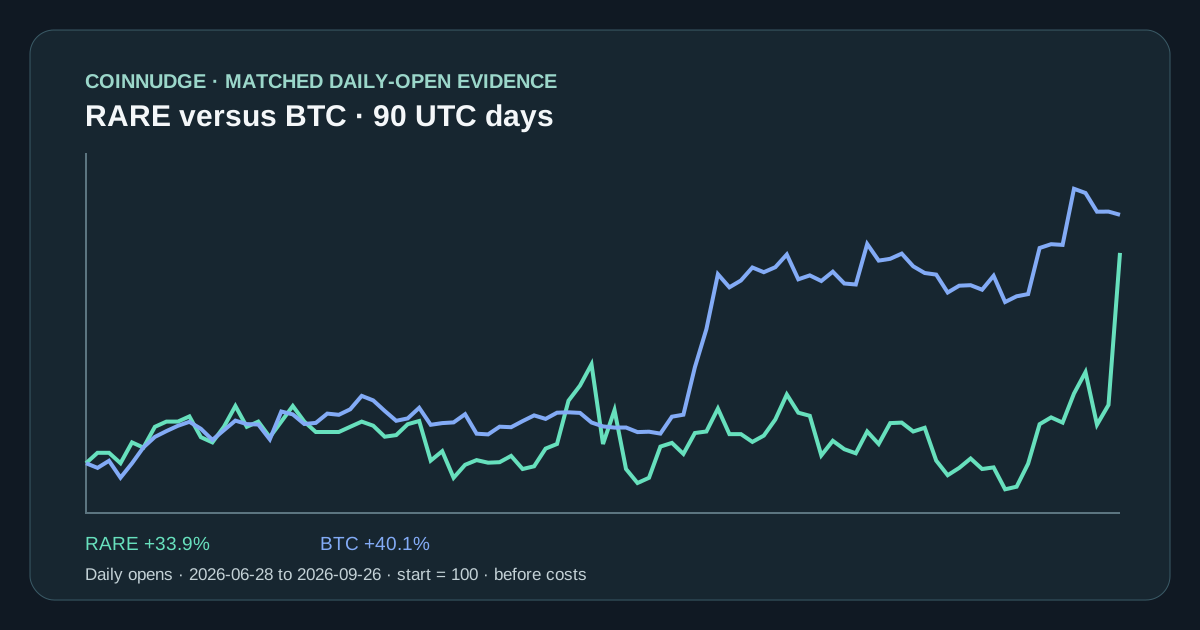
RARE gained +33.9% in the frozen 90-day path ending September 26, 2026, but did not beat BTC’s +40.1%. The 7-, 14- and 30-day rows did show relative strength; changing the horizon changes the answer. Neither the rebound nor the longer-period underperformance independently measures NFT sales or DAO fee receipts. The matched windows below show how much the answer changes with entry horizon, while the chart compares normalized values from the same UTC start. Both RARE/USDT and BTC/USDT come from CoinNudge’s local Binance spot archive, which may contain retrospective backfills.
A spot return excludes fees, spread, slippage, taxes and any financing cost. Drawdown uses daily opens and therefore can miss worse intraday prices. A price increase cannot independently establish that token economics improved.
| Matched UTC holding window | RARE return | BTC return | RARE − BTC | Path drawdown |
|---|---|---|---|---|
| 7 days · 2026-09-19–2026-09-26 | +26.0% | +4.0% | +22.0 pp | −7.4% |
| 14 days · 2026-09-12–2026-09-26 | +35.0% | +8.9% | +26.1 pp | −7.4% |
| 30 days · 2026-08-27–2026-09-26 | +25.1% | +6.4% | +18.7 pp | −13.8% |
| 60 days · 2026-07-28–2026-09-26 | +33.4% | +31.9% | +1.5 pp | −17.4% |
| 90 days · 2026-06-28–2026-09-26 | +33.9% | +40.1% | −6.1 pp | −17.4% |
| 180 days · 2026-03-30–2026-09-26 | +14.7% | +27.4% | −12.7 pp | −52.3% |
| 365 days · 2025-09-26–2026-09-26 | −67.3% | −22.8% | −44.5 pp | −78.2% |
Verify: All asset daily inputs
Did 56 historical RARE starts support holding it instead of BTC?
The main hypothesis was that RARE would beat BTC over prespecified 90-day month-start holding periods. The observed main result was 8/56 BTC-beating paths, median RARE return −21.9% versus median BTC +1.1%, and 56/56 with a deeper asset drawdown. A BTC-beating count is not a buy probability, because starts overlap and the studied coin was selected as a currently interesting asset.
The sample is one symbol, not all available coins: 1812 RARE daily opens from 2021-10-11 to 2026-09-26. We predeclared first-of-month 30/90-day and Monday 14-day entry dates, require complete same-UTC asset and BTC paths, and keep excluded candidates in a separate ledger. Both RARE/USDT and BTC/USDT come from CoinNudge’s local Binance spot archive, which may contain retrospective backfills.
The 56 month-start windows overlap and should not be treated as 56 independent trades. Taking every third eligible start leaves 19 paths, of which 3 beat BTC; its median RARE return was −19.0%. This is a dependence sensitivity, not a significance test.
| Prespecified holding sample | Complete / candidate | RARE median | Beat BTC | Deeper drawdown | Status |
|---|---|---|---|---|---|
| Monthly 90 days | 56/56 | −21.9% | 8/56 | 56/56 | Descriptive; overlapping |
| Monthly 30 days | 58/58 | −9.7% | 16/58 | 57/58 | Descriptive; overlapping |
| Monday 14 days | 257/257 | −2.4% | 79/257 | 238/257 | Descriptive; overlapping |
Verify: Full research JSON · All candidate outcomes
Was RARE resilient when BTC had just fallen?
RARE’s median 90-day return was negative in both prior-BTC states: −19.6% across 29 starts after BTC strength and −22.4% across 27 after weakness. Each group had only four BTC-beating paths. This split does not support treating RARE as a reliable shelter after a weak Bitcoin month. BTC state means its 30-day return before entry, not whether BTC fell during the later holding window; this is not a simultaneous sell-off hedge test.
Before each hypothetical entry, BTC’s preceding 30-day daily-open return classifies the market as up or down. The classification uses only information available before that entry, not the later BTC outcome. The table tests whether RARE’s relationship with BTC is stable across prior environments.
Even a large subgroup is only descriptive: there is one asset, one exchange pair and correlated market periods. If a subgroup is below 20 observations, treat its ratio as exploratory. We do not present a small split as evidence of a predictive trading signal.
| Pre-entry BTC state | 90-day starts | RARE median | Beat BTC |
|---|---|---|---|
| Prior BTC 30d up | 29 | −19.6% | 4/29 |
| Prior BTC 30d down | 27 | −22.4% | 4/27 |
| Prior BTC state unavailable | 0 | — | 0/0 |
Verify: Full observation ledger
Can a strong RARE rebound outweigh the broader holding record?
A RARE rebound can be real without overturning the full cohort’s weak BTC-relative result. The weakest BTC-relative 90-day start was 2024-09-01: RARE −21.4% versus BTC +65.3%, with −44.2% daily-open path drawdown. The strongest counterexample was 2023-11-01: RARE +85.9% versus BTC +25.0%. These were selected after calculation to illustrate both tails, never to define a trading rule.
The table shows 12 most recent eligible 90-day starts out of 56; 44 older starts remain in the public CSV. Dates are UTC, endpoints use opening prices, and the drawdown column describes the loss a holder might have seen before the endpoint. A positive final return could still have been difficult to hold through.
The current 90-day result and the historical cohort answer different questions. A short rally may be real while the base rate of earlier starts is weak. The risk check is to ask what would invalidate the issuer’s token mechanism and whether the present price can be executed at the intended size.
| UTC start | UTC end | RARE return | BTC return | RARE − BTC | Path drawdown |
|---|---|---|---|---|---|
| 2025-07-01 | 2025-09-29 | −1.4% | +4.7% | −6.0 pp | −27.5% |
| 2025-08-01 | 2025-10-30 | −31.7% | −5.0% | −26.7 pp | −50.2% |
| 2025-09-01 | 2025-11-30 | −51.6% | −16.1% | −35.5 pp | −59.1% |
| 2025-10-01 | 2025-12-30 | −57.8% | −23.5% | −34.3 pp | −62.7% |
| 2025-11-01 | 2026-01-30 | −27.5% | −22.8% | −4.8 pp | −43.1% |
| 2025-12-01 | 2026-03-01 | −34.5% | −25.9% | −8.6 pp | −43.0% |
| 2026-01-01 | 2026-04-01 | −33.3% | −22.1% | −11.2 pp | −52.6% |
| 2026-02-01 | 2026-05-02 | −18.5% | −0.6% | −17.8 pp | −34.1% |
| 2026-03-01 | 2026-05-30 | −3.6% | +9.7% | −13.3 pp | −36.8% |
| 2026-04-01 | 2026-06-30 | −14.8% | −11.8% | −3.0 pp | −50.2% |
| 2026-05-01 | 2026-07-30 | −32.8% | −16.2% | −16.6 pp | −37.2% |
| 2026-06-01 | 2026-08-30 | −22.4% | +6.2% | −28.5 pp | −30.2% |
Verify: All case rows
Why is RARE daily turnover not enough to size a trade?
Across 30 valid recent daily candles, median quoted daily RARE turnover on Binance Spot RAREUSDT was $298,839. This is traded amount accumulated over 24 hours, not bid-side depth at one instant. The higher the intended order relative to live depth, the less a historical daily-open return describes attainable performance.
No synchronized live spread or level-two depth is frozen for this release, so this report cannot quote a trustworthy $10,000 execution cost. Check a fresh order book, pair identity, fees and withdrawal route before interpreting the historical numbers as personally tradable.
For a proposed RARE order, compare its size with same-time asks for an entry and bids for an exit, calculate size-weighted prices plus your actual fees, and check the permitted withdrawal network. If depth is absent or the estimated exit loss exceeds your budget, reduce the size or wait; the historical turnover figure cannot pass that test for you.
| Execution input | Observed or missing | Action |
|---|---|---|
| 30-day median daily quote turnover | $298,839 | Context only; not executable depth |
| Spot venue | Binance Spot RAREUSDT | Check your actual trading venue |
| Live spread and ±1% depth | Not captured in release | Obtain a current order-book snapshot |
| Leverage, funding and liquidation | Not modelled | Do not apply spot outcomes to perps |
Verify: Venue candle inputs
When could holding RARE make sense beyond an NFT-sector rebound?
RARE is a governance-and-marketplace thesis, not a documented passive fee yield. A stronger holding case would require repeat art sales and reconciled treasury receipts plus a clearly specified holder benefit; an NFT-sector bounce without those records leaves the token-value bridge unproven.
Specify whether you are studying governance participation or passive price exposure. For the former, verify current participation rights; for the latter, do not assume DAO treasury income is yours. If the holder-benefit bridge remains missing, do not present a rebound as resolved token economics. Use a fresh executable quote and your own horizon and loss limit; none of the historical start frequencies is a future win probability.
| Decision gate | Evidence to request | Failure mode |
|---|---|---|
| Project activity | Weekly completed NFT sale volume and fee receipts by contract | Project story remains unmeasured |
| Token capture | Active curator participation and RARE locked/staked by week | Usage never reaches passive holder |
| Opportunity cost | 56 90-day starts versus BTC | One recent rally replaces full distribution |
| Supply | Official SuperRare materials describe one billion RARE total and allocations; provider circulating supply is a dated estimate, not a sale or unlock event. | Actual transfers or emissions overwhelm demand |
| Execution | Fresh spread and order-book depth | Historical price cannot be filled |
Verify: RARE frozen token-economics evidence · RARE BTC-matched holding paths
How can the RARE analysis be reproduced?
Reproduce the RARE price results from the public daily-input and observation files: verify the release manifest hashes, join asset and BTC opens on UTC dates, require a complete path, then recalculate returns and running-peak drawdown. A hash mismatch or a missing date means stop and resolve the input mismatch, not fill it with zero.
Calculation version single-coin-paired-paths-20260927-2.0; price endpoint 2026-09-26 UTC; asset coverage 2021-10-11–2026-09-26; source type local Binance archive, potentially retrospective backfill. Price returns are end daily open divided by start daily open minus one. BTC-relative results are percentage-point differences, and path drawdown is the worst normalized daily open versus the earlier running peak.
All dates, qualified observations, excluded candidate starts and exact inputs are available below. Both RARE/USDT and BTC/USDT come from CoinNudge’s local Binance spot archive, which may contain retrospective backfills. Historical backfills are not labelled as data originally observed by CoinNudge at those old event dates. The provider supply snapshot was retrieved on 2026-09-27T03:59:28.770Z; it is not a 2023 or 2025 point-in-time supply estimate.
The release manifest hashes frozen inputs and outputs. Operating-source review is a separate version with nulls for unverified activity and token capture. No p-value or out-of-sample trading edge is asserted; sample selection, overlapping windows, venue differences and survival of the selected token limit inference.
Editorial review: October 3, 2026. Definitions, result explanations and holding conditions were clarified; no historical experiment was rerun. Price evidence still ends September 26, 2026, and the separate supply/source review remains dated September 27. Recheck current issuer terms, transfers and order-book liquidity before using this historical report for a present decision.
| Public evidence file | Purpose | Availability |
|---|---|---|
| Research JSON | /research-data/hot-coin-profiles/2026-09-27-v2/rare.json | All summary and row-level results |
| Outcome CSV | /research-data/hot-coin-profiles/2026-09-27-v2/rare-observations.csv | Every qualifying historical start |
| Exclusion CSV | /research-data/hot-coin-profiles/2026-09-27-v2/rare-exclusions.csv | Missing or rejected candidates |
| Asset candle CSV | /research-data/hot-coin-profiles/2026-09-27-v2/rare-daily-inputs.csv | Unrounded price/turnover inputs |
| BTC candle CSV | /research-data/hot-coin-profiles/2026-09-27-v2/btc-daily-inputs.csv | Same-date comparator |
| Field dictionary | /research-data/hot-coin-profiles/2026-09-27-v2/field-dictionary.json | Formula and null semantics |
| Fundamental review | /research-data/coin-fundamentals/2026-09-27-v3/rare.json | Issuer rules and explicit evidence gaps |
| Manifest | /research-data/hot-coin-profiles/2026-09-27-v2/manifest.json | Frozen SHA-256 identities |
Verify: Frozen paired-price study · Full cohort observations · Asset daily spot inputs · Same-date BTC inputs · Excluded candidate ledger · Calculation dictionary · Frozen input manifest · Tokenomics and fundamental source review · Frozen CoinGecko supply snapshot · Binance official kline specification · SuperRare official RARE FAQ · SuperRare official fee policy · SuperRare public API documentation
Take the next step with this evidence.
Choose ongoing Telegram monitoring or inspect structured data in your own research workflow.
Receive qualifying events in Telegram.
Use the ready-made alert checklist, message explanations and daily briefing. Check the supported categories and coins before subscribing; every Research page is not a separate alert category.
Check the alert list · View alert plans
Inspect the data before choosing a pack.
Prepared research packs supply scoped features, separate outcomes where available and quality flags. Buy a fixed edition once and download directly; API use is optional.
Check data pack samples · Explore the full data catalog · Compare data plans
Each purchased pack includes its specified fields and published date range. This page's full dataset is not automatically included. Other data families require coverage, date, field and source-use confirmation before purchase. Telegram Pro is a separate 30-day service; historical packs are one-time purchases.
Frequently asked questions
What is RARE coin and what is it used for?
RARE is a curation and DAO-governance token around the SuperRare art marketplace. Marketplace fees can reach a community treasury; that is not the same as an automatic cash distribution to each RARE holder. That mechanism does not guarantee an investment return.
Is RARE coin worth buying or holding?
RARE is a governance-and-marketplace thesis, not a documented passive fee yield. A stronger holding case would require repeat art sales and reconciled treasury receipts plus a clearly specified holder benefit; an NFT-sector bounce without those records leaves the token-value bridge unproven. The overlapping historical cohort is descriptive; price evidence ends September 26, 2026, and current supply and executable liquidity must be checked separately.
How has RARE performed compared with Bitcoin?
In the 90-day same-UTC period ending September 26 2026, RARE returned +33.9% and BTC returned +40.1%. Across 56 eligible historical 90-day month-starts, 8 beat BTC.
How many historical RARE observations are in this study?
1,812 daily asset opens and 371 accepted holding-path rows across three horizons. Historical retrieval is retrospective, not original-date local observation.
Do SuperRare NFT fees go straight to RARE holders?
No. The published fee rule sends them to the DAO community treasury; passive tokenholders do not receive an automatic proportional payout.
What is RARE used for?
Official documentation describes curation, DAO governance and limited ecosystem participation; rights depend on current program terms.
Is a 90-day RARE rebound evidence of an NFT adoption cycle?
No. A price path is not an independent sales or treasury-flow series.
Can I download and reproduce the RARE result?
Yes. The complete JSON, observation CSV, daily inputs, exclusion ledger, field dictionary and SHA-256 release manifest are linked in the method section.
Sources and verification
- Frozen paired-price studyAll calculations, observations, hashes and inclusion counts
- Full cohort observationsEvery eligible 14/30/90-day start
- Asset daily spot inputsAll daily opens and quoted turnover
- Same-date BTC inputsBTC/USDT benchmark
- Excluded candidate ledgerMissing paired paths, if any
- Calculation dictionaryReturn and drawdown formulas
- Frozen input manifestSHA-256 for release files
- Tokenomics and fundamental source reviewIssuer claims and explicitly missing operating evidence
- Frozen CoinGecko supply snapshotProvider estimate and retrieval time
- Binance official kline specificationDaily candle field meanings
- SuperRare official RARE FAQOfficial issuer or protocol disclosure
- SuperRare official fee policyOfficial issuer or protocol disclosure
- SuperRare public API documentationOfficial issuer or protocol disclosure
Track RARE in the wider market context.
Use this report to frame the token-economics questions, then verify today’s liquidity and supply before acting.
Explore market alerts