Single-coin evidence report · By CoinNudge Research · · Guide updated 2026-10-03 · 20 min read
What is Quant (QNT) coin, and is it worth holding?
Quant (QNT) coin is a utility token associated with Overledger, not equity in Quant. Market evidence ends at the 2026-09-26 UTC daily open; supply and operating records have separate dates below. QNT’s dated 90-day spot return was +50.3% versus BTC +40.1%, but 18/58 complete historical monthly 90-day starts beat BTC and 53/58 had deeper daily-open drawdowns. The case to hold QNT depends on measurable token demand from Overledger, not enterprise adoption headlines alone. Quant documents a USD-or-QNT subscription choice, but no public monthly customer-to-QNT settlement series was found; enterprise adoption cannot yet be translated into verified net QNT demand.
See the research evidence · Check live market context
Quick answer: QNT coin in three checks
- Quant (QNT) coin is a utility token associated with Overledger, not equity in Quant. Market evidence ends at the 2026-09-26 UTC daily open; supply and operating records have separate dates below. QNT’s dated 90-day spot return was +50.3% versus BTC +40.1%, but 18/58 complete historical monthly 90-day starts beat BTC and 53/58 had deeper daily-open drawdowns. The case to hold QNT depends on measurable token demand from Overledger, not enterprise adoption headlines alone. Quant documents a USD-or-QNT subscription choice, but no public monthly customer-to-QNT settlement series was found; enterprise adoption cannot yet be translated into verified net QNT demand.
- Historical coverage: 1852 daily opens; 58 complete 90-day monthly starts. Monthly starts overlap and are descriptive, not a future win rate.
- Token-specific question: Does Overledger enterprise adoption necessarily create demand for QNT?
What does Quant Overledger do—and where does QNT actually enter?
Quant sells Overledger as cross-ledger infrastructure. QNT can be used to subscribe to the platform, but Quant also accepts USD. A business-customer announcement therefore does not by itself measure QNT bought or retained.
The investor question is: Does Overledger enterprise adoption necessarily create demand for QNT? This report tests what the token does, what it does not entitle a holder to, how supply can change and what actual dated spot paths showed. Price history is not used as proof that product use caused the move.
| QNT research check | Observed or documented answer | Evidence boundary |
|---|---|---|
| Token and project | Quant sells Overledger as cross-ledger infrastructure. QNT can be used to subscribe to the platform, but Quant also accepts USD. A business-customer announcement therefore does not by itself measure QNT bought or retained. | Business success and tokenholder benefit differ |
| Available local/venue daily opens | 1,852 from 2021-09-01 to 2026-09-26 | local archive, potentially retrospective backfill |
| Current chart | 90 matched UTC days vs BTC | Historical opens, not a live quote |
| Provider-estimated circulating supply | 14,544,176 | CoinGecko 2026-09-27T02:55:20.000Z |
Verify: Quant official Overledger FAQ · Quant services terms
Can enterprise subscriptions paid in USD still create QNT demand?
USD-paid subscriptions do not by themselves prove net QNT demand. Quant’s public FAQ describes Overledger for developers and enterprises and says subscriptions can be paid in USD or QNT. That is a real payment option, not evidence of mandatory on-market QNT purchasing for every enterprise customer. An investor needs the share of subscriptions settled in QNT, any treasury conversion, the timing of purchases and whether purchased units remain locked or recirculate.
A customer using Overledger may be buying software access; a QNT holder owns a token, not equity in Quant or a contractual share of SaaS revenue. Older Quant materials discuss network and gateway incentives. This report does not treat an old proposed architecture as proof of the current distribution mechanism without current transactions or product terms.
The owner of a token, user of a product, operator earning incentives and shareholder of a company can be different parties. The table below keeps their claims separate instead of transferring a product benefit to every QNT wallet.
Reconcile subscription receipts → payment currency → QNT acquired → QNT retained or returned to market over the same interval. Count a conversion only with identified settlement evidence; an exchange or treasury transfer alone is not a customer payment. If receipts and token flows cannot be matched, report the gap rather than a capture percentage.
| Role | What the source supports | What it does not establish |
|---|---|---|
| Overledger customer | May subscribe in USD or QNT under Quant terms | Customer payment choice does not imply every contract requires QNT |
| QNT holder | Holds a transferable utility token | Not Quant corporate equity or an automatic share of platform revenue |
| Prospective network participant | Must verify current program terms and active transfers | Older gateway proposals are not current guaranteed rewards |
Verify: Quant official Overledger FAQ · Quant services terms
Is QNT’s capped supply enough to offset business-adoption uncertainty?
No: a near-cap supply estimate narrows dilution uncertainty but does not verify QNT absorption. CoinGecko’s frozen circulating estimate is close to its reported 14.61 million total and maximum units. That narrows one type of future-issuance question, but a scarce unit does not guarantee rising price. Concentrated holders can sell existing supply, and Quant may change commercial payment choices without changing the token cap.
The sharper valuation question is token flow: how many QNT units are acquired for subscriptions, held for how long, and ultimately returned to market? We did not obtain a verified, dated company-wide series of these flows. A capped-supply argument should remain conditional until that bridge between business use and token absorption is demonstrated.
The 2026-09-27T02:55:20.000Z CoinGecko snapshot lists 14,544,176 circulating QNT, 14,612,493 total and 14,612,493 maximum. A reported stock difference is not an unlock event, a date or a sell order. Actual vesting rules and transfer records need a separate dated check.
| Supply or valuation field | Frozen value | Use correctly |
|---|---|---|
| Circulating units | 14,544,176 | Provider estimate; not an on-chain audit |
| Total units | 14,612,493 | Do not substitute for current float |
| Maximum units | 14,612,493 | Missing maximum is not zero |
| Market capitalization | $2,401,083,213 | Price × provider circulating amount |
| Fully diluted valuation | $2,412,361,570 | Scenario stock value; not near-term selling amount |
Verify: Original provider snapshot · Quant official Overledger FAQ · Quant services terms
Can Overledger customer growth be verified as net QNT buying?
Net QNT buying from Overledger customer growth remains unverified in this release. The customer-to-holder bridge has three separate steps: paying Overledger customers, the currency and amount of their subscription, then any QNT acquired and retained rather than recirculated by a treasury. Quant publicly documents the payment choice, but not a reconciled time series for the latter two steps. A partner announcement is not a substitute for an invoice, QNT settlement or dated lock record.
There is no defensible monthly QNT capture percentage in this release. Ethereum token-transfer counts would mix exchange movement, custody transfers and subscriptions unless Quant identifies settlement wallets and contract semantics. A user assessing QNT should ask for recurring QNT-settled fees and net treasury absorption; until then, the project-business thesis and token-demand thesis remain distinct.
| QNT operating / token-capture test | Dated evidence | What it can prove |
|---|---|---|
| Product rule | USD or QNT subscription option | Issuer-documented; not a usage count |
| Paying customers by month | Not publicly verified | Cannot estimate subscription growth |
| QNT bought, locked or recirculated by month | Not publicly verified | No net token-demand inference |
| Passive-holder revenue claim | None documented here | QNT is not Quant equity |
Verify: Frozen operating-evidence record · Quant payment options
Did the recent QNT rally also beat Bitcoin over longer windows?
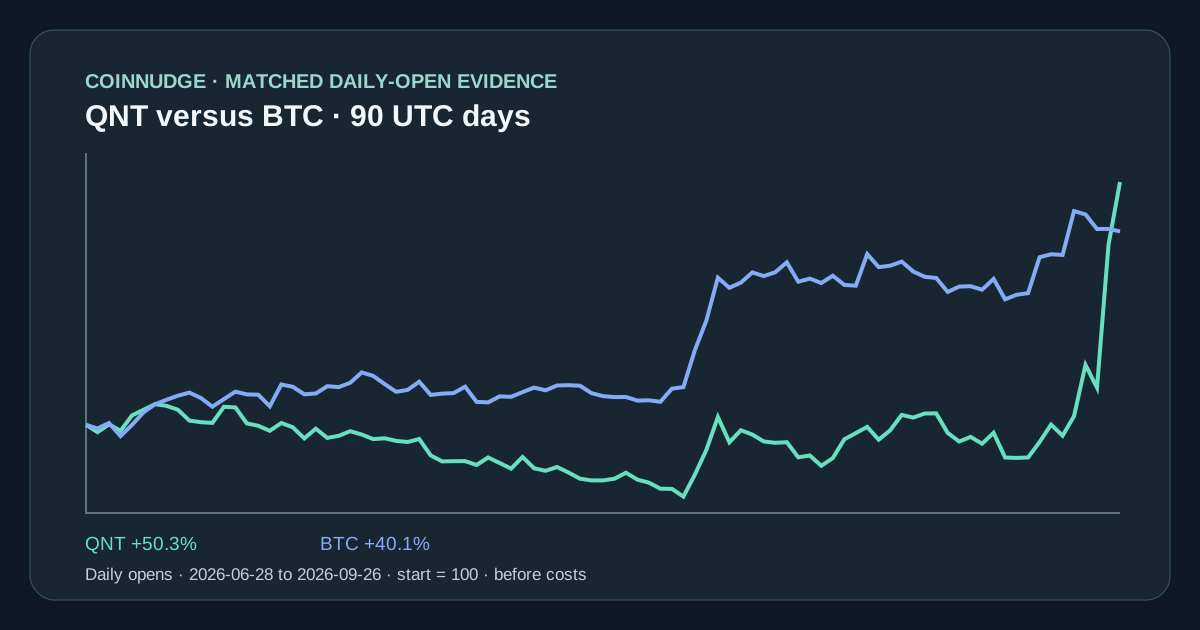
The September 26 UTC-open 90-day return was +50.3% versus BTC +40.1%; the asset’s same-window daily-open peak-to-trough drawdown was −18.4%. This is one end-date path, not a 90-day expected return.
The line chart normalizes QNT and BTC to 100 at the same UTC start, making relative direction visible without pretending that the two assets have comparable unit prices. Both asset and BTC come from Binance USDT spot daily opens. Intraday low, spread, fees and actual execution can produce a worse realized experience than the line shows.
| Holding window | QNT spot return | BTC spot return | QNT − BTC | Asset path drawdown |
|---|---|---|---|---|
| 7 days | +55.9% | +4.0% | +51.9 pp | −4.2% |
| 14 days | +55.7% | +8.9% | +46.8 pp | −5.3% |
| 30 days | +56.2% | +6.4% | +49.7 pp | −9.0% |
| 60 days | +60.5% | +31.9% | +28.6 pp | −9.9% |
| 90 days | +50.3% | +40.1% | +10.2 pp | −18.4% |
| 180 days | +43.3% | +27.4% | +15.9 pp | −31.0% |
| 365 days | +13.8% | −22.8% | +36.6 pp | −47.6% |
Verify: Full frozen return inputs
Across 58 month-starts, did QNT reward a 90-day holder?
QNT beat BTC in 18 of 58 complete 90-day month-start paths, with a −5.6% median return and 53 deeper drawdowns. We predefine calendar-first 90-day and 30-day starts plus Monday 14-day starts from the first available daily bar through the last date that permits a complete exit on 2026-09-26. Every candidate must have each asset and BTC daily open in the path. We neither choose a favorable entry date nor fill a missing day with zero. The three cohorts answer different holding-horizon questions; they are not pooled into a single success rate.
The 58 90-day monthly starts are descriptive and overlap. An every-third-month subset has only 20 observations and 5 BTC-beating paths; it is a dependence sensitivity, not an independent win-probability estimate. The 90-day monthly starts median QNT return was −5.6%, BTC’s was +2.7%, and 18/58 asset paths finished ahead of BTC. 53/58 had a deeper daily-open drawdown than BTC.
| Prespecified cohort | Complete / candidates | QNT median | Beat BTC | Deeper drawdown | Reading status |
|---|---|---|---|---|---|
| monthly 30d | 60/60 | −3.3% | 25/60 | 50/60 | Descriptive; dependent windows |
| monthly 90d | 58/58 | −5.6% | 18/58 | 53/58 | Descriptive; dependent windows |
| weekly 14d | 262/262 | −2.5% | 95/262 | 224/262 | Descriptive; dependent windows |
Verify: Full candidate and outcome dataset · Excluded/missing ledger
Did QNT behave differently after stronger versus weaker BTC months?
QNT’s median 90-day return was negative in both prior-BTC groups: −9.2% (29 nonnegative starts) and −2.2% (28 negative starts). For the 90-day monthly starts sample, we classify the previous 30-day BTC return using only BTC daily opens before each hypothetical entry. This is a genuinely pre-entry state label, not a split by whether BTC rose after entry. It tests whether the observed relation looks different across prior market environments, but small and overlapping groups cannot establish a trading rule.
The worst BTC-relative 90-day start was 2024-01-01: QNT −3.2% versus BTC +64.6%, with −28.3% QNT path drawdown. The best counterexample was 2022-07-01: QNT +154.9% versus BTC −2.7%. Both belong to the same prespecified candidate universe; neither was selected to define the rule.
10 of 58 90-day observations are printed below (the most recent ten by start date; the remaining 48 are in the complete CSV). A daily-open drawdown misses intraday moves, and a historical endpoint omits spreads, liquidity and tax. The cohort table above includes every eligible horizon group.
| Prior BTC 30d state | n | QNT median | QNT beat BTC |
|---|---|---|---|
| Prior BTC 30d ≥ 0 | 29 | −9.2% | 8/29 |
| Prior BTC 30d < 0 | 28 | −2.2% | 10/28 |
| Prior BTC unavailable | 1 | +17.7% | 0/1 |
Which QNT entry dates support or contradict the headline?
The ten most recent QNT 90-day starts illustrate entry-date differences; they are not all 58 starts or the odds of a favorable purchase. The rows below are the ten most recent 90-day starts for the main sample. Date, terminal return and path drawdown should be read together. A positive final return may still have required surviving a large temporary loss. A negative BTC-relative result does not imply an absolute loss, and vice versa.
QNT’s current headline path and the distribution of older starts answer different questions. For a decision today, verify live fundamentals, possible supply transfers, current spread and your own maximum loss before inferring anything from a past cohort.
| UTC entry | Horizon | QNT return | BTC return | QNT − BTC | QNT drawdown |
|---|---|---|---|---|---|
| 2025-09-01 | 90d | −7.8% | −16.1% | +8.3 pp | −32.9% |
| 2025-10-01 | 90d | −30.0% | −23.5% | −6.5 pp | −33.8% |
| 2025-11-01 | 90d | −9.3% | −22.8% | +13.5 pp | −31.8% |
| 2025-12-01 | 90d | −37.4% | −25.9% | −11.5 pp | −44.2% |
| 2026-01-01 | 90d | +0.6% | −22.1% | +22.7 pp | −32.7% |
| 2026-02-01 | 90d | −0.3% | −0.6% | +0.3 pp | −17.7% |
| 2026-03-01 | 90d | +12.1% | +9.7% | +2.5 pp | −15.6% |
| 2026-04-01 | 90d | −6.0% | −11.8% | +5.7 pp | −20.1% |
| 2026-05-01 | 90d | −12.0% | −16.2% | +4.2 pp | −25.1% |
| 2026-06-01 | 90d | −14.8% | +6.2% | −21.0 pp | −24.9% |
Verify: Download all cohort rows
Can QNT holders exit at the headline market price?
No: the frozen $736,962 median daily turnover is not an executable exit bid. QNT’s archived Binance Spot USDT daily candles have 30 valid quote-turnover days in the last 30. Their median daily quoted turnover is $736,962. This is an amount traded throughout a day, not the amount available at the current bid, and it does not prove a $10,000 or institutional-size order can be executed near a headline price.
The evidence in this release does not include a synchronized, venue-specific level-two book for QNT. We therefore do not report a fabricated current spread, ±1% depth or expected slippage. Before taking action, inspect the live order book, trade size, market impact, available pairs and withdrawal conditions on the actual venue.
Before an actual QNT trade, compare intended size with fresh bids/asks on the same venue and estimate entry plus exit fees and adverse slippage. Repeat after a material price move. If the fill estimate is missing or exceeds the loss budget, reduce proposed size or wait. This is an execution-check method, not a fill simulation performed in the frozen study.
| Execution question | Observed answer | Missing check |
|---|---|---|
| 30-day median daily quote turnover | $736,962 | Not executable depth |
| Venue | Binance Spot USDT | Check the intended trading venue |
| Live bid/ask spread | Not sampled for this release | Capture a fresh order book |
| $10,000 round-trip costs | Not estimated | Include exchange fees, slippage and funding if leveraged |
Verify: Current multi-market liquidity study · Dated venue candle inputs
What should QNT community claims prove before you rely on them?
A QNT partnership claim needs a demonstrated payment-to-token-demand bridge before supporting a holding thesis. Community discussion often turns enterprise partnerships into a QNT price target. Ask for the precise product, paying customer, currency of payment and token-lock rule. A bank or enterprise using interoperable software may be positive for Quant’s business yet still fail to establish net QNT demand.
This release has no verified count of unique social users or independently filtered sentiment. A trending placement or message volume could include promotions, repeated posts or ticker collisions. We use community discussion to identify claims to test, not as a measured demand or tokenholder-income variable.
Verify: Quant official Overledger FAQ · Quant services terms
When would holding QNT have an evidence-backed thesis?
QNT is a conditional token-demand thesis, not a verified share of enterprise software revenue. The evidence does not justify an unconditional “buy” or “sell.” The stronger case would be: Dated platform disclosures show sustained QNT settlement or other enforceable token use, net purchases can be reconciled, and usable spot depth persists after the current attention fades. The weaker case would be: Overledger usage grows but payments remain predominantly USD with no verified token absorption, or a rapid rally meets large holder sales and weak order-book depth.
A practical holding checklist is to define a time horizon, the project-to-token mechanism, next supply milestone, position size and acceptable drawdown. Decide what observation would falsify the thesis. Even the larger historical cohort is descriptive, overlapping and vulnerable to survivorship and regime changes.
For a QNT holding decision, record which subscription or lock disclosure would confirm token demand and which observation would invalidate it. Verify the dated source, payment currency, token quantity and retention period together. If only customer announcements are available, leave the token-capture claim unconfirmed rather than infer a price target.
| Decision gate | Evidence to request | Failure sign |
|---|---|---|
| Token-specific value capture | Does Overledger enterprise adoption necessarily create demand for QNT? | Only project growth is shown |
| Supply and float | Official allocation plus actual transfers | Unmeasured release reaches market |
| Historical opportunity cost | 58 complete 90-day monthly starts versus BTC | Single rally is treated as a general rule |
| Execution | Fresh venue depth, size and fees | Quoted price cannot be filled |
| Thesis invalidation | Overledger usage grows but payments remain predominantly USD with no verified token absorption, or a rapid rally meets large holder sales and weak order-book depth. | No observable reassessment trigger |
Verify: Frozen QNT operating evidence · Complete QNT paired-price study
How were QNT/BTC paths and evidence boundaries calculated?
Calculation single-coin-paired-paths-20260927-1.0; daily-open endpoint 2026-09-26 UTC; coverage 2021-09-01–2026-09-26. The asset’s historical source is local archive, potentially retrospective backfill. This is retrospective market research, not a claim that CoinNudge observed every older bar in real time.
QNT uses Binance QNT/USDT and BTC uses Binance BTC/USDT; both are paired at the same UTC daily open. Recent endpoints use 7/14/30/60/90/180/365 daily-open intervals only when all intermediate opens exist. Cohorts use every calendar month-first 30/90-day start and every Monday 14-day start from first available bar, with complete paired paths only. No strategy, fees, spreads, taxes, staking or causal token-use inference. Overlapping windows are dependent; fewer than 20 rows is exploratory. Historical archive/API retrieval is not proof the data was locally known at the original event time. Returns equal end open divided by start open minus one. BTC-relative differences are percentage points. Drawdown is the minimum of path value divided by its prior peak minus one. Candidate starts and all outcomes are preserved; a missing path is null, never a zero return.
The release exposes the calculation inputs, field dictionary, 380 observed cohort rows, 0 excluded candidates, source supply snapshot and SHA-256 input/output identities. Data from CoinGecko and project documents have their own timestamps and are not inserted as features known at a historical start. An independent rerun should match the downloadable rows before interpreting the prose.
Editing updated 2026-10-03: clarified section answers, holding decisions and evidence scope only. September frozen datasets, formulas, sample counts, charts and method version remain unchanged; the editing date is not a new market observation.
| Reproduction file | Purpose | Boundary |
|---|---|---|
| Research JSON | /research-data/hot-coin-profiles/2026-09-27-v1/qnt.json | Summary, version and hashes |
| All outcome rows | /research-data/hot-coin-profiles/2026-09-27-v1/qnt-observations.csv | Every candidate that passed paired coverage |
| Missing/excluded starts | /research-data/hot-coin-profiles/2026-09-27-v1/qnt-exclusions.csv | Explicit absent pairs; no invented zeroes |
| Asset daily inputs | /research-data/hot-coin-profiles/2026-09-27-v1/qnt-daily-inputs.csv | Unrounded venue observations |
| BTC daily inputs | /research-data/hot-coin-profiles/2026-09-27-v1/btc-daily-inputs.csv | Same-date comparator |
| Field dictionary | /research-data/hot-coin-profiles/2026-09-27-v1/field-dictionary.json | Deterministic formulas and status |
| Release manifest | /research-data/hot-coin-profiles/2026-09-27-v1/manifest.json | SHA-256 of frozen files |
Verify: CoinNudge frozen paired-price study · All matched outcome rows · All asset daily inputs · Same-date BTC daily inputs · Missing-pair ledger · Frozen CoinGecko supply snapshot · Field dictionary and calculation contract · Quant official Overledger FAQ · Quant services terms · Frozen operating-evidence record
Take the next step with this evidence.
Choose ongoing Telegram monitoring or inspect structured data in your own research workflow.
Receive qualifying events in Telegram.
Use the ready-made alert checklist, message explanations and daily briefing. Check the supported categories and coins before subscribing; every Research page is not a separate alert category.
Check the alert list · View alert plans
Inspect the data before choosing a pack.
Prepared research packs supply scoped features, separate outcomes where available and quality flags. Buy a fixed edition once and download directly; API use is optional.
Check data pack samples · Explore the full data catalog · Compare data plans
Each purchased pack includes its specified fields and published date range. This page's full dataset is not automatically included. Other data families require coverage, date, field and source-use confirmation before purchase. Telegram Pro is a separate 30-day service; historical packs are one-time purchases.
Frequently asked questions
What is QNT coin used for?
Quant sells Overledger as cross-ledger infrastructure. QNT can be used to subscribe to the platform, but Quant also accepts USD. A business-customer announcement therefore does not by itself measure QNT bought or retained. Documented use is not a guaranteed token price or holder income.
Is QNT coin worth holding based on this evidence?
Quant (QNT) coin is a utility token associated with Overledger, not equity in Quant. Market evidence ends at the 2026-09-26 UTC daily open; supply and operating records have separate dates below. QNT’s dated 90-day spot return was +50.3% versus BTC +40.1%, but 18/58 complete historical monthly 90-day starts beat BTC and 53/58 had deeper daily-open drawdowns. The case to hold QNT depends on measurable token demand from Overledger, not enterprise adoption headlines alone. Quant documents a USD-or-QNT subscription choice, but no public monthly customer-to-QNT settlement series was found; enterprise adoption cannot yet be translated into verified net QNT demand. This is dated non-personalized research, not a trade instruction.
How did QNT perform versus Bitcoin?
Across the frozen 90-day same-UTC daily-open window, QNT returned +50.3% and BTC returned +40.1%. Historical paths do not forecast the next period.
How much historical QNT data is available?
This release covers 1852 asset daily opens from 2021-09-01 through 2026-09-26 on Binance Spot USDT. Backfills and public API retrieval are retrospective, not original-date CoinNudge observations.
Does every Quant customer have to buy QNT?
No blanket claim is supported. Quant’s public FAQ says a subscription can be paid in USD or QNT.
Is QNT the same as Quant company stock?
No. Token ownership is not an equity interest or automatic SaaS revenue claim.
Does a 14.61 million maximum supply make QNT a good buy?
No. Supply cap is one input; token demand, concentration, liquidity and market risk remain unresolved.
Does Overledger usage prove QNT buying?
No. Quant allows platform fees in USD or a QNT subscription, but this release has no publicly reconciled monthly series of customer payments, treasury purchases, locks and recirculation.
Can I verify the QNT calculations?
Yes. The full JSON, 380 cohort rows, daily input files, field dictionary, exclusion ledger and manifest are linked on the page.
What evidence should I check before holding QNT?
For a QNT holding decision, record which subscription or lock disclosure would confirm token demand and which observation would invalidate it. Verify the dated source, payment currency, token quantity and retention period together. If only customer announcements are available, leave the token-capture claim unconfirmed rather than infer a price target.
Sources and verification
- CoinNudge frozen paired-price studyVersion, full summary, all observations and hashes
- All matched outcome rowsComplete monthly and weekly cohort ledger
- All asset daily inputsUnrounded source opens, turnover and provenance
- Same-date BTC daily inputsBTC comparator candles
- Missing-pair ledgerExplicit rejected candidates, empty if none
- Frozen CoinGecko supply snapshotProvider-defined supply and timestamp
- Field dictionary and calculation contractPrecise formulas and missing-value semantics
- Quant official Overledger FAQEnterprise product and USD/QNT subscription options
- Quant services termsContractual definition of QNT and platform use
- Frozen operating-evidence record
Follow QNT conditions with transparent market context.
Use this historical report to frame your questions, then check current liquidity, supply and Telegram alerts separately.
Explore alert coverage