Order-type and execution-cost study · By CoinNudge Research · · Guide updated 2026-10-03 · 10 min read
Should you use a market or limit order to buy crypto?
Choose a crypto market order when immediate execution matters more than controlling the entry price; choose a limit order when the maximum price matters more than certainty of execution. A marketable limit order can still take liquidity, so 'limit' does not automatically mean a maker fee. In one frozen Binance spot order-book observation on September 25, 2026, a $1,000 BTC market buy reached the best ask, just 0.0012 basis points above the best bid; the same-size SAGA buy walked the ask book and its modeled buy VWAP was 14.77 basis points above the best bid. A posted bid might improve the price only if it fills. These are snapshot counterfactuals, not observed order outcomes or a recommendation to trade either coin.
Inspect current crypto depth · Calculate a trade's break-even move
Price control is not the same as a cheaper completed trade
- A market order prioritizes speed but can cross the spread and walk several ask levels. A buy limit sets a ceiling, yet can remain unfilled or only partly fill.
- In the frozen $1,000 example, the market-buy VWAP was 0.0012 bps above BTC's best bid but 14.77 bps above SAGA's; the observed book, size and time are part of the answer.
- A limit order that executes immediately against resting liquidity is a taker order on venues that classify fees by maker/taker behavior. Check your account's actual schedule.
- The lower quoted price of a passive order is not a realized saving unless the order fills and the market opportunity remains comparable.
What is the difference between a crypto market order and a limit order?
A market buy requests the available ask liquidity now. It can execute at several prices and may be limited or partially filled by venue protections. A buy limit declares the highest price you accept; a sell limit declares the lowest. If its price crosses the book, it may execute immediately and pay taker treatment rather than resting as maker liquidity.
The right choice is a trade-off among urgency, price ceiling, quantity and the cost of missing the trade. The labels alone do not tell you which choice has lower realized cost. Coinbase and Binance documentation both warn that market orders can face slippage and limit orders may partially fill or fail to fill under specified conditions.
| Order choice | What you control | Main risk |
|---|---|---|
| Market buy/sell | Size and timing, not a guaranteed execution price | Spread and deeper-book slippage; protection may stop a full fill |
| Resting buy/sell limit | Worst acceptable price | Waiting, partial fill or no fill; opportunity cost |
| Marketable limit | Price ceiling/floor with immediate attempt | Can still take liquidity and pay taker fees |
Verify: Coinbase Advanced order types · Binance Spot price-range execution rule
How much can a crypto market order cost at $1,000?
In the frozen $1,000 six-book observation, market-buy VWAP was 0.0012 bps above BTC's best displayed bid but 14.7719 bps above SAGA's. This is a cost-versus-bid reference, not an observed saving from choosing a limit order. SAGA's modeled same-book round trip was −0.460% under the stated 0.10% fee per fill.
The fixed snapshot covers six preselected Binance USDT spot books, each requested sequentially at 1,000 levels. We sweep a hypothetical $1,000 buy through visible asks, compare its volume-weighted average price with the best displayed bid, then show the immediate same-book round-trip loss. A hypothetical passive bid might not fill, prices may move while waiting, and actual maker/taker fees depend on the execution.
Read the table with the order size and observation time, not as a current route quote or a ranking of which coin to buy. The bid-reference gap and immediate round-trip loss are separate calculations; neither estimates an unplaced order's fill probability.
| Binance USDT spot pair | $1k market buy vs best bid | Modeled instant round trip at 0.10% each side | Interpretation |
|---|---|---|---|
| BTC | 0.0012 bps | −0.2000% | Best ask and bid almost identical in this book |
| ETH | 0.0374 bps | −0.2004% | Small observed crossing cost, not a future guarantee |
| BNB | 0.1293 bps | −0.2013% | Depth adequate for this modeled size |
| SOL | 0.8601 bps | −0.2086% | Spread matters beyond fees |
| DOGE | 1.0543 bps | −0.2105% | Quoted unit price does not determine spread cost |
| SAGA | 14.7719 bps | −0.4601% | Ask-depth walk materially changed the $1k execution proxy |
Verify: Frozen six-book observations · Original 1,000-level book responses
Does a larger crypto market order cause more slippage?
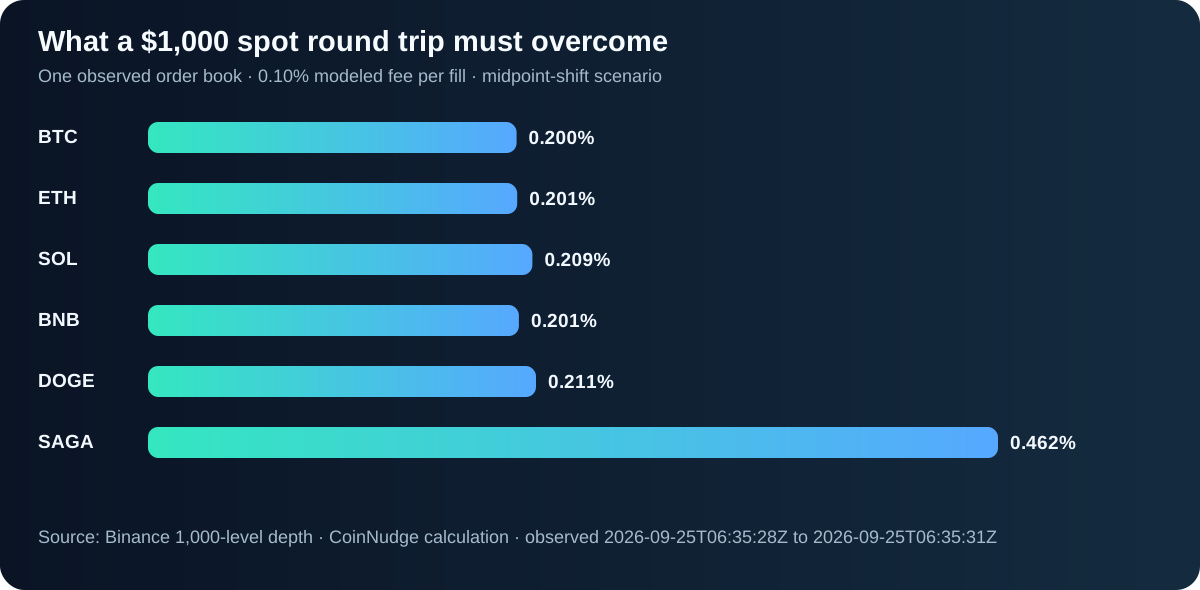
Order size matters only relative to the available depth at each price. In this same book, BTC's buy VWAP stayed at the top ask for $100, $1,000 and $10,000, so the simplified immediate round-trip loss stayed about 0.2000% at the 0.10%-per-side fee assumption. SAGA's modeled loss widened from 0.2772% at $100 to 0.4601% at $1,000 and 0.9799% at $10,000 because larger buys consumed deeper asks and a same-book sale hit thinner bids.
This is not a historical average or a prediction for the next order. Visible liquidity can cancel, refill or move before an order reaches the venue. The six markets were selected in advance for contrasting liquidity, not sampled as a representative universe.
| Observed pair | $100 immediate round-trip loss | $1,000 loss | $10,000 loss |
|---|---|---|---|
| BTC | 0.2000% | 0.2000% | 0.2000% |
| SAGA | 0.2772% | 0.4601% | 0.9799% |
Verify: Cost release and method
Does a crypto limit order always pay a lower maker fee?
No. Maker/taker classification depends on whether the order adds resting liquidity or immediately removes it, not merely on choosing a button labeled 'limit'. A marketable limit can cross the spread and execute immediately. A post-only instruction can prevent taking liquidity where supported, but it can also reject or leave the order waiting. Your actual VIP tier, pair, region and exchange product determine fees.
Our numerical table deliberately holds a hypothetical 0.10% each-side fee constant to isolate book mechanics. It does not claim this is every user's Binance fee or a universal maker discount. A passive-vs-market net comparison would require a specified maker schedule **and** observed fill/cancel timing, which a single book snapshot cannot supply.
Verify: Coinbase maker/taker fee distinction · Binance fee overview
When should you prefer a market order, a limit order, or no order?
If you need an immediate hedge or exit and the displayed book is deep enough for your size, a market or carefully capped marketable limit may be reasonable after checking expected costs. If your thesis only makes sense below a maximum buy price or above a minimum sell price, a resting limit protects that price but may miss the trade. If the spread or depth cost overwhelms the potential edge, no order may be preferable.
Set the decision before looking at whether a later chart made the missed trade look brilliant. For a fair historical comparison, record both filled and unfilled limit orders, opportunity cost, adverse selection after fills, fees and the same account exposure. This snapshot cannot answer that outcome question; it answers the price-and-depth side only.
| Your task | Useful order approach | Pre-trade check |
|---|---|---|
| Urgent exit or hedge | Market or capped marketable limit | Top-of-book depth, protection bands and worst acceptable price |
| Patient entry at a ceiling | Resting limit | How long you can wait and what nonfill would cost |
| Thin book with weak edge | Reduce size or skip | Cost versus expected payoff, not only the headline price |
Verify: Current liquidity context
What should you check when a crypto limit order touches the price but does not fill?
Check the order's actual status and cumulative filled quantity, not just the chart. A price touch does not prove enough opposing quantity traded through your queue position; a candle high/low does not identify which resting order was filled.
Confirm pair, side, price, time-in-force and venue order status. If partly filled, treat the executed portion as real exposure and the remainder as a separate open instruction. Before replacing the remainder, confirm cancellation or final status to avoid duplicating the intended position. If the desired size exceeds the quantity you can accept at that price, wait, reduce size or explicitly accept a bounded marketable order—do not chase without recalculating risk.
The book snapshot cannot estimate how often this workflow would succeed or whether a missed trade was costly. An outcome study would need submitted orders, status transitions, queue/fill assumptions, unfilled cases and the same opportunity set. That evidence is not present in the published six-book experiment.
Verify: Coinbase's order-type, partial-fill and time-in-force rules · Frozen six-book study boundary
How can you cap entry-price risk without assuming a limit guarantees execution?
A marketable limit can cap the worst acceptable order price while attempting to execute immediately, but it can remain partly or wholly unfilled. A pure market order prioritizes access to available liquidity, not a guaranteed final VWAP. Exchange rules and supported instructions govern what actually happens.
Before submitting, inspect the exact pair's spread and cumulative opposite-side depth at your size, estimate both-side fees and choose a maximum acceptable price. If current depth disappears or the spread exceeds the thesis's margin, reduce size or skip. For an urgent exit, evaluate the cost of delay as well as price impact; do not turn a protective exit into an indefinite wait merely to earn maker treatment.
This is a decision workflow, not a promise of exchange execution. The fixed BTC/SAGA example illustrates how size and depth can change the cost; it does not certify today's book, an execution algorithm or any account's fee tier.
Verify: Official market and limit behavior · Current crypto order-book liquidity methods · Published size/cost scenarios
How was the market-versus-limit comparison calculated?
The comparison is reproducible as a visible-book counterfactual, not as an observed limit-order outcome. A $100/$1,000/$10,000 notional buy consumes asks from lowest price upward until filled; buy VWAP equals spent USDT divided by purchased base units. The quoted bid reference is the highest observed resting bid. Difference in basis points = (buy VWAP / best bid − 1) × 10,000. The same-book immediate round trip separately sells the purchased quantity into bids and charges the stated hypothetical fee on each side.
The published release contains six original book payloads with timestamps and checksums, all 36 fee-and-size scenarios, an independent arithmetic verifier and protocol. The books were fetched sequentially, so cross-coin rows are not simultaneous. Queues, latency, hidden liquidity, real fills and personal fee tiers are unavailable. No general winner or statistical confidence interval is claimed from one observation per market.
| Public evidence | What you can reproduce | What you cannot infer |
|---|---|---|
| Book snapshots JSON | Visible bid/ask levels at retrieval | Future depth or a resting order's queue position |
| 36-row scenario CSV | VWAP, same-book round trip and break-even arithmetic | Real exchange fees for your account |
| Standalone verifier and protocol | Deterministic formulas and hashes | Historical average market-vs-limit success rate |
Verify: Independent 720-field cost audit · Protocol and selection
Take the next step with this evidence.
Choose ongoing Telegram monitoring or inspect structured data in your own research workflow.
Receive qualifying events in Telegram.
Use the ready-made alert checklist, message explanations and daily briefing. Check the supported categories and coins before subscribing; every Research page is not a separate alert category.
Check the alert list · View alert plans
Inspect the data before choosing a pack.
Prepared research packs supply scoped features, separate outcomes where available and quality flags. Buy a fixed edition once and download directly; API use is optional.
Check data pack samples · Explore the full data catalog · Compare data plans
Each purchased pack includes its specified fields and published date range. This page's full dataset is not automatically included. Other data families require coverage, date, field and source-use confirmation before purchase. Telegram Pro is a separate 30-day service; historical packs are one-time purchases.
Frequently asked questions
Is a limit order always cheaper than a market order in crypto?
No. A resting limit controls its price but may not fill; an immediately executable limit can still take liquidity and pay taker fees. Compare realized costs and missed trades, not the order label.
How much slippage did your $1,000 BTC and SAGA example show?
In one September 25 Binance spot book, market-buy VWAP exceeded the best displayed bid by 0.0012 bps for BTC and 14.7719 bps for SAGA. This is a bid-reference gap, not realized slippage versus a future fill.
Will my limit buy fill if price touches my limit?
Not necessarily. Queue position, available selling volume, venue rules and partial fills matter; a visible price touch alone does not prove your order executed.
Is a limit order a maker order?
Only if it rests and adds liquidity under the venue's classification. A limit order that immediately executes against existing orders can be taker.
Do these figures include my Binance fee tier?
No. The published six-book study uses hypothetical 0.10% and 0.05% per-side scenarios; your account, venue, pair and region may differ.
Are these futures or spot order books?
Spot. Futures funding, borrowing, mark-price liquidation and product-specific execution protections are not included in the six-book calculation.
Sources and verification
- Binance fixed spot-book research releaseSix timestamped books and 36 cost scenarios; not future fills.
- Coinbase Advanced order typesOfficial market/limit mechanics and market protection.
- Binance Spot price-range ruleOfficial partial-fill and protection behavior.
- Coinbase maker/taker fee explanationFee classification depends on execution behavior.
See live liquidity and your own exchange fee tier before assuming a market or limit order is cheaper.
CoinNudge monitors market context; you remain responsible for any actual order.
Open market radar