Backtesting data selection guide · By CoinNudge Research · · Guide updated 2026-10-03 · 14 min read
Which crypto backtesting data do you need: candles, trades or order books?
Choose crypto backtesting data according to the decision and fill you must simulate. Completed OHLCV candles can test a closed-bar trend rule; trades add transaction timing and aggressor-side evidence; an order-book history is needed to examine visible depth and queue-sensitive execution. Higher frequency alone does not make a strategy more profitable. In CoinNudge's frozen BTC EMA9/21 example over one common year, 5m, 15m and 1h inputs produced 2,516, 819 and 191 simulated trades respectively; all three net account returns were negative under the published costs. This one-rule example helps specify the data contract, not rank every trading timeframe.
Inspect the BTC test · Check historical coverage
Which crypto backtesting data does your strategy require?
- Start from holding period, signal timing and fill question; a one-hour rebalance does not automatically require tick-level order-book history.
- Candles cannot reconstruct the order of an intrabar stop and target; trades do not reveal the full resting book or a hypothetical queue position.
- The unchanged one-year BTC study used 105,120 complete 5m bars, 35,040 15m bars and 8,760 1h bars; its authored EMA rule lost on all three.
- Current paid packs are fixed-edition processed research products. Use the sole catalogue to distinguish their actual files from public experiment evidence, raw internal archives and unavailable tick/order-book products.
Should a crypto backtest use OHLCV candles, trades or order books?
An OHLCV bar gives open, high, low, close and volume for a fixed interval. It can support a rule whose inputs are only completed bars and whose execution assumptions are explicit. Individual trades add transaction sequence and signed-side proxies where supplied. Order-book snapshots or updates add visible resting liquidity and spread. These data families answer different questions; a provider's 'historical crypto data' label is insufficient to establish fit.
Tick detail creates storage and synchronization work. It is necessary only when the research conclusion depends on intrabar sequence, depth, spread or execution. Even a full historical book cannot tell exactly where an unplaced hypothetical order would have sat in the queue without a fill model and venue rules.
| Historical crypto data | Can answer | Cannot establish by itself |
|---|---|---|
| Completed 1h or 1d OHLCV | Closed-bar trends, rebalancing and coarse risk paths | Intrabar order of high/low or exact fill |
| Completed 5m or 15m OHLCV | Shorter closed-bar rules and bounded path proxies | True stop/target sequence inside a bar |
| Trades / aggregate trades | Transaction sequence, traded amount and eligible side fields | Resting depth, cancellation or hypothetical queue place |
| Order-book updates / snapshots | Visible spread, depth and changing liquidity | Guaranteed fill for a hypothetical order |
Verify: Binance public OHLCV and trade fields · Specialist tick and order-book data types
What changed when the same BTC rule used 5m, 15m and 1h data?
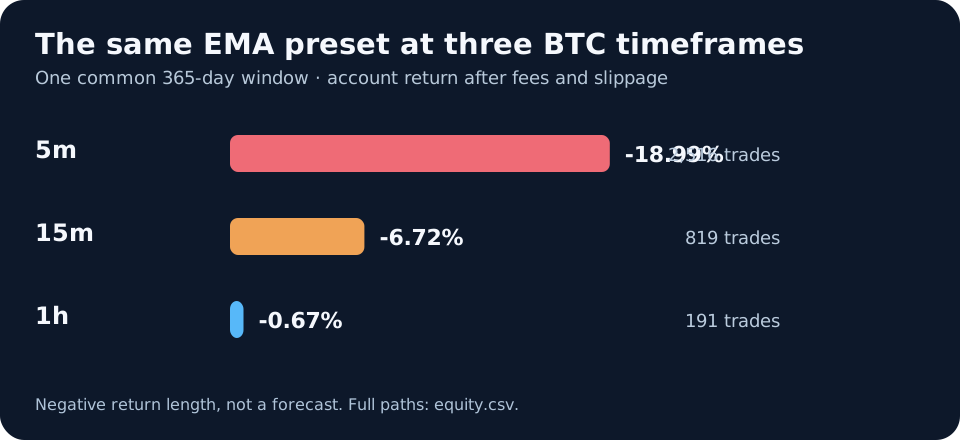
All three BTC presets produced negative net account returns; faster presets traded more and incurred more modeled costs, but the experiment changed EMA calendar horizons too and cannot isolate frequency as the cause. The frozen test uses Binance BTCUSDT spot from 2025-09-25 06:00 UTC to 2026-09-25 06:00 UTC, exclusive end. It applies the same EMA9/EMA21 long-only crossover definition to each completed-bar interval, enters at the next open, permits a 2% stop and 4% target, and charges 5 basis points commission plus 2 basis points adverse slippage per fill. The 15m bars are rebuilt only from complete groups of three 5m bars; warmup is outside the score window.
The 5m test produced 2,516 trades and −18.99% net account return, 15m produced 819 and −6.72%, and 1h produced 191 and −0.67%. These are three different clock-time EMA horizons, not merely three compressions of an otherwise identical trade. The 1h result was least negative here; no causal or future superiority claim follows.
| BTCUSDT completed bars | Bars / missing | Trades | Net simulated account return | Modeled commissions |
|---|---|---|---|---|
| 5m | 105,120 / 0 | 2,516 | −18.99% | $1,257.68 |
| 15m | 35,040 / 0 | 819 | −6.72% | $409.37 |
| 1h | 8,760 / 0 | 191 | −0.67% | $95.51 |
Verify: Frozen three-timeframe result JSON · Full BTC interval and trade study · Deterministic reproduction script
Does higher-frequency crypto data make a backtest more accurate?
More detail can resolve a question that coarse data cannot, but it cannot repair an incorrect universe, leaked future feature, unrealistic fee, missing observation or unfilled order. If both stop and target lie within one OHLC bar, their true sequence is unknown from that bar; the BTC example deliberately resolves ambiguous touches stop-first. Trades may clarify sequence if complete, while realistic fills still require execution assumptions and often order-book information.
In the fixed example the 5m policy traded about 13.2 times as often as the 1h policy and incurred materially more modeled commission. Doubling both fee and slippage assumptions worsened net account returns to −36.64%, −12.42% and −1.99% respectively. Faster signals without a measured edge can simply create more cost.
| Question | Minimum data to begin | Additional validation |
|---|---|---|
| Does a completed-hour trend filter work? | Complete 1h OHLCV and dated universe | Next-bar fills, costs and later holdout |
| Which happened first inside a 15m bar? | Trades or shorter contiguous bars | Sequence gaps and actual stop-order rules |
| Would a $10k order move through the book? | Time-aligned order-book depth | Cancellations, queue and order timing |
| Was active buying present at the trigger? | Valid traded amount and side semantics | Feature availability time and zero-volume handling |
Verify: Frozen protocol and cost sensitivity · Order-type and book-cost example
What should a backtesting data vendor specify before you buy?
Request instrument identity, venue, historical eligible symbols, timestamp unit, event versus arrival time, exchange timezone, exact interval semantics, missing-bar policy, source corrections, file version and sample dates. For derivatives also pin contract type and funding/OI units. A daily ZIP and a live API response may represent different observation times; do not concatenate without a documented overlap policy.
If the strategy relies on trades or order books, ask whether the supplier distributes exchange-native messages, normalized records or both, and how sequence gaps are flagged. The same word 'tick' may refer to individual trades, quote changes or depth updates. A sample for the exact symbol and old date you need is more informative than a headline row count.
Verify: Binance public data field and timestamp documentation · Tardis exchange-native and normalized formats · Supplier quality checklist
Which CoinNudge data is actually available for a backtest?
The public BTC three-timeframe study supplies the frozen inputs and replay evidence required to check that particular experiment. It is separate from the paid pack catalogue, and its files do not grant access to all internal raw history.
CoinNudge's new historical purchases are fixed-edition research data packs, bought once rather than renewed monthly. The purchased edition provides its listed downloadable files and 90 days of hosted download/optional API access; downloading does not require an API key, and an API does not add real-time data or unpurchased families. Later editions are separate purchases. Check the sole coverage catalogue for the exact pack, fields, instruments, dates and published status. Existing legacy customers retain their original rights.
Processed historical feature or label files are not automatically a raw multi-year candle archive, a complete point-in-time record or a tick-by-tick execution feed. Match the catalogue's file families to the strategy's necessary inputs. If order-book sequence or historic queue modeling is essential and not listed, that requirement remains unmet regardless of how many candle or feature rows are available.
Verify: Single dataset coverage catalogue · Public BTC example evidence · Current paid plan entitlements
Which extra data does a funding-rate or open-interest backtest require?
Add actual funding settlements, the contract's notional convention and the OI quantity definition when those are part of the question. A predicted rate is not the final payment; a dollar OI value can rise because price rose even when contract quantity did not. Candles alone cannot supply that distinction.
Identify venue, contract, settlement time, rate unit and exposure active at each payment. For OI, preserve raw quantity and conversion information, then align only a record available by the decision time; keep unavailable or delayed OI as missing rather than carrying a later number backwards. Spot and perpetual symbols can share a ticker while representing different tradable products.
Select the pack or source only after those fields and actual historical coverage match. A price-strategy study that ignores these costs must remain labeled a spot or simplified paper test, not a leveraged derivatives performance result.
Verify: Historical funding and OI data selection · Exact published research-pack coverage
How do you validate crypto backtest inputs before the full replay?
Run a preflight on the most demanding interval first: verify identity, closed-bar boundaries, ordering, duplicates and a complete UTC grid, then reconcile one aggregated bar and one cost-sensitive trade. A successful file download is not the pass condition.
For 15m derived from 5m, require three contiguous closed inputs in the same 15m bucket: first open, maximum high, minimum low, last close and summed volume. If an input is missing, flag the bucket rather than treating two bars as a complete three-bar candle. For event-driven data, inspect sequence gaps and arrival-time ordering instead of fabricating fixed-grid rows.
Next challenge an ambiguous stop/target bar, a missing interval and a symbol boundary. State whether each produces an explicit conservative assumption, a skipped trade or HOLD. Store the schema, exclusions and input hashes with the run; buy finer data only if the remaining uncertainty can materially change the question's answer.
Verify: Frozen BTC candle coverage and deterministic replay · BTC test input and execution protocol
How do I choose the cheapest data that can answer my crypto research question?
Define the strategy first: decision interval, required fields, hold length, stop and target, order type, venues, years and eligible assets. Then choose the coarsest history that still observes the crucial event and test one difficult date. A data sample fails if it cannot explain a missing interval or if a purported pre-trade feature was not available at the decision time.
Calculate storage and ingestion burden after validating scientific fit. A one-hour portfolio question may start with free candles. An event-and-outcome study may use a processed event release. Intrabar execution work can justify trade and depth history, but needs a separate source and fill model. Preserve exact source and release versions whichever path you choose.
Verify: Evaluate actual CoinNudge product coverage · Check a real event-row sample
Take the next step with this evidence.
Choose ongoing Telegram monitoring or inspect structured data in your own research workflow.
Receive qualifying events in Telegram.
Use the ready-made alert checklist, message explanations and daily briefing. Check the supported categories and coins before subscribing; every Research page is not a separate alert category.
Check the alert list · View alert plans
Inspect the data before choosing a pack.
Prepared research packs supply scoped features, separate outcomes where available and quality flags. Buy a fixed edition once and download directly; API use is optional.
Check data pack samples · Explore the full data catalog · Compare data plans
Each purchased pack includes its specified fields and published date range. This page's full dataset is not automatically included. Other data families require coverage, date, field and source-use confirmation before purchase. Telegram Pro is a separate 30-day service; historical packs are one-time purchases.
Frequently asked questions
Is OHLCV enough to backtest a crypto strategy?
It can be enough for a completed-bar rule when you accept explicit next-bar fills, costs and intrabar ambiguity. It cannot prove historical queue position, order-book slippage or which of two intrabar price levels was touched first.
Do I need tick data for a one-hour Bitcoin strategy?
Not automatically. Begin with complete one-hour candles if decisions depend only on closed hourly bars. Add trades or book history only if the research claim depends on transaction sequence or execution.
Did the 1h BTC rule outperform because the data was better?
That conclusion is unsupported. The frozen rule changed signal frequency and effective EMA calendar horizon with the bar interval. All three versions lost money under modeled costs over this one common BTC year.
Does a CoinNudge data pack include every historical candle and execution feed?
No. New purchases are one-time fixed-edition packs, not the former six-pair monthly plans. Each pack includes only its listed published feature/label files and actual coverage; hosted downloads and optional API access last 90 days. Public experiment evidence and internal raw archives are not automatically additional purchase rights.
Can candles prove my stop-loss would have executed at its stated price?
No. An OHLC bar can show a level was crossed but not a guaranteed executable fill. The frozen paper example uses a declared stop-first ambiguity rule and adverse slippage assumptions.
Sources and verification
- CoinNudge frozen BTC three-timeframe studyCommon one-year inputs, trade counts and modeled outcomes.
- CoinNudge calculation protocolSignal, fill, cost and ambiguity rules.
- Binance public archiveOfficial data types, intervals and timestamp units.
- Tardis historical data FAQSpecialist trade and order-book format distinctions.
Choose data by the decisions your backtest must reconstruct.
Use the public BTC replay to test assumptions, then verify the exact dates, intervals and entitlements of any dataset you plan to buy.
Check dataset coverage