Single-asset evidence report · By CoinNudge Research · · Guide updated 2026-10-03 · 20 min read
What is DOGE coin, and is it worth holding?
DOGE is the native currency of Dogecoin, an open-source proof-of-work network. Its yearly issuance is roughly fixed in units but the supply has no terminal cap. For a holding decision, a DOGE holding thesis is chiefly a demand-and-liquidity thesis: sustained use and willing buyers must be evaluated against ongoing issuance and historically large drawdowns. In the frozen Binance spot daily-open window ending September 25, 2026, DOGE returned +26.4% versus BTC +40.5%; across 57 earlier monthly starts, its median was −8.3% and 19/57 beat BTC. Overlapping history is not a future win rate or personal buy call.
Inspect all historical starts · Check current market context
What should investors know about DOGE?
- DOGE gained +26.4% in the last frozen 90-day window; this differs from its historical monthly-start median −8.3%.
- 19/57 complete historical 90-day starts beat BTC, while 55/57 had a deeper daily-open drawdown.
- A DOGE holding thesis is chiefly a demand-and-liquidity thesis: sustained use and willing buyers must be evaluated against ongoing issuance and historically large drawdowns.
What is Dogecoin used for beyond its meme identity?
DOGE is the native currency of Dogecoin, an open-source proof-of-work network. Its yearly issuance is roughly fixed in units but the supply has no terminal cap.
DOGE is a proof-of-work currency rather than a capped governance or revenue-share token. Its meme identity can influence attention, but the network's function and the holder's economic claim should be examined separately.
For holding DOGE, ask whether durable use and willing buyers can absorb ongoing issuance, how the price compares with BTC over common dates, and whether the intended order can exit. The 57 historical starts below cannot establish a recurring payment to holders.
| DOGE at a glance | Dated evidence | How to read it |
|---|---|---|
| Documented token role | Can transfer and spend DOGE | Not an automatic claim on every project activity |
| Last frozen 90-day spot return | +26.4% | BTC on the same UTC dates: +40.5% |
| Historical 90-day monthly median | −8.3% | 57 overlapping complete starts, not a forecast |
| Current circulating supply | 156,073,186,384 | CoinGecko response updated 2026-09-26T10:12:20.000Z |
Verify: Dogecoin official inflation explanation · Dogecoin project site
What can a DOGE holder actually claim—and what cannot they claim?
A DOGE holder can transfer or spend the currency, but does not automatically earn mining rewards, a company dividend or a token-governance payout. Miner rewards belong to the participants performing the network's proof-of-work.
Community participation can help improve software or use, but it is not a contractual income claim. An externally offered DOGE yield account has its own borrower, custodian or product conditions; distinguish it from a native reward for passive ownership.
If the stated reason to hold depends on a promised payout, identify its payer and enforceable terms. Without that evidence, do not count community popularity as an income asset.
| Who owns what | Documented role or participation | What cannot be inferred |
|---|---|---|
| DOGE holder | Can transfer and spend DOGE | No company equity, dividend or capped-supply right |
| Miner | Earns block rewards for securing the proof-of-work network | Rewards create new units that may be sold |
| Community member | Can participate in open-source discussion and use | Social membership is not enforceable revenue participation |
Verify: Dogecoin official inflation explanation · Dogecoin project site · Dogecoin source documentation: proof-of-work mining
Can you earn native staking income just by holding DOGE?
No native proof-of-stake reward is established for passive DOGE holding: Dogecoin is a proof-of-work network and newly issued rewards go to miners. A DOGE earn product offered elsewhere should not be described as the network paying every holder.
Before comparing a yield offer with ordinary DOGE, identify the counterparty, custody arrangement, withdrawal restrictions and where the return comes from. If those terms cannot be verified, the proposed yield is not an evidenced addition to this report's historical returns.
The frozen DOGE/BTC study excludes lending, custodial rewards and mining operations. It cannot establish that an external product would have rescued the historical drawdowns or that a quoted yield compensates for its own additional risk.
Verify: Dogecoin source documentation: proof-of-work mining · Dogecoin protocol issuance explanation · Frozen DOGE spot-only study
Can DOGE demand keep up with ongoing issuance?
Whether demand absorbs ongoing DOGE issuance is not established by this release: a matching payments, inventory and miner-sale series is missing. Roughly fixed annual issuance and a declining percentage inflation rate do not by themselves show that demand keeps pace.
Dogecoin’s own inflation explainer describes about five billion new DOGE a year. There is no scheduled one-off venture-token cliff in the same sense as a newly launched token, but miners receive newly issued coins. A decreasing percentage inflation rate does not mean the absolute issuance stops.
DOGE’s community identity and broad exchange access are visible, yet meme attention cannot substitute for a measured payments series, persistent balances or miner-sale estimates. Do not infer that a social spike, celebrity mention or ETF speculation alone yields token cash flow.
To study whether demand absorbs new DOGE, distinguish real payment transfers from internal exchange moves and self-churn, then compare relevant inventory and observed market liquidity over matching dates. This release does not contain a fully attributed miner-sale or payments-demand series. The issuance mechanism is known; the degree of demand absorption is not inferred from a celebrity mention.
DOGE's dated price experiment below measures spot returns and drawdown paths, not the causal contribution of project adoption. The release has no independently frozen continuous operating-economics series that completes this value-capture test.
Verify: Dogecoin official inflation explanation · Dogecoin project site
What does roughly five billion new DOGE per year mean for holders?
Roughly five billion newly issued DOGE per year means continuing miner rewards, not an unlimited number created in any single year. The issuance percentage can decline as the unit stock grows while the absolute new-unit amount continues.
CoinGecko’s separate 2026-09-26T10:12:20.000Z response reports 156,073,186,384 circulating DOGE out of 171,786,043,127 total, with no maximum-supply field. These are provider classifications, not an audit of custodian balances or a schedule of future exchange selling.
The protocol continues roughly five billion DOGE annual issuance. There is no finite max-supply field in the frozen provider snapshot. Circulating and total numbers can differ across providers; treat them as classification estimates and confirm protocol supply separately. Divide annual new units by current stock only if comparing rates with a correctly dated denominator.
DOGE's recurring supply question is mined issuance against the dated unit stock, not a team vesting cliff or maximum-minus-float unlock. Miner rewards can reach markets, but units created and units actually sold are different quantities. Reconcile protocol supply when provider total and circulating fields differ; keep rate estimates tied to the chosen denominator. Lower percentage inflation does not end new-unit creation.
| DOGE supply field | Frozen provider value | Reading rule |
|---|---|---|
| Circulating supply | 156,073,186,384 | CoinGecko provider definition at 2026-09-26T10:12:20.000Z |
| Total supply | 171,786,043,127 | May differ from circulating and maximum supply |
| Maximum supply | Not reported | Missing is not zero and not equal to total supply |
| Reported circulating / maximum | Not defined | Not a dated release schedule or tradable-float audit |
Verify: Frozen original supply response · Dogecoin official inflation explanation · Dogecoin project site
DOGE tokenomics: ongoing miner issuance with no final cap
DOGE continues to issue roughly five billion coins per year under its documented mining model and has no terminal supply cap. Percentage inflation can fall as the supply base grows while new miner rewards continue; this is not a venture-token cliff schedule or native staking yield.
For a holding decision, compare new units with actual payment use, concentrated existing balances and exit liquidity. Social attention can increase demand, but it does not give holders a dividend or stop miners from receiving newly issued units. The dated price study measures neither a current reward yield nor future demand.
| Token-economics dimension | Documented mechanism or attributed claim | What remains unproven / investor implication |
|---|---|---|
| Supply model | Dogecoin describes roughly five billion newly issued DOGE per year and no terminal maximum. | A shrinking percentage inflation rate does not mean new issuance stops. |
| Distribution | Proof-of-work miners receive newly created units under network rules. | Miner rewards can enter markets; no venture-style dated cliff is implied. |
| Use and rights | DOGE can be transferred and spent as network currency. | Community visibility does not grant a dividend, equity or fixed-cap claim. |
| Investor check | Compare current supply, miner issuance, transactional use, concentration and exchange depth. | Supply economics and social-driven demand must be assessed separately. |
Did DOGE rallies translate into sustained outperformance versus BTC?
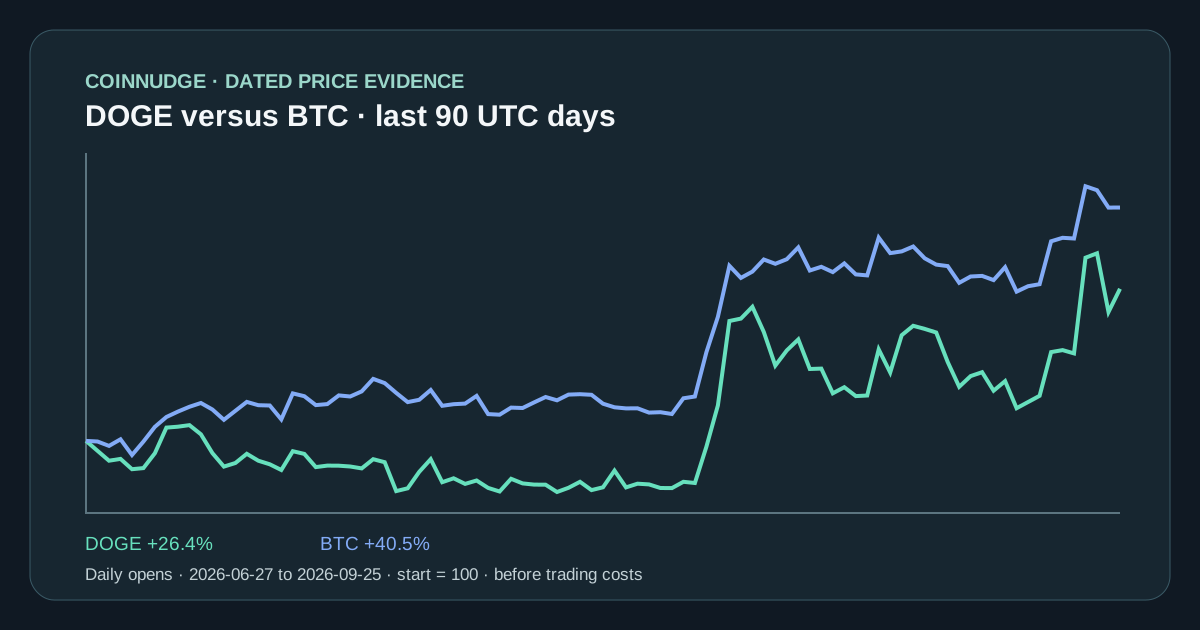
At the September 25 UTC daily-open endpoint, DOGE returned +26.4% over 90 days versus BTC +40.5% on exactly the same days. The 365-day DOGE path was −60.3% versus BTC −25.5%. These different windows are one dated path each—not five independent tests or a prediction.
The 90-day chart plots all 91 matched UTC daily opens from 2026-06-27 to 2026-09-25, normalized to 100 on the first day. A later CoinGecko price or 24-hour change may differ because the venue, market window and timestamp differ. The table reports the actual shared-start comparison rather than mixing unrelated provider percentages.
| Matched holding window | DOGE spot return | BTC spot return | DOGE minus BTC / status |
|---|---|---|---|
| 7 days | +17.2% | +10.5% | 6.7 pp |
| 30 days | +11.8% | +7.5% | 4.3 pp |
| 90 days | +26.4% | +40.5% | -14.1 pp |
| 180 days | +5.3% | +27.2% | -21.9 pp |
| 365 days | −60.3% | −25.5% | -34.8 pp |
Verify: Full dated path and methods
How often did DOGE beat BTC after a monthly entry?
Across the frozen matched 90-day monthly starts, DOGE's median return was −8.3% versus BTC +1.9%, and 19/57 starts beat BTC. That is descriptive historical evidence, not a future success probability; the full overlapping sample, dependence check and opposing cases appear below.
We prespecified every first day of a month after the Binance listing had a full prior month through June 2026. Of 57 candidate 90-day starts, 57 had a complete 91-daily-open DOGE/BTC pair and 0 were excluded for missing daily opens. The DOGE median endpoint was −8.3%, BTC's was +1.9%; DOGE beat BTC in 19/57. Those windows overlap and must not be treated as 57 independent win-probability trials.
DOGE had a deeper daily-open peak-to-trough drawdown in 55/57 matched windows. The lower 10th-percentile DOGE endpoint was −45.4% and the upper 90th percentile +67.0%. Every-third-month sensitivity has only 19 observations and 7 BTC-beating starts; it is a dependence check, not a statistically powered forecast.
The worst BTC-relative start was 2023-01-01: +9.6% for DOGE against +72.1% BTC, with −31.6% asset drawdown. A counterexample is 2024-09-01: +321.0% for DOGE versus +65.3% BTC. Showing both prevents the current rally or a past collapse from becoming the whole story.
| 90-day monthly cohort measure | DOGE | BTC / paired comparison | Interpretation |
|---|---|---|---|
| Complete starts | 57 | 57 | Same UTC dates and 91 daily opens |
| Median endpoint | −8.3% | +1.9% | Not an expected future return |
| 10th / 90th percentile | −45.4% / +67.0% | −24.9% / +47.8% | Descriptive tail range |
| Outperformed BTC | 19/57 | — | Overlapping monthly windows |
| Deeper path drawdown | 55/57 | — | Measured at daily opens only |
| Every-third-month check | 7/19 | — | Small non-overlap sensitivity |
Verify: All matched starts and excluded candidates · Frozen calculation contract
Which DOGE entry months beat BTC, and what losses appeared along the way?
Both winning and losing DOGE windows are shown: all 57 eligible same-date DOGE/BTC 90-day observations are visible chronologically below. The worst BTC-relative start was 2023-01-01: +9.6% for DOGE against +72.1% BTC, with −31.6% asset drawdown. A counterexample is 2024-09-01: +321.0% for DOGE versus +65.3% BTC. These are contrasting examples from the complete table, not independent future scenarios. A first-of-month start is the frozen sample design, not a suggested buying schedule.
Compare terminal return with interim drawdown in each row. Daily-open paths can understate intraday harm; fees, spreads, slippage, tax, staking and leverage are excluded. The complete input CSV and exclusion ledger are available for independent recalculation.
| UTC start | DOGE 90d | BTC 90d | DOGE − BTC | DOGE path drawdown |
|---|---|---|---|---|
| 2021-10-01 | −17.8% | +6.0% | -23.8 pp | −47.5% |
| 2021-11-01 | −49.0% | −37.7% | -11.2 pp | −52.7% |
| 2021-12-01 | −37.9% | −24.2% | -13.7 pp | −42.7% |
| 2022-01-01 | −18.9% | −1.5% | -17.4 pp | −39.6% |
| 2022-02-01 | −6.3% | +0.0% | -6.3 pp | −32.6% |
| 2022-03-01 | −38.0% | −31.7% | -6.3 pp | −54.9% |
| 2022-04-01 | −49.6% | −55.8% | +6.2 pp | −69.4% |
| 2022-05-01 | −46.0% | −36.8% | -9.1 pp | −61.1% |
| 2022-06-01 | −25.7% | −36.2% | +10.5 pp | −38.4% |
| 2022-07-01 | −8.9% | −2.7% | -6.2 pp | −34.1% |
| 2022-08-01 | +78.8% | −10.7% | +89.5 pp | −34.1% |
| 2022-09-01 | +65.4% | −18.0% | +83.4 pp | −47.6% |
| 2022-10-01 | +15.0% | −14.4% | +29.4 pp | −50.5% |
| 2022-11-01 | −29.0% | +15.9% | -44.9 pp | −51.9% |
| 2022-12-01 | −24.3% | +34.8% | -59.1 pp | −35.9% |
| 2023-01-01 | +9.6% | +72.1% | -62.5 pp | −31.6% |
| 2023-02-01 | −18.0% | +21.4% | -39.4 pp | −31.6% |
| 2023-03-01 | −9.5% | +19.9% | -29.4 pp | −26.4% |
| 2023-04-01 | −17.6% | +7.0% | -24.5 pp | −37.1% |
| 2023-05-01 | +0.9% | +0.4% | +0.5 pp | −24.7% |
| 2023-06-01 | −7.3% | +1.9% | -9.2 pp | −25.4% |
| 2023-07-01 | −7.4% | −11.3% | +3.9 pp | −26.1% |
| 2023-08-01 | −10.9% | +18.1% | -29.0 pp | −25.9% |
| 2023-09-01 | +26.1% | +45.9% | -19.8 pp | −17.0% |
| 2023-10-01 | +46.5% | +56.0% | -9.5 pp | −17.0% |
| 2023-11-01 | +19.2% | +25.0% | -5.8 pp | −23.5% |
| 2023-12-01 | +38.8% | +65.5% | -26.7 pp | −23.5% |
| 2024-01-01 | +122.3% | +64.6% | +57.8 pp | −29.2% |
| 2024-02-01 | +69.4% | +42.5% | +26.9 pp | −39.4% |
| 2024-03-01 | +39.7% | +10.7% | +29.0 pp | −40.8% |
| 2024-04-01 | −44.6% | −14.4% | -30.2 pp | −45.9% |
| 2024-05-01 | −3.7% | +10.1% | -13.8 pp | −40.2% |
| 2024-06-01 | −36.9% | −12.1% | -24.8 pp | −42.2% |
| 2024-07-01 | +2.9% | +4.9% | -2.0 pp | −34.0% |
| 2024-08-01 | +44.2% | +12.5% | +31.7 pp | −24.1% |
| 2024-09-01 | +321.0% | +65.3% | +255.7 pp | −18.3% |
| 2024-10-01 | +175.2% | +48.0% | +127.2 pp | −33.1% |
| 2024-11-01 | +100.5% | +47.6% | +52.9 pp | −33.1% |
| 2024-12-01 | −52.1% | −12.5% | -39.6 pp | −56.7% |
| 2025-01-01 | −47.3% | −11.8% | -35.5 pp | −62.9% |
| 2025-02-01 | −45.1% | −5.8% | -39.3 pp | −56.7% |
| 2025-03-01 | +6.5% | +25.2% | -18.7 pp | −40.6% |
| 2025-04-01 | +1.7% | +31.3% | -29.6 pp | −39.6% |
| 2025-05-01 | +30.0% | +25.3% | +4.8 pp | −39.6% |
| 2025-06-01 | +11.1% | +3.6% | +7.5 pp | −30.2% |
| 2025-07-01 | +43.7% | +4.7% | +39.0 pp | −30.2% |
| 2025-08-01 | −8.3% | −5.0% | -3.3 pp | −36.2% |
| 2025-09-01 | −30.6% | −16.1% | -14.5 pp | −51.5% |
| 2025-10-01 | −47.2% | −23.5% | -23.7 pp | −54.1% |
| 2025-11-01 | −37.1% | −22.8% | -14.3 pp | −37.4% |
| 2025-12-01 | −35.6% | −25.9% | -9.7 pp | −41.7% |
| 2026-01-01 | −21.4% | −22.1% | +0.7 pp | −41.7% |
| 2026-02-01 | +4.1% | −0.6% | +4.7 pp | −19.7% |
| 2026-03-01 | +6.0% | +9.7% | -3.7 pp | −13.8% |
| 2026-04-01 | −20.5% | −11.8% | -8.7 pp | −36.6% |
| 2026-05-01 | −34.1% | −16.2% | -17.9 pp | −40.1% |
| 2026-06-01 | −15.1% | +6.2% | -21.2 pp | −31.7% |
Does DOGE trading volume mean you can exit at the quoted price?
A quoted DOGE price does not guarantee your order can buy or exit there. This report has one dated Binance order-book sample, separate from historical daily turnover; execution requires a fresh route-specific book and cost check.
The historical DOGE/USDT Binance spot candles show $67,918,295 median daily quote turnover across 30 complete UTC days. This is a transaction-flow measure, not cash available at a specific bid or ask. It also excludes other exchanges and market-maker obligations.
A separate CoinNudge Binance book sample observed at 2026-09-26T10:11:09.494Z shows 1.02 bps quoted spread and $2,118,811 returned depth within ±1% of mid. The modelled $10,000 buy slippage is 0.86 bps before fees and latency. Recheck the live book and your actual venue; this is one snapshot, not guaranteed execution.
Before an actual DOGE order, match the pair, venue and observation time, then estimate the buy from asks and the planned exit from bids at the intended size. Add fees and any transfer costs; one basis point is 0.01%. If the returned levels cannot fill the size, or access/data is delayed, reduce the planned exposure or wait for adequate evidence—not extrapolate the historical turnover into depth.
| Liquidity or execution measure | Dated observed value | Limit |
|---|---|---|
| 30-day Binance spot median daily quote turnover | $67,918,295 | 30 complete archived UTC days; turnover ≠ executable depth |
| Sampled bid/ask spread | 1.02 bps | One Binance book observation; can change by the second |
| Visible depth within ±1% of mid | $2,118,811 | Returned 500 levels per side only |
| Simulated $10k buy / sell slippage | 0.86 / 0.67 bps | Excludes fees, latency and later book changes |
Verify: Frozen top-30 order-book source · Current market-depth research
Can Dogecoin community attention sustain demand after hype fades?
A mature Dogecoin community can sustain discussion without proving durable paid use or future buying. For a holding thesis, separate a reproducible usage claim from a social price forecast or an unsupported reward offer.
Search-trending lists and public discussions show attention to DOGE at the September 26 review. The cited lists are dynamic, and this release did not freeze a defensible unique-person or social-mention count. Attention is not a count of buyers, tokenholder rights or durable usage.
DOGE has a mature meme community, but attention includes promotions and speculative forecasts. A serious holding thesis should distinguish durable transactional use from recurring short-lived price cycles.
To use DOGE discussion constructively, choose one factual claim, follow its direct source, note the date and beneficiary, and compare it with the rights and supply checks in this report. An unsupported promotion remains attention evidence; it is not converted into a holder-benefit claim or buying score.
Verify: Cross-platform social directory · CoinGecko short-window search attention · Dogecoin official inflation explanation · Dogecoin project site
Is DOGE worth holding without a fixed supply cap?
There is no unconditional yes from this evidence. A DOGE holding thesis is chiefly a demand-and-liquidity thesis: sustained use and willing buyers must be evaluated against ongoing issuance and historically large drawdowns. The last frozen 90-day return was +26.4%, while the median of 57 earlier monthly-start windows was −8.3%; 19/57 beat BTC. These overlapping historical paths describe risk, not the chance of a profitable hold from today.
Evidence that would strengthen a holding thesis: Repeated real transfers and broad liquid demand persist across cycles while issuance is absorbed without requiring perpetual social hype. Evidence that would weaken or end it: Interest fades after a price spike, miner flow and existing holders add selling pressure, or price underperforms BTC during matched periods.
A holder should state a time horizon, position size, acceptable drawdown and specific facts that would trigger a reassessment. Revision trigger for this report: A consensus change to DOGE issuance or independently measured durable payments growth would require an updated thesis. The checklist is not a personal recommendation, target price or promise that the next 90 days resemble a prior cohort.
For DOGE, classify the intended exposure as use of a currency or speculative demand—not a fixed-cap income investment. Check the current payment/venue route and the planned exit amount, then use the complete drawdown ledger to stress the horizon. If the thesis relies only on another attention spike or an unverified yield offer, keep that dependency explicit rather than replacing missing evidence with a permanent-hold slogan.
| Holding decision check | Evidence to verify | Why it matters |
|---|---|---|
| Tokenholder benefit | Can transfer and spend DOGE | No company equity, dividend or capped-supply right |
| Future tradable supply | Official allocation dates and actual transfers | Provider float alone is not a sell forecast |
| Ability to exit | Fresh bid/ask depth plus fees and latency | Historical turnover is not a fill guarantee |
| Opportunity cost versus BTC | 57 complete historical paired starts plus current common window | Absolute gains can still lag BTC |
| Thesis invalidation | A consensus change to DOGE issuance or independently measured durable payments growth would require an updated thesis. | A stated reason to reassess is more useful than an indefinite hold slogan |
Verify: Frozen DOGE/BTC price study · Complete DOGE monthly observation ledger · Dogecoin official inflation explanation · Dogecoin project site
How were DOGE issuance claims separated from historical price data?
Reproduce DOGE's spot results from the matched asset/BTC daily inputs, complete observation CSV, exclusions and frozen JSON below. Keep the original calculation version and cutoff: the October 3, 2026 edit clarifies decisions and subquestions, not a recalculation or a fresh market release.
Calculation hot-coin-spot-paths-1.0; historical cutoff 2026-09-25 UTC. The archived candle ledger preserves event_time, observed_at and ingested_at. Historical fills may have been collected retrospectively; this study does not claim every bar was available to CoinNudge on its original event date.
Recent returns use the same UTC daily-open start and endpoint for DOGE and BTC with every intermediate day present. The monthly study buys at the first-day open and exits at the day-90 open, with 91 complete daily opens per pair; maximum drawdown is min(path / prior running peak − 1). It assumes no costs or dividends. The asset and BTC daily input CSVs enable independent numerical replay. Candidate and exclusion counts, input SHA-256 78b4f746e1a1d7d0e87fb0d1a65519011ae54e562230c1e255241b5a593c68da of the complete normalized archive objects, and output SHA-256 c44bd5d86a0d0d1210abaa7fee5bdf8097240197249c7178f2b771e6a08144fa of the research result identify the frozen release; the manifest separately hashes each downloadable file.
Supply comes from a separate CoinGecko 2026-09-26T10:12:20.000Z observation; the separate book package was generated at 2026-09-26T10:14:13.653Z, while the DOGE row was observed at 2026-09-26T10:11:09.494Z. Neither is silently inserted as information known to historical cohort investors. No causal claim links community activity or project usage to later return.
| Reproducible file | Contents | Time/interpretation boundary |
|---|---|---|
| Research JSON | /research-data/hot-coin-profiles/2026-09-26-v1/doge.json | Calculation version, summary and full paired cohort |
| Observation CSV | /research-data/hot-coin-profiles/2026-09-26-v1/doge-monthly-observations.csv | 57 matched monthly starts |
| Asset daily inputs | /research-data/hot-coin-profiles/2026-09-26-v1/doge-daily-inputs.csv | Event, observation and ingestion dates |
| BTC daily inputs | /research-data/hot-coin-profiles/2026-09-26-v1/btc-daily-inputs.csv | Matched BTC daily opens and provenance |
| Excluded starts | /research-data/hot-coin-profiles/2026-09-26-v1/doge-exclusions.csv | 0 missing pairs; header retained if zero |
| Supply source | /research-data/hot-coin-profiles/2026-09-26-v1/coingecko-supply-source.json | Dated provider fields, not a historical feature |
| Order-book source | /research-data/hot-coin-profiles/2026-09-26-v1/orderbook-source.json | Sampled current market, may omit this asset |
Verify: CoinNudge frozen spot-path research · Complete monthly observation ledger · Daily historical input ledger · Matched BTC daily input ledger · Frozen CoinGecko supply response · Dated order-book source · Social directory and limitations · Dogecoin official inflation explanation · Dogecoin project site
Take the next step with this evidence.
Choose ongoing Telegram monitoring or inspect structured data in your own research workflow.
Receive qualifying events in Telegram.
Use the ready-made alert checklist, message explanations and daily briefing. Check the supported categories and coins before subscribing; every Research page is not a separate alert category.
Check the alert list · View alert plans
Inspect the data before choosing a pack.
Prepared research packs supply scoped features, separate outcomes where available and quality flags. Buy a fixed edition once and download directly; API use is optional.
Check data pack samples · Explore the full data catalog · Compare data plans
Each purchased pack includes its specified fields and published date range. This page's full dataset is not automatically included. Other data families require coverage, date, field and source-use confirmation before purchase. Telegram Pro is a separate 30-day service; historical packs are one-time purchases.
Frequently asked questions
What is Dogecoin (DOGE) used for?
DOGE is the native currency of Dogecoin, an open-source proof-of-work network. Its yearly issuance is roughly fixed in units but the supply has no terminal cap. This answers the token's documented role, not whether its price is attractive.
Is DOGE worth holding?
There is no unconditional yes in this dated research. A DOGE holding thesis is chiefly a demand-and-liquidity thesis: sustained use and willing buyers must be evaluated against ongoing issuance and historically large drawdowns. The historical 57 monthly 90-day starts overlap, and 19/57 beat BTC; this is not a future success rate. Check your own horizon, loss limit and live evidence before deciding.
Is DOGE a good coin to buy now?
This report is not a personalized buy call. The latest dated 90-day DOGE path was +26.4% versus BTC +40.5%, but only 19/57 earlier 90-day monthly starts beat BTC and rights, supply and execution still matter.
How has DOGE performed over 7, 30, 90 and 365 days?
The matched Binance spot daily-open returns are 7 days +17.2%; 30 days +11.8%; 90 days +26.4%; 365 days −60.3% through September 25, 2026. These are dated historical windows, not live quotes.
Does DOGE have a maximum supply?
No finite maximum is specified in the frozen provider response; the protocol describes ongoing roughly five-billion-a-year issuance.
Does DOGE inflation rate fall?
As a percentage of the growing total, yes, but the absolute annual new-unit amount continues.
Does DOGE community popularity pay holders?
No automatic cash-flow or equity right was verified.
Can I reproduce this DOGE study?
Yes. The page exposes every 57 matched 90-day start, the daily input CSV, exclusions, version and hashes. The windows overlap, so observed counts are not independent future probabilities.
Does DOGE trading volume guarantee easy execution?
No. The 30-day Binance spot turnover is separate from one sampled order book. At the cited snapshot the returned ±1% book depth was $2,118,811; later depth and actual fills can differ.
Is a DOGE earn account the same as native staking?
No. DOGE uses proof of work. An external yield product needs its own custody, counterparty and withdrawal assessment and is not included in the spot-path experiment.
What are DOGE tokenomics?
DOGE has ongoing issuance of roughly five billion coins yearly and no fixed terminal cap. The annual percentage inflation rate declines as the base grows, while the number of newly issued units continues.
Sources and verification
- CoinNudge frozen spot-path researchMatched daily-open returns, full cohort and audit hashes.
- Complete monthly observation ledgerEvery eligible 90-day matched start.
- Daily historical input ledgerActual daily inputs with observation and ingestion time.
- Matched BTC daily input ledgerThe same-date BTC opens used in every paired return and drawdown.
- Frozen CoinGecko supply responseProvider-defined current float, total and maximum supply at its own timestamp.
- Dated order-book sourceSampled Binance books for covered markets; not the entire exchange.
- Social directory and limitationsDirectional 7-day X and 30-day Reddit mention counts; bot and promotion filtering unverified.
- Dogecoin official inflation explanationFixed annual unit issuance and declining percentage rate.
- Dogecoin project siteNetwork and community source.
- Dogecoin source documentation: proof-of-work miningPrimary source implementation FAQ; mining rewards are not passive staking.
Monitor DOGE market changes without treating a dated report as a current order.
Use this report for the thesis and risk checks, then verify current liquidity and any alert separately.
Preview Telegram alert coverage