Historical decision study · By CoinNudge Research · · Guide updated 2026-10-03 · 24 min read
DCA vs DCA Plus Buying the Dip: Does Holding Cash Help?
Plain Bitcoin DCA remained the stronger default in this frozen test. Across 85 complete one-year monthly starts, investing every contribution immediately returned +31.5% at the median. Reserving 25% for 10%, 20% and 30% drawdowns returned +28.6%, beat plain DCA in only 37/85 (43.5%), and improved median cash-flow-adjusted drawdown by less than one percentage point. The paired median advantage for the reserve was -0.0%; its 95% moving-block interval (-4.8% to +0.4%) crossed zero. A small reserve may help behaviour, but this evidence does not support waiting for dips as a reliable return enhancer.
Preview alert list · Explore research data · See alert plans
Key points
- Plain DCA one-year median: +31.5% across 85 starts.
- A 25% reserve beat plain DCA in 37/85 (43.5%).
- Its 95% block interval for paired excess was -4.8% to +0.4%.
- The conclusion remained similar across 1-, 2- and 4-year endpoints and three start regimes.
Does Bitcoin DCA plus buying the dip improve the same-budget result?
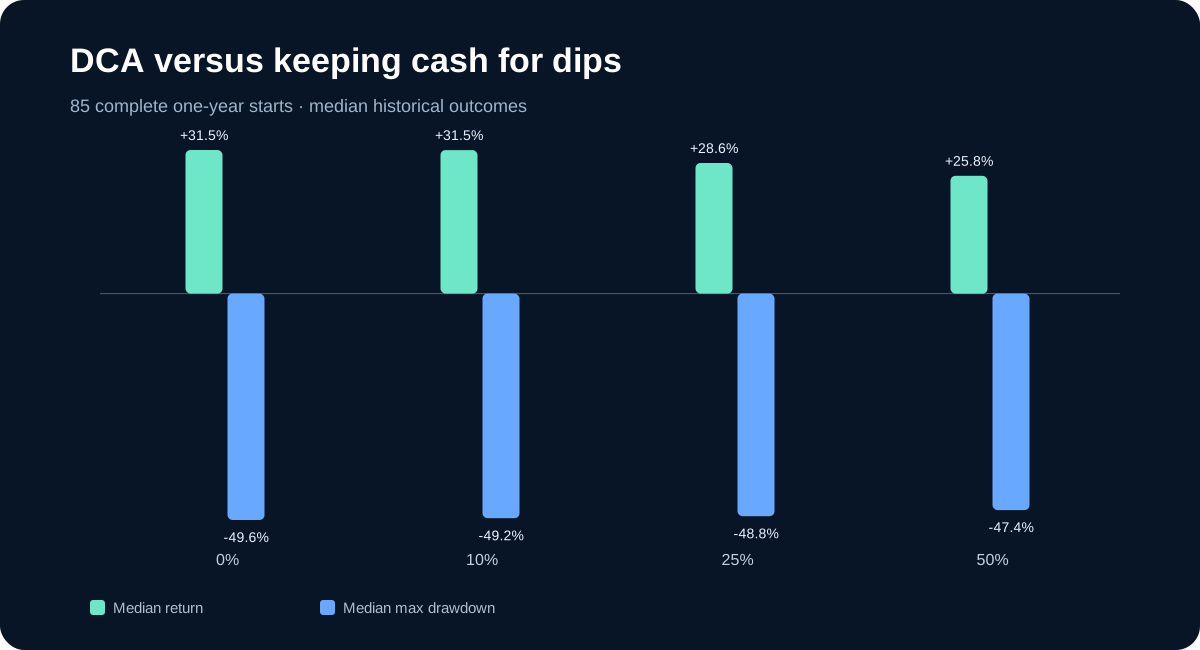
Plain Bitcoin DCA remained the stronger default in this frozen test. Across 85 complete one-year monthly starts, investing every contribution immediately returned +31.5% at the median. Reserving 25% for 10%, 20% and 30% drawdowns returned +28.6%, beat plain DCA in only 37/85 (43.5%), and improved median cash-flow-adjusted drawdown by less than one percentage point. The paired median advantage for the reserve was -0.0%; its 95% moving-block interval (-4.8% to +0.4%) crossed zero. A small reserve may help behaviour, but this evidence does not support waiting for dips as a reliable return enhancer.
The 10% reserve was almost tied with plain DCA at the median. Larger reserves gave up more upside while only modestly changing drawdown. All four policies had the same 61 positive and 24 negative one-year starts because the dominant risk was still the shared Bitcoin path.
This is not an argument against emergency cash. The experiment only reallocates an already committed USD 12,000 Bitcoin budget. Personal liquidity, taxes and income stability are outside the model.
| Reserved from each contribution | Complete starts | Median terminal return | Beat plain DCA | Median max drawdown | Median trades |
|---|---|---|---|---|---|
| 0% | 85 | +31.5% | Baseline | -49.6% | 12 |
| 10% | 85 | +31.5% | 37/85 (43.5%) | -49.2% | 48 |
| 25% | 85 | +28.6% | 37/85 (43.5%) | -48.8% | 48 |
| 50% | 85 | +25.8% | 36/85 (42.4%) | -47.4% | 48 |
Did a dip reserve become better over two or four years?
Extending the Bitcoin DCA comparison did not establish a consistent dip-reserve premium. In 49 complete four-year monthly starts, plain DCA had a +235.0% median versus +229.0% for the 25% reserve, while all four policies had positive endpoints. These are fewer mature starts than the 85 one-year cohorts; longer holding changes the eligible entry-date mix and does not create independent cycles.
The four-year rows are highly overlapping and only 49 monthly starts are mature. They are a horizon sensitivity, not 49 independent market cycles.
| Terminal horizon | Policy | Complete starts | Median return | Beat plain DCA | Median drawdown |
|---|---|---|---|---|---|
| 1 year | Plain DCA | 85 | +31.5% | Baseline | -49.6% |
| 1 year | 25% reserve | 85 | +28.6% | 37/85 (43.5%) | -48.8% |
| 1 year | 50% reserve | 85 | +25.8% | 36/85 (42.4%) | -47.4% |
| 2 years | Plain DCA | 73 | +145.7% | Baseline | -55.0% |
| 2 years | 25% reserve | 73 | +140.9% | 23/73 (31.5%) | -54.1% |
| 2 years | 50% reserve | 73 | +124.3% | 22/73 (30.1%) | -53.4% |
| 4 years | Plain DCA | 49 | +235.0% | Baseline | -76.6% |
| 4 years | 25% reserve | 49 | +229.0% | 23/49 (46.9%) | -76.6% |
| 4 years | 50% reserve | 49 | +230.1% | 22/49 (44.9%) | -76.5% |
Did the starting market regime change the result?
No starting-state split established a reliable dip-reserve advantage in this frozen BTC contribution test. The reserve was most intuitive after Bitcoin had already fallen more than 30%, yet it still did not produce a positive median paired excess. In that deep-drawdown group, new contributions frequently deployed their reserved buckets immediately because the preset thresholds were already active.
Starting near a trailing high was not a reason to hold half the budget back in this sample: the 50% reserve lagged plain DCA by 2.3 percentage points at the paired median. Regime labels use only the prior close and trailing 365-day high, so no future bottom is leaked into the decision.
| Start regime | Starts | Plain DCA median | 25% reserve median | 25% paired excess | 50% paired excess |
|---|---|---|---|---|---|
| Within 10% of 365d high | 24 | +16.9% | +16.6% | -1.1% | -2.3% |
| 10–30% below high | 25 | +27.2% | +25.3% | -1.9% | -3.8% |
| More than 30% below high | 36 | +32.9% | +33.2% | +0.0% | -0.0% |
What did 'DCA plus buy the dip' mean in this test?
Every policy receives twelve USD 1,000 contributions, 30 UTC dates apart. Plain DCA buys with all of each contribution. The alternatives buy with 90%, 75% or 50%, then split the remainder into three independent reserve buckets.
The buckets wait for Bitcoin to close at least 10%, 20% or 30% below the highest close in the preceding 365 UTC dates. A qualifying completed close executes at the next UTC open. If a threshold never appears, its money remains cash until the shared day-365 terminal open.
The thresholds, reserve shares, contribution dates and cost allowance were fixed before calculating outcomes. We did not search for the drawdown levels that produced the best backtest.
| Policy component | Frozen rule | Why it matters |
|---|---|---|
| Budget | 12 × $1,000 | Equal nominal contributions for every policy |
| Regular DCA | Buy at each scheduled UTC open | No hindsight delay |
| Dip reserve | Equal 10% / 20% / 30% drawdown buckets | A completed close is required |
| Unfilled reserve | Cash at zero yield | Missed exposure stays in the account result |
| Costs | 0.15% each purchase and terminal sale | More fills do not disappear from the comparison |
Why can buying lower still underperform plain DCA?
A reserve buys some Bitcoin at lower prices when a qualifying drawdown arrives. But it also holds cash during rallies, and future contributions can arrive while Bitcoin is already below a threshold. A cheaper individual fill does not prove the whole account ends with more money.
The 25% reserve produced a paired median difference of -0.0% versus plain DCA and beat it in 37/85 (43.5%). The 50% reserve reduced median drawdown by about 2.2 percentage points, but its median terminal return fell to +25.8%.
The useful trade-off is therefore not 'higher return for free.' It is potentially smoother deployment and slightly less historical drawdown in exchange for cash drag and more rule complexity.
| Reserve | Median excess vs plain DCA | Median cash left at terminal | Median modelled costs |
|---|---|---|---|
| 0% | +0.0% | +0.0% | $42 |
| 10% | -0.0% | +0.0% | $40 |
| 25% | -0.0% | +0.0% | $39 |
| 50% | -0.1% | +0.0% | $37 |
Are 85 starts the same as 85 independent years?
No. Monthly one-year windows share most of their daily prices. The main table is useful for seeing many entry dates, but it must not be read as 85 independent market cycles.
A greedy non-overlapping sensitivity leaves only eight starts. Plain DCA had a +29.1% median there, versus +25.6% for the 25% reserve and +22.0% for the 50% reserve. Eight observations are too few for a universal rule, but they do not rescue the claim that holding more cash reliably improved returns.
Changing cash yield, contribution frequency, thresholds or the definition of a drawdown can change the result. Those are new hypotheses, not permissions to rewrite this frozen edition.
| Reserve | Non-overlapping starts | Median return | Losing starts |
|---|---|---|---|
| 0% | 8 | +29.1% | 2/8 (25.0%) |
| 10% | 8 | +27.7% | 2/8 (25.0%) |
| 25% | 8 | +25.6% | 2/8 (25.0%) |
| 50% | 8 | +22.0% | 2/8 (25.0%) |
What changed when cash earned interest and dependence was modelled?
Paying the reserve a hypothetical 3% or 5% annual yield narrowed cash drag but did not turn the 25% or 50% reserve into a positive median edge. Most outstanding buckets eventually deployed, so terminal cash was usually near zero; interest only accrued while capital waited.
The moving-block bootstrap resamples 12-start blocks to preserve part of the monthly overlap. For the 25% reserve, the 95% interval for median paired excess was -4.8% to +0.4%. Because zero lies inside the interval, the sample does not establish a stable advantage either way.
| Cash yield | Reserve | Starts | Median excess vs plain DCA | Beat plain DCA |
|---|---|---|---|---|
| +3% | 25% | 85 | -0.0% | 37/85 (43.5%) |
| +3% | 50% | 85 | -0.0% | 36/85 (42.4%) |
| +5% | 25% | 85 | -0.0% | 38/85 (44.7%) |
| +5% | 50% | 85 | -0.0% | 37/85 (43.5%) |
How do you choose a Bitcoin dip reserve without changing the tested budget?
First separate emergency savings from an investment contribution plan. This experiment credits twelve $1,000 BTC contributions at 30-day intervals to every policy; a $12,000 total commitment does not mean all $12,000 was investable on day zero. The separate upfront-budget DCA/lump-sum study answers that different cash-availability question.
If regret from buying before a fall is the main problem, a modest preset reserve can make the process easier to follow. Define the contribution, maximum reserve and expiry before the next move. Do not keep increasing the cash allocation because price rose or redefine a dip after every decline.
If maximizing historical exposure is the goal, this sample favoured plain DCA over large reserves. Neither path removes Bitcoin's drawdown risk.
Verify: Bitcoin DCA versus lump sum · Current Bitcoin market context
Data, exclusions and reproducibility
BTC-only calculations use 3,322 completed Binance BTCUSDT UTC daily candles from 17 August 2017 through 20 September 2026. Version 2.0 publishes 828 complete policy observations across 1-, 2- and 4-year endpoints, start-regime labels, cash-yield sensitivities and block-bootstrap intervals.
The public observation CSV contains every complete row used in the tables. The candidate CSV preserves pending or missing rows instead of turning them into zero returns. JSON includes the frozen contract, summaries and all observations. The standalone Python program rebuilds all three studies from the named frozen inputs.
Rolling observations overlap and share the same market cycles; counts are not independent trials. Historical percentages are descriptive, not probabilities for the next trade. The SHA-256 manifest protects this edition from accidental file changes; it does not remove selection, venue or execution limitations.
Verify: Complete study JSON · Observation CSV · Summary CSV · Candidate and missing ledger · Reproduction program · Preset protocol · File hashes
Take the next step with this evidence.
Choose ongoing Telegram monitoring or inspect structured data in your own research workflow.
Receive qualifying events in Telegram.
Use the ready-made alert checklist, message explanations and daily briefing. Check the supported categories and coins before subscribing; every Research page is not a separate alert category.
Check the alert list · View alert plans
Inspect the data before choosing a pack.
Prepared research packs supply scoped features, separate outcomes where available and quality flags. Buy a fixed edition once and download directly; API use is optional.
Check data pack samples · Explore the full data catalog · Compare data plans
Each purchased pack includes its specified fields and published date range. This page's full dataset is not automatically included. Other data families require coverage, date, field and source-use confirmation before purchase. Telegram Pro is a separate 30-day service; historical packs are one-time purchases.
Frequently asked questions
Is DCA plus buying the dip better than regular DCA?
Plain Bitcoin DCA remained the stronger default in this frozen test. Across 85 complete one-year monthly starts, investing every contribution immediately returned +31.5% at the median. Reserving 25% for 10%, 20% and 30% drawdowns returned +28.6%, beat plain DCA in only 37/85 (43.5%), and improved median cash-flow-adjusted drawdown by less than one percentage point. The paired median advantage for the reserve was -0.0%; its 95% moving-block interval (-4.8% to +0.4%) crossed zero. A small reserve may help behaviour, but this evidence does not support waiting for dips as a reliable return enhancer.
How much cash did you reserve?
The preset policies reserve 10%, 25% or 50% of each USD 1,000 contribution and split it equally across 10%, 20% and 30% trailing-365-day drawdown triggers.
What happens if Bitcoin never reaches the dip level?
In the primary zero-yield rule, the unused bucket remains cash until the common terminal date; it is not a zero-return BTC trade. Separate 3% and 5% cash-yield sensitivities credit interest only while reserves wait.
Does the test use future lows?
No. It uses the trailing 365-day high known at a completed close, followed by execution at the next UTC open.
Did the reserve reduce drawdown?
Modestly. Median unitized drawdown moved from -49.6% for plain DCA to -47.4% for the 50% reserve, while median return also fell.
Did the answer change over four years?
No clear reserve premium appeared. Plain DCA returned +235.0% at the median versus +229.0% for a 25% reserve across 49 mature monthly starts.
Are 85 starts independent?
No. They are overlapping monthly starts in one Bitcoin history. The page shows a greedy non-overlapping sensitivity and moving-block uncertainty interval.
Are fees included?
Yes: the base uses 0.15% per purchase and terminal hypothetical sale, with zero cash yield. Separate 3% and 5% annual cash-yield sensitivities are published. Tax and market impact remain excluded; compare the same cohort and contribution dates.
Should emergency savings be used to buy dips?
This study does not support that. It credits twelve $1,000 investment contributions at 30-day intervals; the total $12,000 commitment is neither emergency savings nor cash all available on day zero. Personal liquidity decisions remain outside the experiment.
Sources and verification
- Binance spot Kline documentationOfficial OHLCV field definitions; candles are not personal execution records.
- Binance public-data documentationPublic historical-file and checksum documentation.
- Frozen CoinNudge evidence manifestHashes, byte sizes and edition scope.
Use the result as a decision check—not an automatic order.
Compare current market conditions and supported alerts before making your own decision.
Open Market Radar