Investor decision guide · By CoinNudge Research · · Guide updated 2026-10-03 · 16 min read
AI Trading vs Human Trading: Which Tasks Should You Automate?
AI trading versus human trading is a choice about which tasks to automate—not a proven contest with one universal return winner. Use ordinary code for precise orders and hard loss limits, a model only for a contextual judgment you can test, and human oversight for objectives, permission changes and unusual failures. Published behavioral and financial-firm surveys explain discipline and adoption, but do not establish an AI advantage in crypto profits. This guide helps you choose a workflow, test its added value after costs and know when to pause it.
Watch AI Live Trade · Explore Telegram alerts · Explore research data
Is AI trading better than human trading? The short answer
- Manual traders may deviate from plans under stress, overtrade or delay realizing losses. Those are documented behavioral risks, not traits of every person or proof that any AI strategy wins.
- Automation can monitor continuously and apply programmed limits consistently. A language model alone cannot guarantee discipline: independent code, reliable data and working execution are required.
- Our evidence-based forecast is that AI will handle a growing share of trading workflows, although no cited study measures its share of crypto trading volume or proves superior returns.
- The credible long-term direction is human-designed strategy plus AI-assisted analysis plus hard-coded risk controls, tested against manual and simple rule-based baselines after costs.
Will AI trading become more common? What do adoption studies actually show?
Financial-firm adoption supports a possibility of more AI-assisted workflows, not a measured share of autonomous crypto trades or higher returns. The UK and EU studies below measure firm usage, intentions or fund disclosures rather than crypto order volume.
The Bank of England and FCA received responses from 118 UK-regulated firms in their 2024 survey. Seventy-five percent said they already used AI somewhere in their business, versus 58% in the 2022 survey. In an accompanying Bank of England speech, 11% of respondents reported using AI for algorithmic trading and a further 9% planned to do so within three years. Those are firm-level self-reports across financial services, not the percentage of trades performed by AI, a cryptocurrency-only sample or a promise that plans will be implemented.
ESMA's 2026 EU securities-market study reports that 70% of surveyed firms anticipated increasing AI-related investment during 2025–2027, but says current uses remain concentrated in lower-autonomy back-office applications. Its earlier review screened roughly 825,000 documents from 44,000 EU investment funds and identified 145 funds explicitly disclosing AI or ML in their investment process. Disclosure is not a census of all AI use, and the study did not establish a general performance advantage. Together, the data support a directional forecast of broader AI-assisted workflows—not a numerical forecast for autonomous crypto trading or an earnings claim.
Use adoption evidence to justify evaluating a narrow task, not allocating capital to a model. Preserve each survey's population and year when citing it; a planned use is not an implemented trading system, and non-LLM machine learning is not a language-model trader.
| Primary evidence | Observed figure | What it measures | What it does not prove |
|---|---|---|---|
| Bank of England/FCA, 2024; 118 UK firms | 75% using AI; 58% in 2022 | Any AI use at surveyed regulated firms | AI-led trading or crypto market-volume share |
| Bank of England, 2024 speech | 11% using AI for algorithmic trading; a further 9% planned | Self-reported firm adoption and plans | That 20% of orders are AI-driven or planned use will occur |
| ESMA, 2026 EU survey | 70% expected higher AI investment in 2025–2027 | Firm spending intentions across securities markets | Higher trading returns or more autonomous orders |
| ESMA, 2025 EU fund-document review | 145 funds explicitly disclosed AI/ML use after screening 44,000 funds | Disclosed use in investment strategies | A complete adoption rate or superior fund performance |
Verify: Bank of England/FCA 2024 AI survey · Bank of England speech on algorithmic-trading AI · ESMA 2026 AI adoption study · ESMA 2025 AI investment-fund study
AI trading vs human trading: where does each approach have an advantage?
Compare manual and AI trading at the task level: a person supplies accountable discretion, code enforces precise constraints, and a language model may interpret supplied context. No capability in this comparison by itself proves higher net returns.
The table distinguishes a capability from a guaranteed outcome. For example, a machine can submit a stop promptly when its software, data feed and exchange connection work; that does not guarantee a fill at the stop price during a gap.
For example, an operator who mainly misses planned exits may need an exchange-native order and alerts, not autonomous AI. An operator who cannot consistently reconcile conflicting data may test an AI summary without granting order authority. Select the bottleneck first; the table is a capability/risk comparison, not a ranking from a head-to-head trial.
| Decision task | Manual trader | AI agent inside a controlled system | What can still go wrong |
|---|---|---|---|
| Follow an entry plan | Can apply context and discretion, but may change criteria after seeing price move. | Can record a structured reason and choose only allowed actions; code can reject a rule violation. | A vague plan or permissive prompt lets the model rationalize inconsistent trades. |
| Control emotion and impulse | Fear, FOMO, fatigue and recent wins or losses can change behavior. | No human fear or revenge impulse; can repeat the same workflow every review. | A model can still overreact to noisy inputs or generate confident but unsound reasons. |
| Watch a 24/7 crypto market | Cannot personally watch every venue and time zone without fatigue. | Can scan scheduled data continuously and queue an alert or permitted decision. | Feed outages, latency and missing symbols can make the apparent coverage incomplete. |
| Place a stop and manage risk | May hesitate to close or move a stop after a loss. | Independent code can enforce position size, stop, drawdown and order bounds without seeking model permission. | Stops can slip; exchange outages and gaps can exceed modeled losses. |
| Adapt to unusual events | Can challenge a broken assumption and suspend a strategy. | Can summarize new evidence quickly if it is supplied and verified. | Novel events, bad inputs and stale knowledge can make model outputs unreliable. |
| Learn from outcomes | Can update a thesis but may remember wins and losses selectively. | Can log every decision, cost, rejected order and outcome for review. | Repeated prompt changes can overfit; a model explanation is not proof that a rule improved. |
| Prove better net returns | Requires a reconciled trading journal and fair benchmark. | Requires the same starting capital, markets, costs, risk and time window as the comparison group. | Discipline and speed alone do not create a profitable edge. |
Verify: Barber & Odean: active trading study · FINRA: AI trading applications and risks
Should you trade manually, use a rule-based bot or add an AI trading agent?
Use manual review for an unproven idea, deterministic automation for an exact rule, and bounded AI assistance only where contextual judgment improves a measured workflow. This choice matrix is an operational recommendation, not a tested return ranking.
Before granting any software order authority, define a market, test period, maximum loss, allowed permissions and a way to stop it. A read-only alert or paper account is the lower-risk first step if you cannot yet state those limits. Reassess the choice when market conditions or your strategy change.
Write an acceptance condition for the task you choose: fewer missed checks without omitted evidence for monitoring; correctly executed permitted orders for automation; or better net outcomes under common risk/cost rules for judgment. If the task cannot be specified or verified, keep approval manual instead of granting broad autonomy.
| Your crypto trading task | Reasonable starting approach | What to verify before risking capital |
|---|---|---|
| Learn the market or test an unproven idea | Manual review, alerts and paper trading | Record a written rule, missed signals, fees and the loss you would have taken. |
| Execute a precise stop, rebalance or threshold rule | Deterministic code or an exchange-native order | Check data freshness, order type, slippage, permissions and a kill switch; an LLM adds no necessary judgment. |
| Compare conflicting evidence across timeframes or sources | AI-assisted analysis with human approval | Log the inputs, counterevidence and rejected proposals; compare with the same workflow without AI. |
| Run an AI agent with simulated orders | Bounded paper account plus independent risk code | Track net return, drawdown, cost, failures and rule violations against manual and code-only baselines. |
| Consider real-money automation | Only after a forward test and operational review | Use least-privilege keys, tested limits, monitoring and a human pause path; paper results do not establish live profitability. |
Verify: FINRA: AI trading applications and risks · FINRA: AI controls and supervision
Why do human traders break rules or delay stop losses?
Human traders can change entry or exit rules under stress, overtrade or delay losses; these are documented behavioral risks, not a claim that every manual trader is irrational. The stock-account study below is not a controlled AI-versus-human crypto experiment.
Behavioral research provides a reason to take this seriously, but its limits matter. Barber and Odean studied 66,465 U.S. brokerage households over 1991–1996. The most active group earned an 11.4% net annualized return versus 18.5% for the least active group; the broad market returned 17.9% over that sample. This is evidence about the potential cost of overtrading, not a causal AI-versus-human trial or a crypto result. Odean separately documented the tendency to realize winners more readily than losers. Neither finding means every human trader is undisciplined.
Precommitting a position size, invalidation level and maximum daily loss can help either a manual or an AI-assisted trader. A skilled human can follow a written plan; a poorly built automated system can violate it. The distinction is whether the limits remain binding when the market becomes uncomfortable.
A concrete manual safeguard is to record entry condition, invalidation, position size and maximum loss before entering, then separately mark any deviation and its reason. Compare planned and actual actions rather than remembering only impressive wins. These controls are available without AI; the fair question is what an additional model changes.
Verify: Barber & Odean original paper · Odean on realizing losses
What can an AI trading agent do better than a person?
AI's plausible advantages are sustained monitoring, structured contextual review and auditable proposals; exact calculations and binding risk discipline come from the surrounding software. A language model alone is not a fully rational or infallible trader.
The word 'can' is important. AI has no human fear, but it is not 'completely rational.' A language model can misread data, hallucinate a catalyst, change its interpretation of a vague instruction or be nudged by a malicious document. Strict rule-following comes from a validated schema and an independent execution gate, not from telling the model to be disciplined. A deterministic rule engine may be the better and cheaper choice when the task is simply 'if price crosses X, place Y.'
For risk control, give the model freedom inside a bounded box: it may suggest long, short, wait, reduce, cancel or place a conditional order, while code separately checks stale data, maximum loss, leverage, total exposure, order lifetime and a kill switch. Logging rejected decisions is as valuable as logging fills because it shows where the model and the risk policy disagreed.
Check added value by removing the model from one otherwise identical paper workflow. If deterministic alerts supply the same useful action with less latency and cost, keep the simpler tool. If model advice adds unverified news or confident unsupported reasons, require source checks and a human gate instead of treating fluency as research.
Verify: FINRA: AI applications and exceptional-market risk · FINRA: controls and human review
Example: how would a human and an AI system handle the same losing BTC trade?
In an illustrative losing BTC trade with a planned $100 maximum loss, the useful automated advantage is executing an independently specified exit—not predicting whether price will recover. A human or model can suggest holding, but neither should silently override the hard loss budget.
Neither path guarantees a $100 realized loss. If BTC gaps through the stop, liquidity vanishes or the venue rejects the order, the actual fill may be worse. This example isolates the benefit of precommitted execution; it does not claim that an AI can predict the next candle or that a stop always improves long-run returns. The precise stop distance still has to match volatility, costs and the tested strategy.
A $100 risk budget is an intended pre-trade loss limit, not an exact realized-loss guarantee. Size the trade against stop distance and estimated costs before sending it, verify the exit order's venue status, and treat gaps or outages as separate execution risks. This example does not claim CoinNudge measured a human-versus-AI stop advantage.
How should humans and AI share trading decisions?
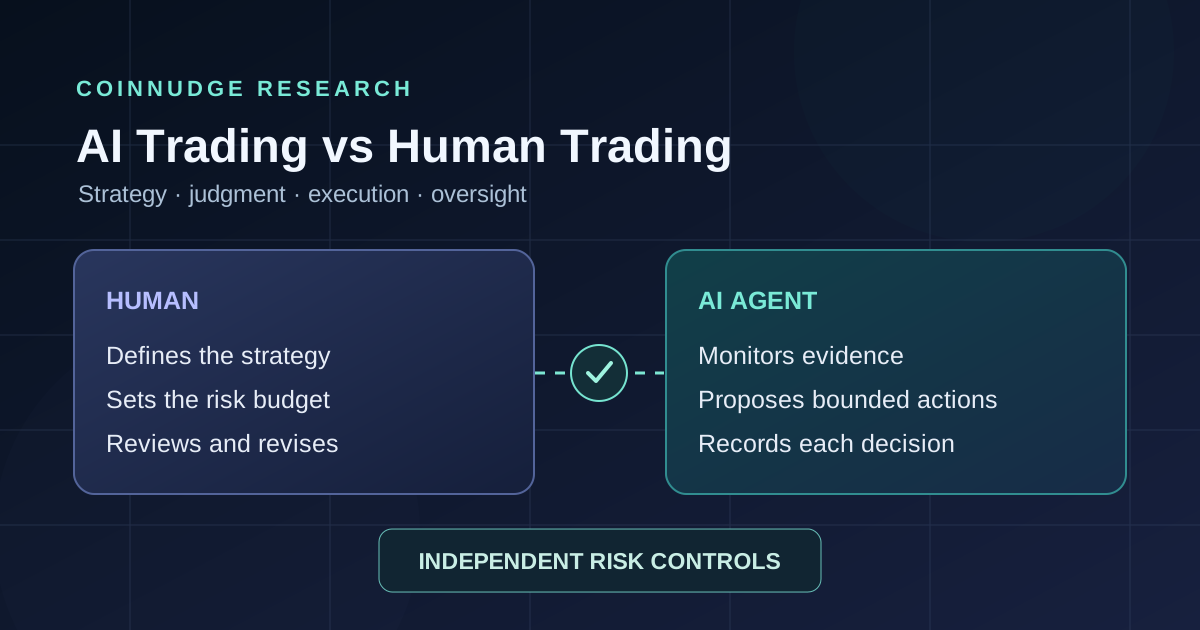
Humans should own the objective and acceptable loss; code should time-align data, calculate values and enforce limits; AI may propose bounded context-sensitive actions. Review complete outcomes through versioned changes rather than allowing one convincing rationale to override risk.
This is not a one-time setup. A rule that worked in a trend can fail in a range; exchange fees, market structure and data coverage change. Review both rejected and accepted decisions, compare with a simple non-AI ruleset, and keep a human override to pause the system. NIST's AI risk framework treats governance and measurement as continuing work, and FINRA's discussion of AI trading emphasizes supervision and guardrails.
At each handoff record a verifiable artifact: approved mandate, timestamped input, proposed action, validator outcome, order/fill IDs and account reconciliation. A proposal without an acknowledged order remains a proposal. If a provider fails, the exit and reconciliation policy must work without waiting for the model.
| Layer | Owner | Non-negotiable check |
|---|---|---|
| Strategy and loss budget | Human | Write the objective, allowed market, per-trade risk and stop condition before the first trade. |
| Data and indicators | Code | Reject stale, missing or future-leaking inputs; keep timestamps and source versions. |
| Contextual judgment | AI agent, if useful | Return a structured action and reason; allow 'wait' and record uncertainty. |
| Execution gate | Independent code | Enforce size, leverage, exposure, stop and order validity even when the model disagrees. |
| Evaluation and iteration | Human with auditable logs | Compare net returns, drawdown, costs and rule violations with manual and simple-rule baselines. |
Verify: NIST AI Risk Management Framework · FINRA: human oversight and hard thresholds
How can you test whether AI actually improves your trading?
Test the added AI layer against manual and code-only variants over the same prospective period, common mandate and comparable exposure. Comparing a bot's best week with one person's worst trade cannot establish superiority.
Evaluate not only net return but maximum drawdown, risk-adjusted return, turnover, stop adherence, decision latency and time spent. The AI layer adds value only if its improvement survives a future out-of-sample or forward paper period after its extra cost and complexity. If code-only matches it, the model may not be needed. If manual trading performs better under abnormal conditions, preserve a human review gate there.
CoinNudge's public AI Live Trade page is a forward paper experiment across model accounts, not this controlled human-versus-AI study. The separate Bitcoin benchmark review tests another question: whether selected AI paper results beat simply holding BTC. Neither should be described as evidence that all AI traders outperform all people.
Predeclare whether the benefit being tested is net trading performance, reduced workload or fewer rule violations. A time-saving assistant may be useful without extra alpha; a return claim must include its added inference expense and failures. Freeze an evaluation window before looking at results, and avoid stopping only underperforming versions.
Verify: CoinNudge AI paper-trading experiment · AI bots versus Bitcoin evidence
Is human-guided AI the new trend in crypto trading?
Human-guided AI is a plausible direction for research and monitoring, but the cited surveys cannot forecast its share of crypto orders or prove it will outperform people. Treat that outlook as an inference, not an investment result.
The likely durable model is complementary: humans set and revise a researched strategy, machines do the tiring and repetitive work, and independent controls keep a bad model output from becoming an unchecked order. A person who can define a sound edge and supervise risk may be more valuable in an AI-enabled market, not less. The best next step for a skeptical investor is to test one narrow task in paper trading before granting any live execution authority.
Choose a next step proportionate to authority: observe a public paper account, test one supported rule, or compare an AI summary with the same task done manually. CoinNudge's live paper tool supplies prospective model behavior, not the controlled manual-versus-AI experiment described here.
Verify: Bank of England/FCA: AI adoption survey · ESMA: AI adoption and trends · FINRA: industry applications and model risks
Take the next step with this evidence.
Choose ongoing Telegram monitoring or inspect structured data in your own research workflow.
Receive qualifying events in Telegram.
Use the ready-made alert checklist, message explanations and daily briefing. Check the supported categories and coins before subscribing; every Research page is not a separate alert category.
Check the alert list · View alert plans
Inspect the data before choosing a pack.
Prepared research packs supply scoped features, separate outcomes where available and quality flags. Buy a fixed edition once and download directly; API use is optional.
Check data pack samples · Explore the full data catalog · Compare data plans
Each purchased pack includes its specified fields and published date range. This page's full dataset is not automatically included. Other data families require coverage, date, field and source-use confirmation before purchase. Telegram Pro is a separate 30-day service; historical packs are one-time purchases.
Frequently asked questions
Is AI trading better than human trading?
AI can be better at continuous monitoring and consistent execution when independent code enforces the rules. It has not been established that AI models generally earn higher net returns than skilled human traders. Test the same strategy and risk budget prospectively before claiming an advantage.
Should a beginner use an AI crypto trading bot?
Start with a written strategy, read-only alerts or paper trading. If a simple rule can be expressed precisely, deterministic code is easier to audit than a language-model agent. Do not give an agent real-money order authority before checking its costs, failures, risk limits and a human pause path.
What percentage of crypto trading is done by AI?
The cited UK and EU studies do not measure a global crypto AI-order or volume share. The Bank of England's 11% figure refers to surveyed firms reporting AI use for algorithmic trading, not 11% of trades or a share attributable to large language models. We therefore do not publish an unsupported market-share estimate.
Will AI trading become more common in the future?
Probably in market screening, monitoring and bounded decision support: UK firms reported more overall AI adoption in 2024 than 2022, and an EU survey found most respondents expected higher AI investment in 2025–2027. That is a directional inference, not a numeric prediction of autonomous crypto-trading volume or returns.
Does AI trading remove emotion?
A model does not feel fear or FOMO as a person does, but its outputs can still be inconsistent, overconfident or wrong. Discipline depends on validated inputs, fixed limits and independent execution code, not on the model's tone.
Will an AI agent always stop a losing trade on time?
No. Code can send a planned stop without hesitation, but stale data, software faults, exchange outages, low liquidity and gaps can delay or worsen a fill. A model should not have permission to override a hard risk limit.
Do people still need to design AI trading strategies?
Yes. People must define the objective, market, risk budget, acceptable losses and evaluation benchmark, then review outcomes and version changes. AI can assist with interpretation but cannot invent a proven trading edge from a prompt.
What is the difference between an AI agent and an ordinary trading bot?
A fixed-rule bot follows explicitly programmed conditions. An AI agent can interpret supplied context and choose among permitted actions, but adds model risk and cost. Use simple code for simple rules; use a model only where its extra judgment can be measured.
Can AI trading beat a manual strategy after fees?
Possibly in a specific controlled test, but this article does not report such a result. Compare contemporaneous manual, code-only and AI-assisted versions of the same strategy after commissions, slippage, funding or borrowing, failures and model costs; then repeat in an out-of-sample or forward period.
Is CoinNudge's AI Live Trade real-money trading?
No. It shows forward paper decisions and simulated BTC accounts. It is not a human-versus-AI controlled experiment or evidence of real-money profitability.
Does AI learn from a loss and become a better trader?
A stored lesson or changed prompt may affect later advice; it is not automatic retraining or evidence of improvement. Version the change and compare prospective results with the prior policy under unchanged risk limits.
Does faster AI decision-making always improve trading?
No. More reviews may add fees, inference cost or noisy reactions. Measure the task-specific benefit under a fixed evaluation period rather than assuming more decisions mean more profit.
Sources and verification
- Bank of England/FCA 2024 AI survey118 UK financial-firm responses; broad AI adoption, not crypto trading volume.
- Bank of England speech: trading-specific adoption11% current and a further 9% planned firm AI use for algorithmic trading; not a trade-volume percentage.
- ESMA 2026 AI adoption surveyEU investment-intention evidence; most current uses are lower-autonomy and not necessarily trading.
- ESMA 2025 AI investment-fund studyDocument-screening evidence; disclosed fund use is not a full adoption census or performance advantage.
- Barber & Odean original paper66,465 U.S. stock-account households; overtrading comparison is not a crypto AI experiment.
- Barber & Odean: active retail tradingU.S. stock-account study; supports a behavioral-risk discussion, not a crypto AI performance claim.
- Odean: realizing lossesOriginal disposition-effect research on investors' selling choices.
- FINRA: AI in securities tradingDocumented applications and exceptional-market risks; not a forecast of trading returns.
- FINRA: AI controls and supervisionHuman review, model risk and independent guardrails.
- NIST AI Risk Management FrameworkFramework for continuing governance, measurement and risk management.
- IOSCO AI and ML reportTesting and monitoring of AI systems across their lifecycle.
- SEC/FINRA/NASAA investor alertWarns against guaranteed AI-return claims and reliance on unverified generated information.
- CoinNudge AI Live TradeForward simulated BTC model decisions; no live-money or human head-to-head claim.
Compare real-time simulated model behavior before trusting an AI trading claim.
The public experiment shows paper BTC positions, fills and outcomes. It does not connect to your account or execute real trades.
Explore AI Live Trade